Astrology is a symbolic system that studies the positions of planets and other celestial bodies at specific moments in time to interpret personality traits, life patterns, and timing of events. A natal chart is a snapshot of the sky at the exact moment of your birth, and transits are the ongoing movements of planets that interact with that snapshot throughout your life. Neither requires any prior knowledge to start exploring.
- Key Takeaways
- What Is Astrology? A Clear Definition and Meaning for Beginners
- What Is a Natal Chart and Why Does It Matter?
- The Big Three: Sun, Moon, and Rising Sign Explained
- How to Read a Natal Chart: A Beginner's Step-by-Step Method
- What Are Transits in Astrology and How Do They Work?
- Astrology Definition and Meaning: Key Terms Beginners Encounter Early
- Astrology Definition and Meaning: Common Beginner Mistakes to Avoid
- FAQ: Astrology Basics for Absolute Beginners
- Conclusion: Your Next Steps Into Astrology
- References
Key Takeaways
- Astrology maps planetary positions to human experience — it’s a symbolic language, not a science in the empirical sense.
- A natal chart (also called a birth chart) is calculated from your exact birth date, time, and location.
- The chart is divided into 12 houses, each representing a life area, and 12 zodiac signs that color how energy expresses.
- Planets in the chart act as the “what” (what kind of energy), signs as the “how,” and houses as the “where.”
- Transits are current planetary movements that trigger themes in your natal chart — they’re how astrologers time trends and life phases.
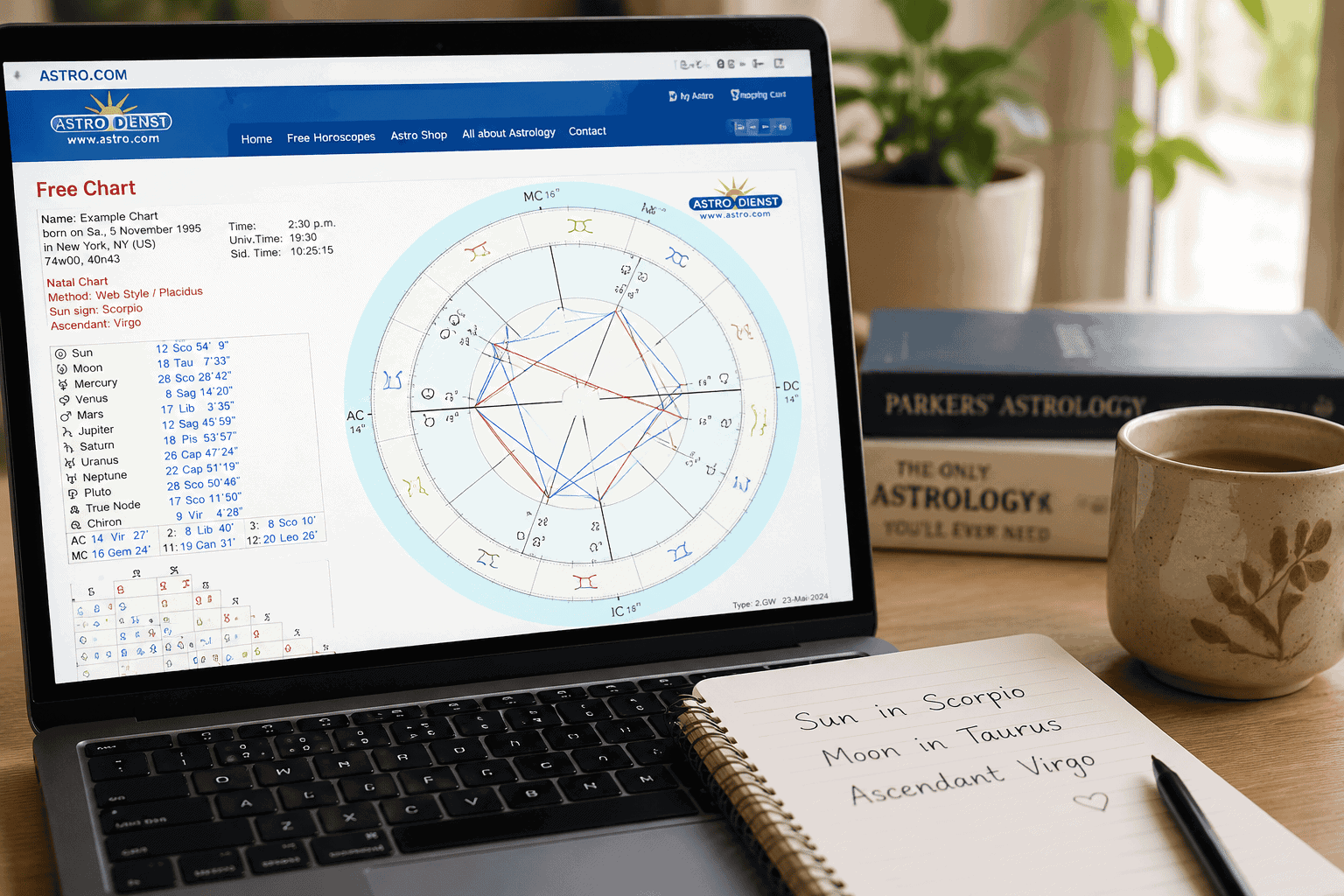
- Free tools like astro.com let beginners generate an accurate natal chart in under two minutes.
- Astrology works best as a self-reflection tool and a framework for understanding cycles, not as a fortune-telling device.
- Beginners often feel overwhelmed — starting with just your Sun, Moon, and Rising sign is enough to get real value quickly.
What Is Astrology? A Clear Definition and Meaning for Beginners
Astrology is the study of how the positions of celestial bodies — planets, the Sun, the Moon, and key points in space — correspond to patterns in human personality and life events. It’s one of the oldest symbolic systems on Earth, with roots in Mesopotamia dating back over 4,000 years [see our deeper history overview at Astrology Definition and Meaning: From Ancient Divination to Modern Self-Discovery].
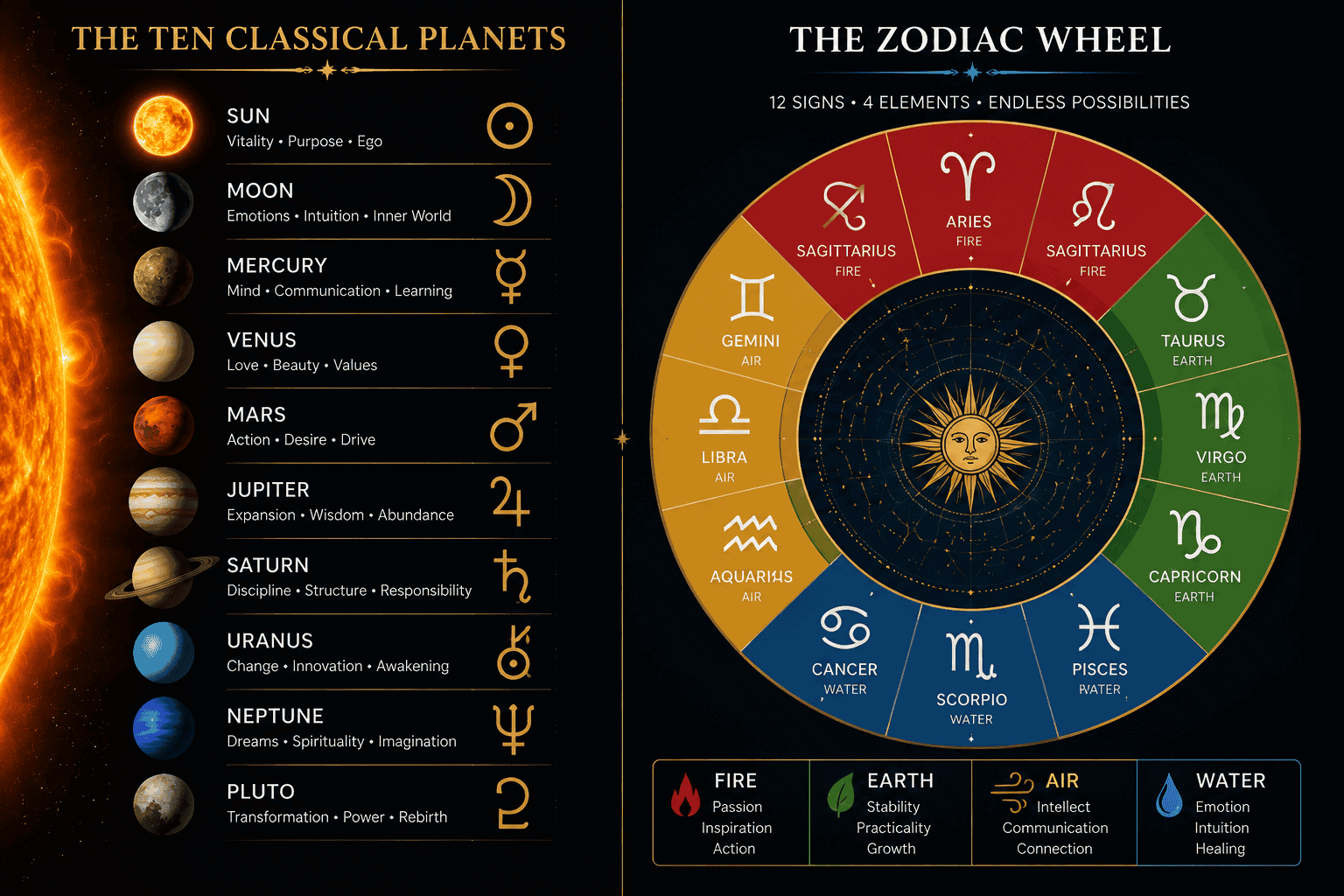
Astrology is not astronomy. Astronomy is a natural science that studies celestial objects physically. Astrology uses those same objects as symbols — each planet carries a set of meanings that astrologers apply to human experience. Think of it like a language: the planets are vocabulary, the zodiac signs are tone, and the houses are context.
Is astrology a science? Most mainstream scientists classify it as a belief system rather than an empirical science, because its claims haven’t been consistently supported by controlled studies. That said, millions of people use it as a psychological and reflective tool — similar to how someone might use personality frameworks like Myers-Briggs. Understanding the astrology definition and meaning this way removes pressure and makes it more accessible.
Three core layers of astrology every beginner needs to know
| Layer | What it represents | Example |
|---|---|---|
| Planets | Types of energy or drives | Mars = action, desire, conflict |
| Zodiac Signs | How that energy expresses | Mars in Taurus = slow, stubborn drive |
| Houses | Where that energy plays out in life | Mars in Taurus in the 2nd House = drive focused on money and possessions |
What Is a Natal Chart and Why Does It Matter?
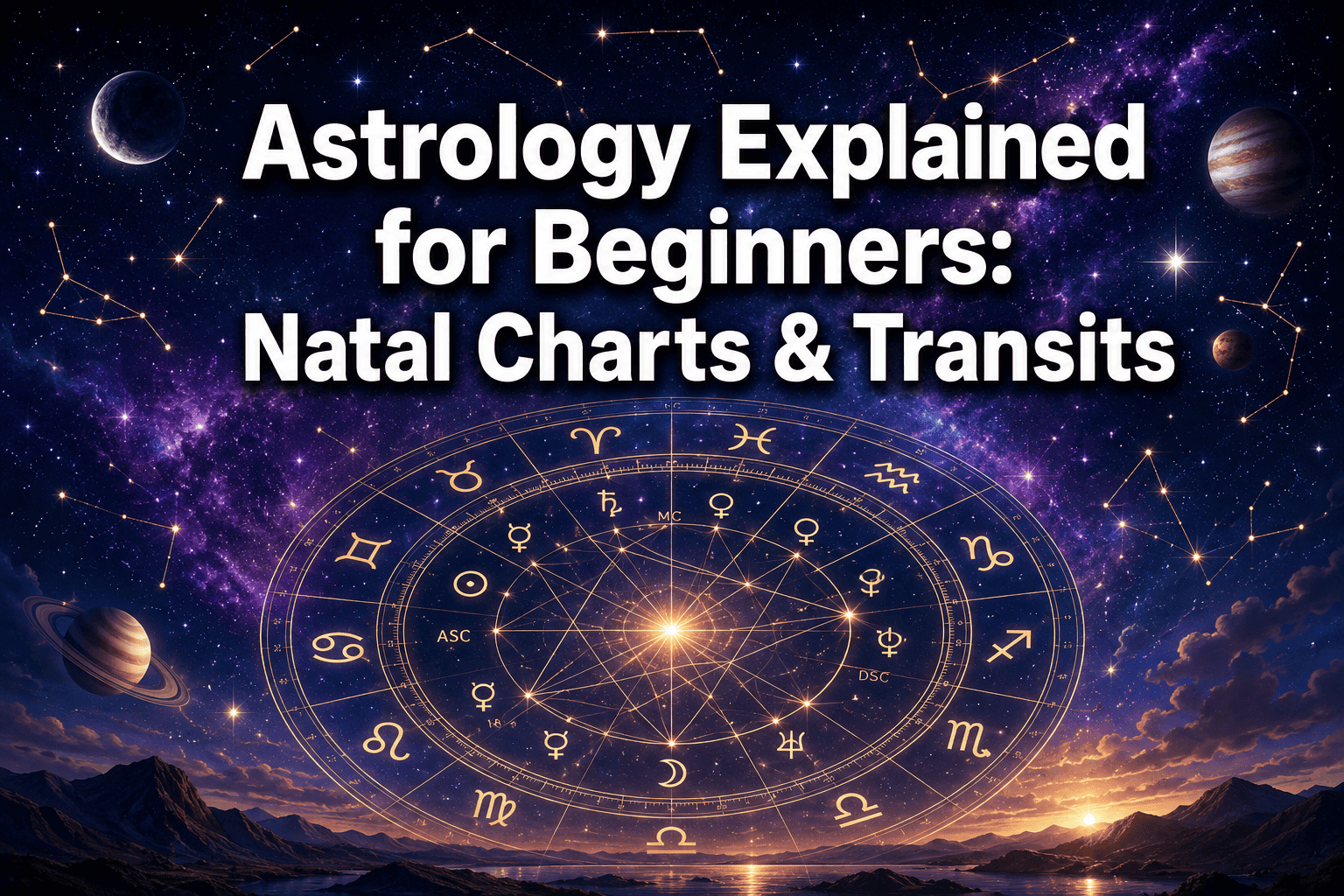
A natal chart (also called a birth chart or horoscope) is a circular map of the sky at the exact moment and location of your birth [10]. It shows where every planet was positioned relative to Earth at that instant, divided across 12 zodiac signs and 12 houses.
Why it matters: The natal chart is the foundation of personal astrology. Every other technique — transits, progressions, solar returns — is read in relation to it. Without understanding your natal chart, the rest of astrology is just general horoscope content.
What you need to generate your natal chart
To get an accurate natal chart, you need three pieces of information:
- Date of birth — day, month, year
- Exact time of birth — even a 15-minute difference can change your Rising sign and house placements
- Place of birth — city and country is enough
Where to get it free: The most trusted free tool is astro.com. Go to “Free Horoscopes” → “Extended Chart Selection” → enter your data. The site generates a full chart with a legend. No account is required for a basic chart [8].
💡 Can’t find your birth time? Check your birth certificate, hospital records, or ask a parent. If it’s truly unknown, use 12:00 noon as a placeholder — but know that your Rising sign and house placements won’t be accurate.
What the chart looks like
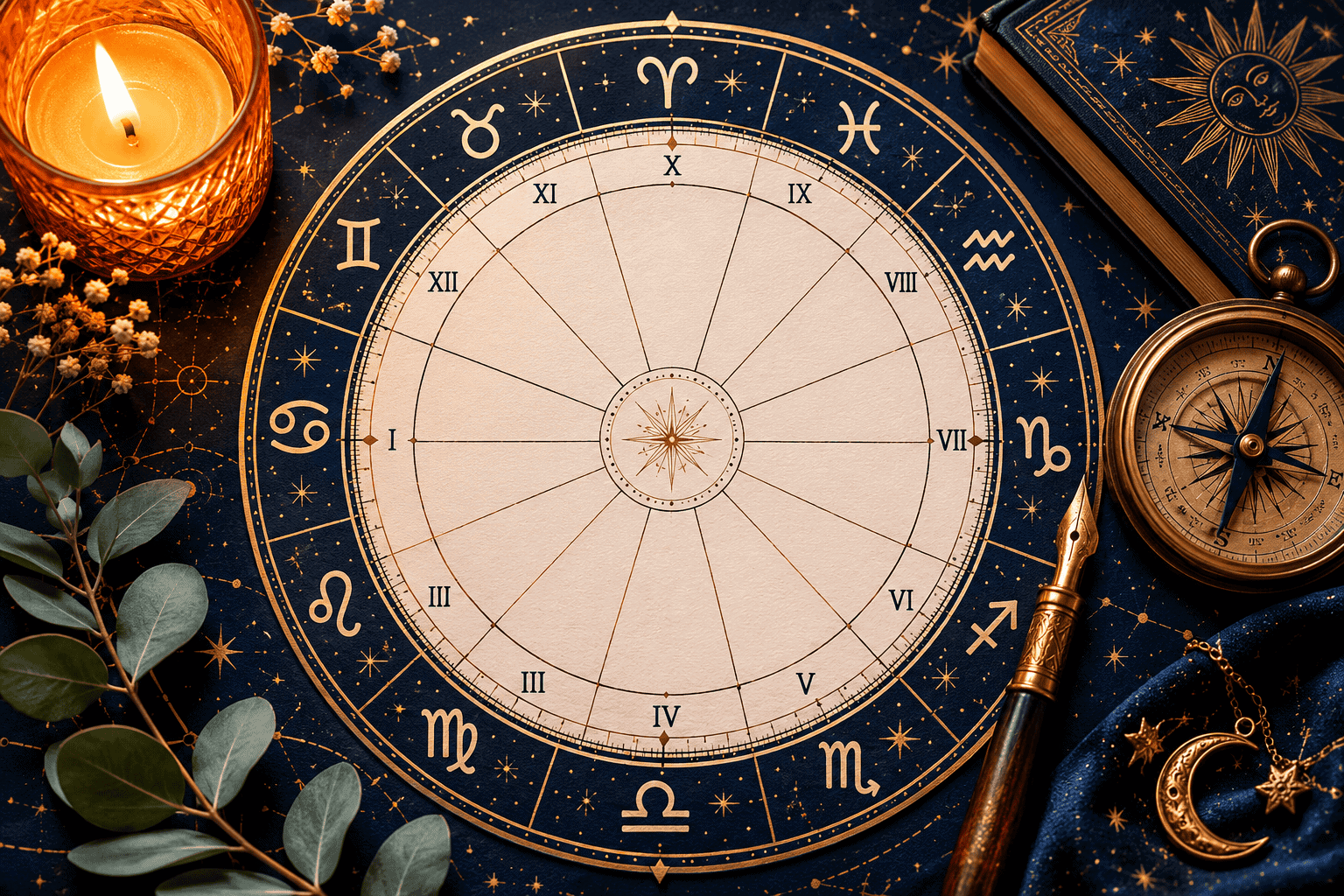
The natal chart is a circle split into 12 “pie slices” (the houses). Around the outer edge sit the 12 zodiac signs. Planetary glyphs (symbols) are placed inside the wheel wherever each planet was positioned at birth [10]. Lines crossing the center (called aspects) show geometric relationships between planets.
For a detailed breakdown of each house’s meaning, the 12 Astrological Houses Explained guide is an excellent next step.
The Big Three: Sun, Moon, and Rising Sign Explained
For absolute beginners, the most practical entry point into the astrology definition and meaning framework is the “Big Three” — the three placements that shape personality most visibly [8].
- 🌞 Sun Sign — Your core identity, ego, and life purpose. This is what most people mean when they say “I’m a Scorpio.” Determined by the date of birth alone.
- 🌙 Moon Sign — Your emotional nature, instincts, and inner world. Changes zodiac sign roughly every 2.5 days, so birth time matters here. For a full breakdown, see Moon Sign Mastery for Beginners.
- ⬆️ Rising Sign (Ascendant) — How you appear to others, your social mask, and the lens through which your whole chart is filtered. Changes every ~2 hours, making birth time critical. The Rising Sign Guide for Beginners covers this in depth.
Choose this starting point if: You’re brand new and feel overwhelmed. Just look up your Sun, Moon, and Rising sign first. That alone gives you a rich self-portrait without needing to interpret a full chart.
For a side-by-side comparison of all three, see Moon Sign vs Sun Sign vs Rising Sign: What Each One Reveals.
How to Read a Natal Chart: A Beginner’s Step-by-Step Method
Reading a natal chart doesn’t require memorizing everything at once. A layered approach works best [8].
Step 1: Identify your Big Three
Start with Sun, Moon, and Rising (as above). These set the overall tone.
Step 2: Note which houses hold the most planets
A cluster of planets in one house (called a stellium) means that life area is especially active for you. Three or more planets in the same house counts as a stellium.
Step 3: Look at each planet’s sign
For each planet, ask: “What does this planet represent, and how does the sign it’s in color that energy?” For example, Venus (love, beauty, values) in Virgo expresses those themes analytically and with attention to detail.
Step 4: Check the house each planet occupies
The house tells you where in life that energy operates. Venus in Virgo in the 7th House = analytical, detail-oriented approach to partnerships and relationships.
Step 5: Spot major aspects
Aspects are angular relationships between planets. The five major ones:
| Aspect | Angle | General meaning |
|---|---|---|
| Conjunction | 0° | Merged, intensified energy |
| Sextile | 60° | Flowing opportunity |
| Square | 90° | Tension, challenge, growth |
| Trine | 120° | Natural talent, ease |
| Opposition | 180° | Polarity, awareness needed |
Common beginner mistake: Trying to interpret every single placement at once. Start with the Big Three and one or two additional planets that feel relevant to a current life question.
What Are Transits in Astrology and How Do They Work?
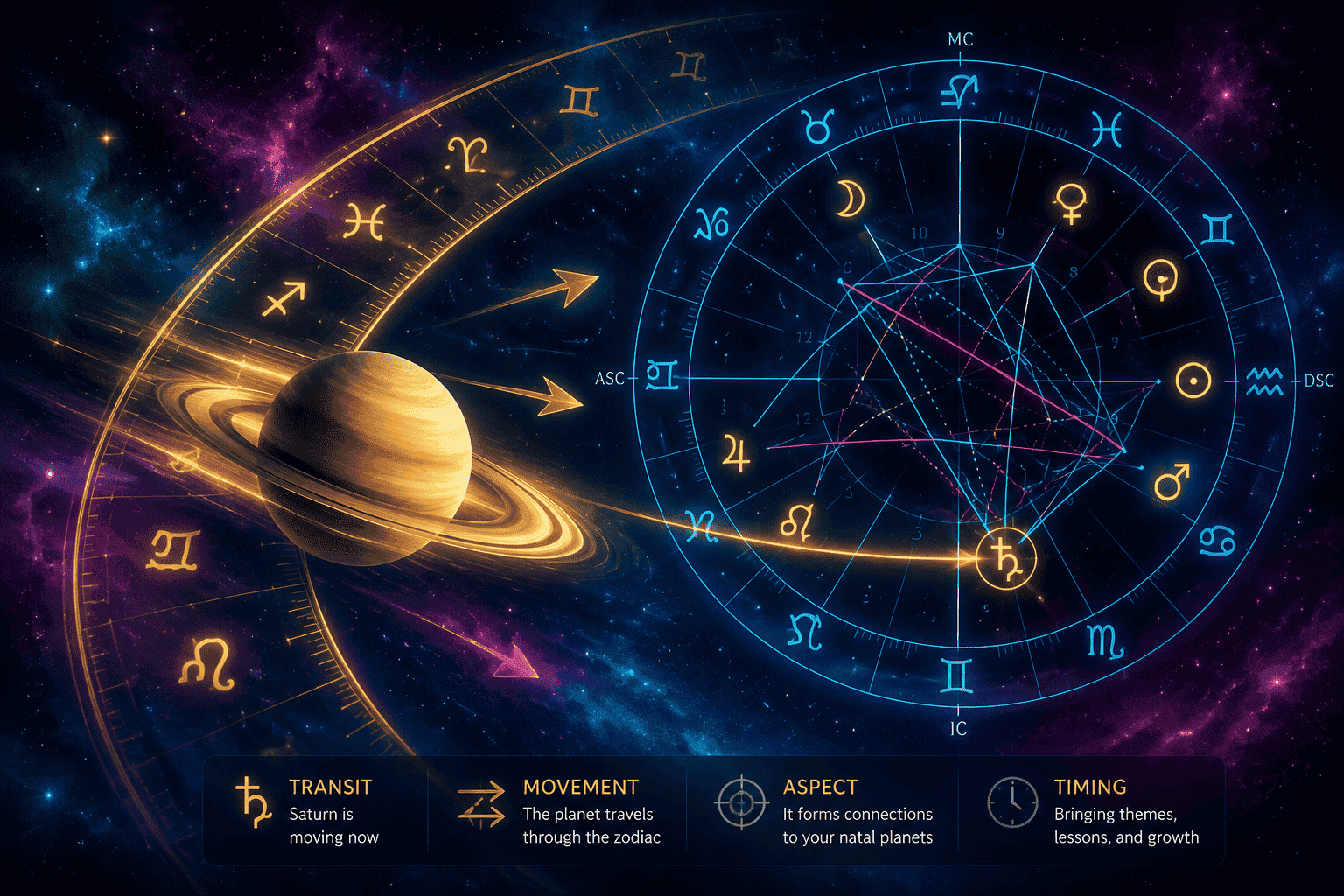
Transits are the real-time movements of planets in the sky as they interact with the fixed positions in your natal chart [2][3]. If your natal chart is a photograph, transits are the live film playing over it.
How it works: Every day, the planets continue moving through the zodiac. When a moving planet reaches the same degree as a planet in your natal chart, it forms a “transit aspect.” That contact activates the themes associated with both the transiting planet and your natal planet [5].
Example: If transiting Saturn (discipline, structure, limitation) forms a conjunction to your natal Venus (love, money, values), you might experience a serious review of a relationship or financial situation — Saturn is testing what Venus represents in your chart.
Why transits matter for beginners
Transits are how astrologers answer the question: “Why is this happening now?” They provide a timing framework for life cycles [7].
- Fast-moving planets (Moon, Mercury, Venus, Mars) create short-term influences lasting hours to days.
- Slow-moving planets (Jupiter, Saturn, Uranus, Neptune, Pluto) create long-term themes lasting months to years [3].
🪐 Practical tip: The most impactful transits for most people are Saturn transits (roughly every 7 years to each natal planet) and Jupiter transits (roughly every 12 years). These mark major life chapters.
How to track your own transits
- Use astro.com → “Extended Chart Selection” → choose “Transits” as the chart type. It overlays current planetary positions on your natal chart.
- Apps like Time Passages or Co-Star show daily transit interpretations in plain language.
- Track the Moon’s cycle as a beginner entry point. The Moon transits through all 12 signs in about 29.5 days, giving you a monthly rhythm to observe.
For a comprehensive look at major planetary movements this year, the Complete Guide to Planetary Transits in 2026 is a practical companion resource.
Astrology Definition and Meaning: Key Terms Beginners Encounter Early
Beyond the Big Three and transits, a handful of terms come up constantly. Here’s a quick-reference glossary:
- Natal chart / Birth chart — The fixed sky map at birth [10]
- Transit — A current planet’s movement across your natal chart [2]
- House — One of 12 life sectors in the chart (career, home, relationships, etc.)
- Aspect — A geometric angle between two planets
- Orb — The allowable degree of deviation for an aspect to still count (e.g., a conjunction within 8° is still active)
- Retrograde — When a planet appears to move backward from Earth’s perspective; associated with review and revision
- Stellium — Three or more planets in the same sign or house
- Progressed chart — A predictive technique where the chart “advances” one day per year of life
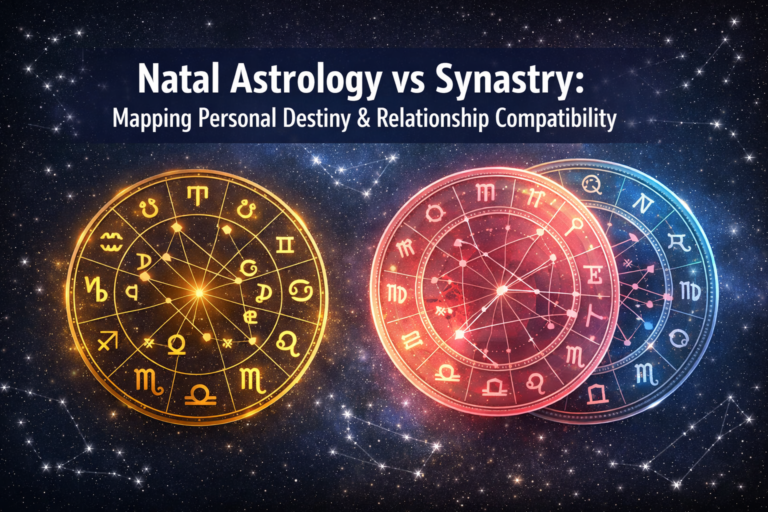
- Synastry — Comparing two natal charts for relationship compatibility (see Natal Astrology vs Synastry)
Orb tip for beginners: When reading transits, use tighter orbs (2–3°) for slow planets and wider orbs (up to 8°) for the Sun and Moon. This keeps your interpretations focused [5].
Astrology Definition and Meaning: Common Beginner Mistakes to Avoid
Understanding the astrology definition and meaning for absolute beginners also means knowing where new learners go wrong.
Mistake 1: Relying only on Sun sign horoscopes Generic Sun sign columns in magazines cover 1/12 of the population with the same advice. Your full natal chart is unique to you.
Mistake 2: Treating every transit as a crisis Not every Saturn transit means disaster. Context matters — what house is involved? What is Saturn’s role in your natal chart? [7]
Mistake 3: Ignoring birth time accuracy An incorrect birth time shifts house cusps and can misplace the Rising sign entirely. Always verify before drawing conclusions from house placements [10].
Mistake 4: Trying to learn everything at once Astrology has centuries of accumulated technique. Start with natal chart basics, spend a few months there, then add transits. Depth beats breadth for beginners.
Mistake 5: Expecting literal predictions Astrology describes potential themes and energies, not fixed outcomes. A challenging transit might manifest as internal growth rather than an external event.
FAQ: Astrology Basics for Absolute Beginners
Q: What’s the difference between a natal chart and a horoscope? A natal chart is your unique birth map. A horoscope is a general forecast, usually written for a Sun sign. Your natal chart is specific; a horoscope is broad.
Q: Do I need my exact birth time? For Sun and Moon signs, no — date alone is enough. For your Rising sign and house placements, yes, exact time is essential [10].
Q: How long does it take to learn to read a natal chart? Most beginners can interpret their Big Three within a few hours of study. Reading a full chart fluently takes months to years of practice.
Q: Are transits the same as retrogrades? No. A retrograde is a type of planetary motion. A transit is any planet’s current position interacting with your natal chart. A planet can be retrograde while transiting your chart [3].
Q: Is astrology compatible with other belief systems? Astrology is a symbolic system and doesn’t require any specific spiritual or religious belief. Many people combine it with psychology, spirituality, or simply use it as a journaling prompt tool.
Q: What’s the best free app or website for beginners? Astro.com is the gold standard for chart accuracy. For daily mobile use, Time Passages and Co-Star are popular beginner-friendly apps [8].
Q: What’s an orb, and why does it matter? An orb is the margin of error allowed for an aspect to be considered active. A tighter orb (1–2°) means the aspect is very precise and strong; a wider orb (6–8°) means it’s still relevant but less intense [5].
Q: How is astrology different from numerology? Astrology uses planetary positions and zodiac signs; numerology uses numbers derived from names and birth dates. They’re separate systems, though some practitioners use both together. See Astrology vs. Numerology: Understanding the Differences for a full comparison.
Q: What does it mean when someone says “Saturn is transiting my 7th house”? It means the planet Saturn is currently moving through the section of the sky that corresponds to the 7th house in their natal chart — the house of partnerships. Saturn themes (responsibility, structure, lessons) are active in relationship areas of life during this period [2].
Q: Can two people born on the same day have different charts? Yes. Birth time and location change the Rising sign, house placements, and Moon sign (if born hours apart). Two people born on the same date but in different cities at different times will have meaningfully different charts [10].
Conclusion: Your Next Steps Into Astrology
The astrology definition and meaning is straightforward once broken into layers: planets are energies, signs are styles, houses are life areas, and transits are the timing mechanism that connects the sky to daily life. None of this requires advanced knowledge to begin.
Here’s a practical starting plan:
- Generate your natal chart today at astro.com using your birth date, time, and place.
- Look up your Sun, Moon, and Rising sign — read one description for each and note what resonates.
- Check what sign the Moon is in today and track it for one full lunar cycle (29.5 days). This builds intuition for transits without overwhelm.
- Pick one planet in your natal chart that interests you and read about its sign and house placement in depth.
- Explore the astrology basics resource hub for structured beginner guides as your knowledge grows.
Astrology rewards patience and observation. The more you track your own experience against planetary cycles, the more meaningful the system becomes — not as prediction, but as a mirror for self-understanding.
References
[2] What Is A Transit In My Birth Chart Astrology Transits Explained For Beginners – https://birthstellar.com/blog/what-is-a-transit-in-my-birth-chart-astrology-transits-explained-for-beginners/
[3] What Are Transits In Astrology Beginner Friendly Guide – https://astro-basics.com/2025/07/21/what-are-transits-in-astrology-beginner-friendly-guide/
[5] How To Read Your Astrological Transits – https://www.nofearastrology.com/how-to-read-your-astrological-transits/
[7] How To Read Your Own Transits A Beginners Guide – https://www.saturnandhoney.com/blog/how-to-read-your-own-transits-a-beginners-guide
[8] Astrology Birth Chart Reading – https://www.allure.com/story/astrology-birth-chart-reading
[10] What Is A Natal Chart – https://www.costarastrology.com/how-does-astrology-work/what-is-a-natal-chart