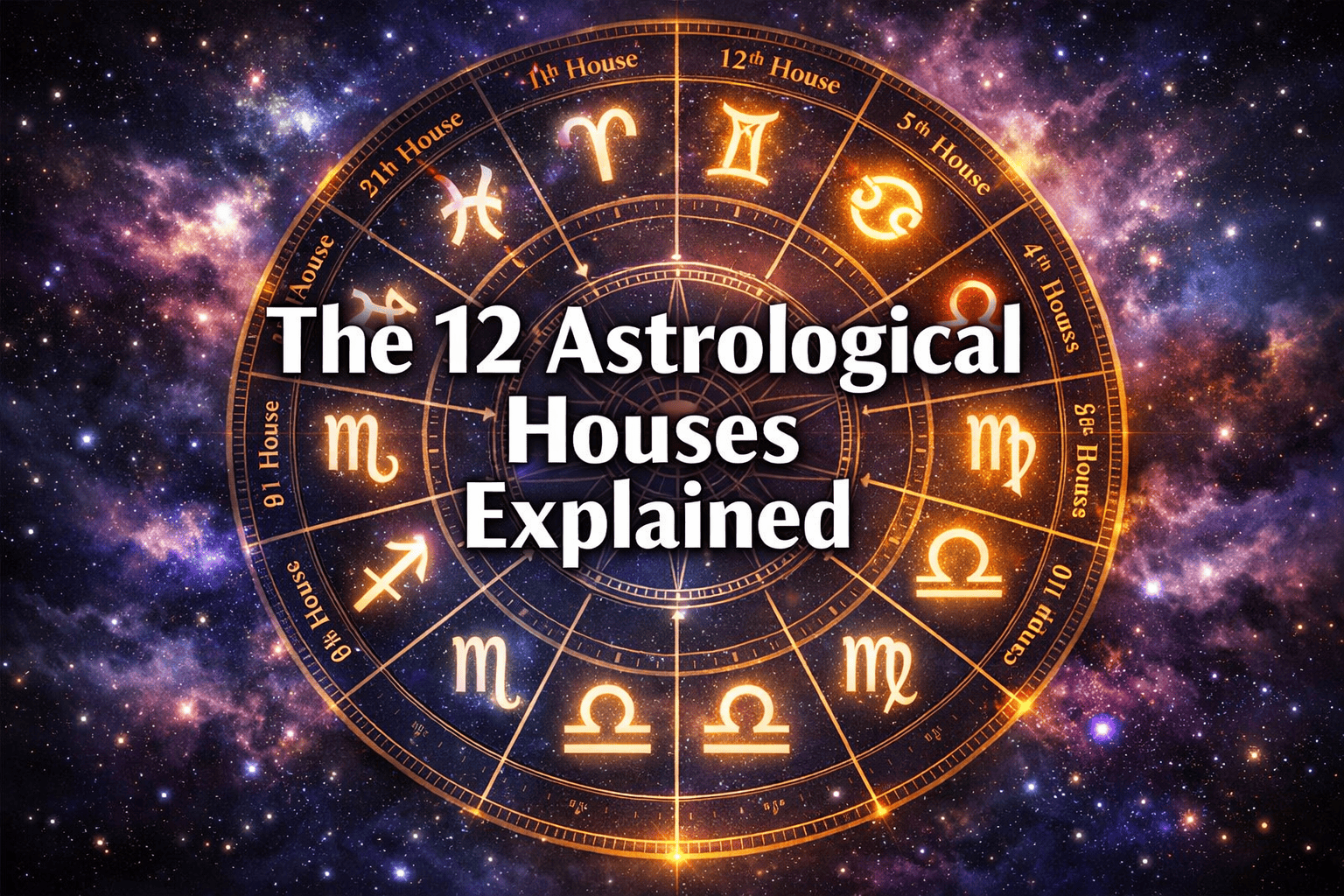
The 12 astrological houses are 12 sections of a natal chart wheel, each governing a specific life area — from your personal identity and finances to relationships, career, and spirituality. Understanding which planets sit in which houses is one of the most practical skills in chart reading, because it shows where in your life each planetary energy plays out.
- Key Takeaways 🌟
- What Are the 12 Astrological Houses and Why Do They Matter?
- How Is the Natal Chart Wheel Structured?
- Houses 1 Through 6: The Personal Houses Explained
- Houses 7 Through 12: The Interpersonal Houses Explained
- Quick Reference: All 12 Houses at a Glance
- How Do Planets in Houses Work? A Practical Overview
- Common Mistakes When Interpreting the 12 Houses
- FAQ: The 12 Astrological Houses Explained
- Conclusion: Your Next Steps for Reading the 12 Houses
- References
Key Takeaways 🌟
- The natal chart is divided into 12 houses arranged counterclockwise in a 360-degree wheel, with the 1st House starting at the 9 o’clock position [1]
- Your Rising Sign (Ascendant) determines which zodiac sign rules your 1st House, and this shapes the entire house layout of your chart [2]
- Houses 1–6 are personal houses covering identity, money, communication, home, creativity, and health [3]
- Houses 7–12 are interpersonal houses covering partnerships, transformation, philosophy, career, community, and spirituality [3]
- A house with no planets is not empty or inactive — the sign on its cusp still colors that life area
- Angular houses (1st, 4th, 7th, 10th) carry the most visible, outward energy in a chart
- Planets in a house don’t just describe what happens there — they describe how you experience and express that life domain
- Beginners should start by identifying their Ascendant, then read each house’s ruling sign before analyzing planetary placements
What Are the 12 Astrological Houses and Why Do They Matter?
The 12 astrological houses form the structural backbone of a natal chart. Think of them as 12 distinct “rooms” in the house of your life — each room has a purpose, a mood, and a set of themes. Planets passing through or placed in these rooms act like guests who bring their own energy to that space.
Without the houses, a natal chart would only tell you what energy you carry (planets) and how it expresses (zodiac signs). The houses answer the crucial third question: where in your life does this energy show up? [4]
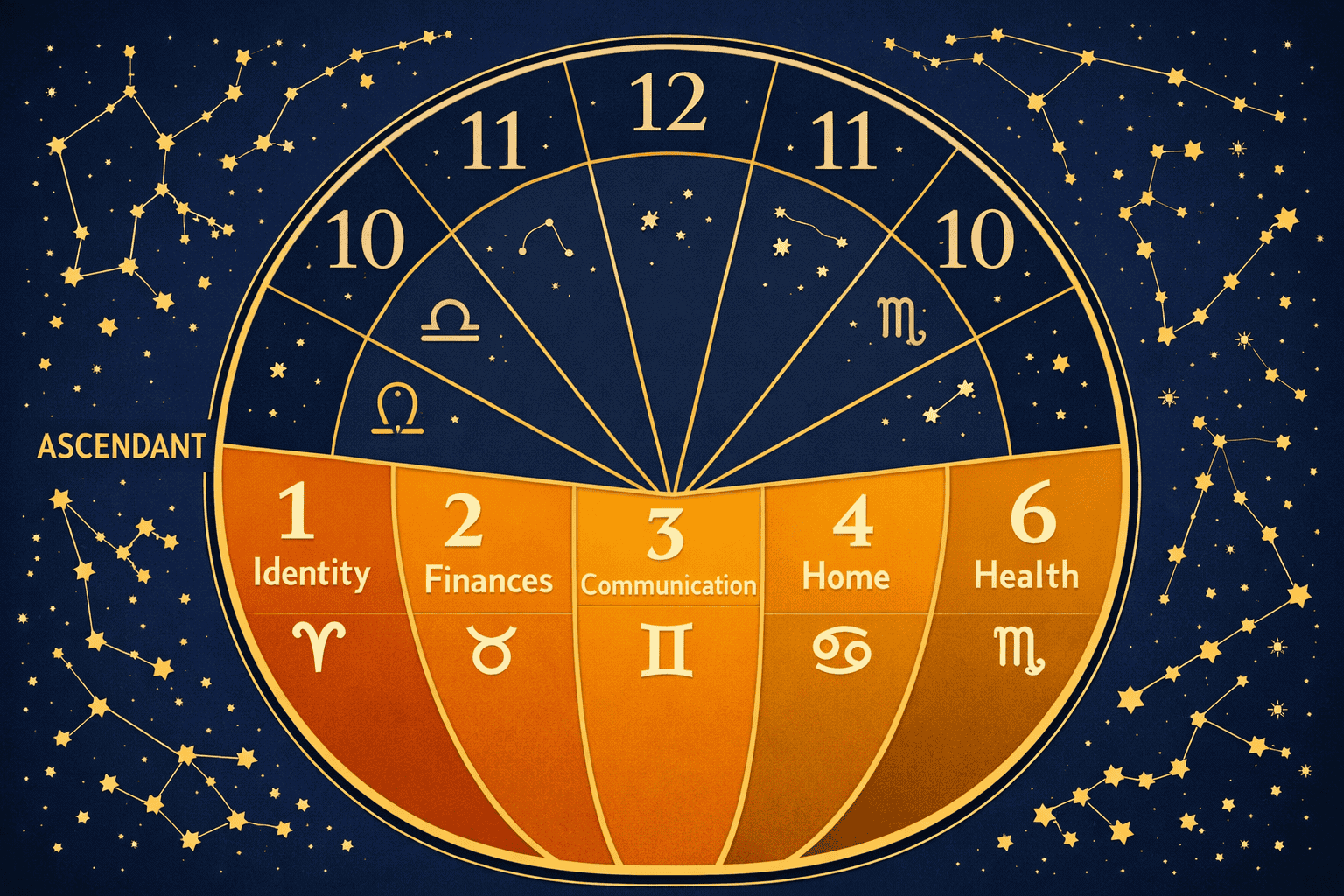
The wheel is divided counterclockwise, and the 1st House always begins at the 9 o’clock position on the left side of the chart — the eastern horizon at the moment of your birth [1]. This is why your exact birth time matters so much. Even a 15-minute difference can shift house cusps and change which sign rules a house.
💡 Quick tip for beginners: If you’re new to chart reading, start with astrology basics and understanding your natal placements before diving into house-by-house analysis.
How Is the Natal Chart Wheel Structured?
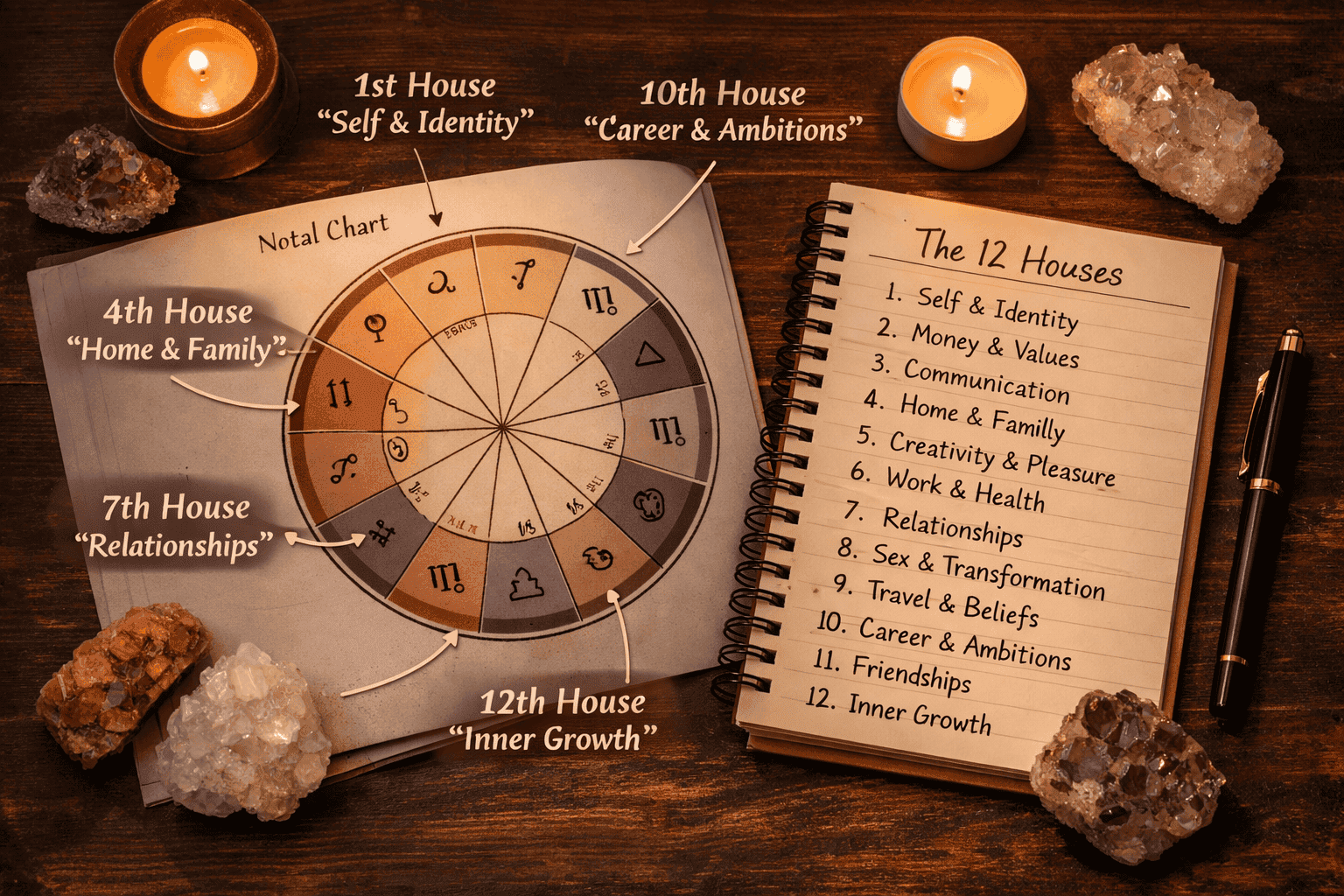
The chart wheel is a circle representing the full 360-degree sky at the moment of your birth. The 12 houses divide this circle into sections, and each section corresponds to a different area of lived experience [1].
Key structural points:
- The Ascendant (Rising Sign) sits on the left, marking the 1st House cusp
- The Descendant sits directly opposite on the right, marking the 7th House cusp
- The IC (Imum Coeli) sits at the bottom, marking the 4th House cusp
- The Midheaven (MC) sits at the top, marking the 10th House cusp [2]
These four points — Ascendant, Descendant, IC, and Midheaven — are called the angles of the chart. Planets near these angles tend to have an outsized, highly visible effect on a person’s life.
House systems: There are several ways to calculate house divisions (Placidus, Whole Sign, Koch, Equal House). Placidus is the most common in Western astrology, but Whole Sign houses — where each sign equals one house — is increasingly popular for beginners because it’s simpler to read [5].
Houses 1 Through 6: The Personal Houses Explained
Houses 1–6 focus on the self, the body, immediate surroundings, and daily life. They describe how you function as an individual before you engage with the wider world [3].
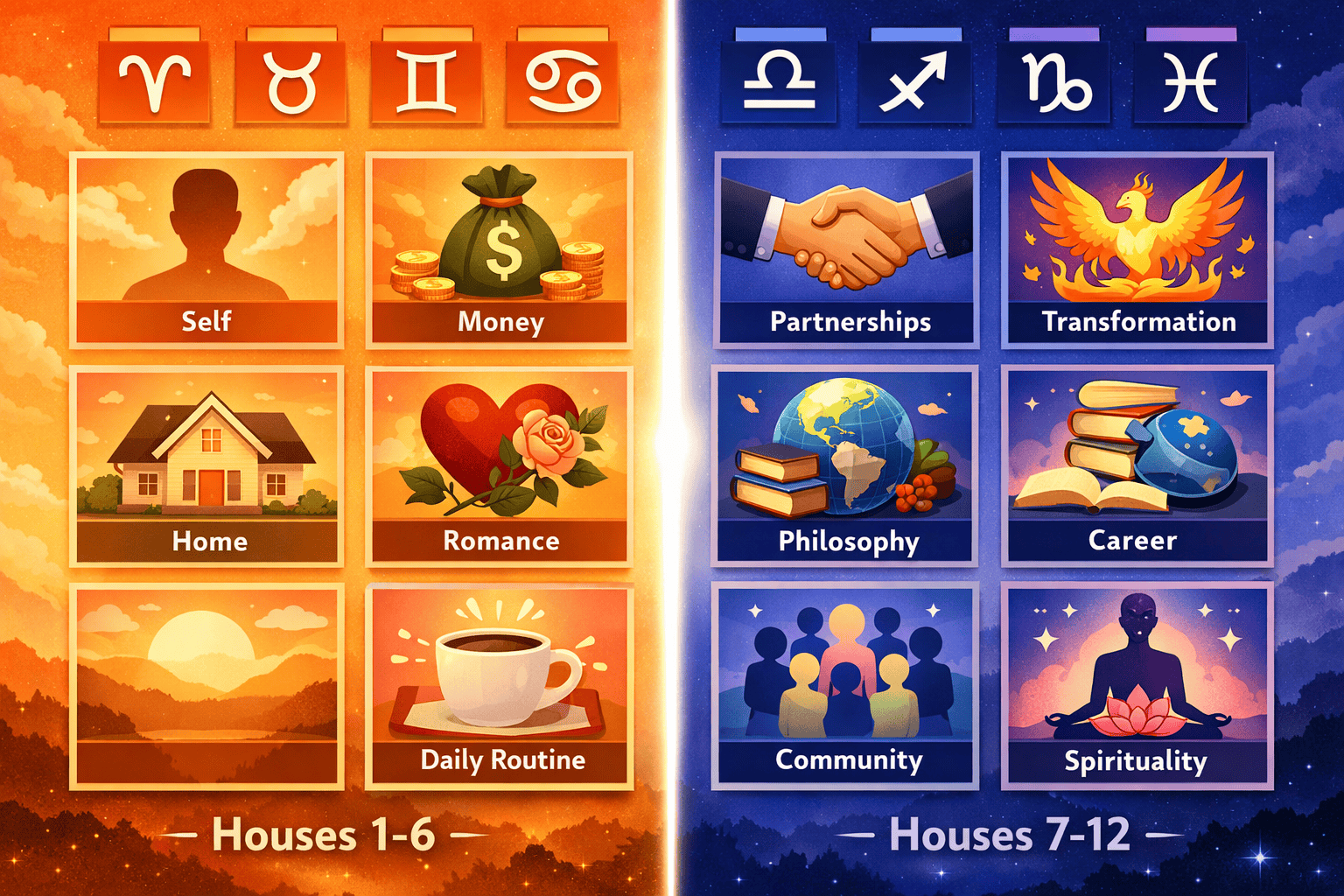
1st House — Identity, Appearance, and First Impressions
The 1st House is your public face. It describes your physical appearance, personality as others first perceive it, and your instinctive approach to life. The zodiac sign on this cusp is your Rising Sign, which is arguably the most important placement for understanding how you move through the world [2].
- Rules: Self-image, the body, beginnings, first impressions
- Natural sign ruler: Aries
- Example: Saturn in the 1st House often creates a serious, reserved demeanor — even if the Sun sign is playful
In 2026, with Saturn entering Aries activating first-house themes for many charts, questions about identity and self-definition are especially prominent.
2nd House — Money, Values, and Material Security
The 2nd House governs what you own and what you value. This includes earned income, possessions, and your relationship with financial security. It also covers self-worth, because how you value yourself often mirrors how you handle money. For a deeper look at 2nd House wealth themes, see natal second house wealth secrets.
- Rules: Earned income, possessions, self-worth, personal values
- Natural sign ruler: Taurus
3rd House — Communication, Siblings, and Local Travel
The 3rd House covers how you think and communicate. It rules everyday conversations, writing, short trips, siblings, and early education. Planets here shape your communication style and mental habits.
- Rules: Speech, writing, local community, siblings, early schooling
- Natural sign ruler: Gemini
4th House — Home, Family, and Roots
The 4th House is the foundation of your chart — literally and figuratively. It describes your home environment, family of origin, and the emotional bedrock you carry from childhood. The IC sits at the 4th House cusp.
- Rules: Home, parents (especially the nurturing parent), ancestry, private life
- Natural sign ruler: Cancer
5th House — Creativity, Romance, and Joy
The 5th House is where life gets fun. It governs creative self-expression, romantic flings (not committed partnerships — that’s the 7th), children, hobbies, and anything done purely for pleasure.
- Rules: Creativity, play, romance, children, gambling, performance
- Natural sign ruler: Leo
6th House — Health, Routines, and Daily Work
The 6th House rules the habits that keep you functioning. This includes physical health, daily work routines, service to others, and even pets. It’s less about career ambition (that’s the 10th) and more about the day-to-day grind. For health themes in the chart, medical astrology basics offers a thorough breakdown.
- Rules: Health, diet, daily routines, work habits, service, pets
- Natural sign ruler: Virgo
Houses 7 Through 12: The Interpersonal Houses Explained
Houses 7–12 move outward from the self into relationships, society, and transcendence. They describe how you engage with others, contribute to the world, and connect with something larger than yourself [3].
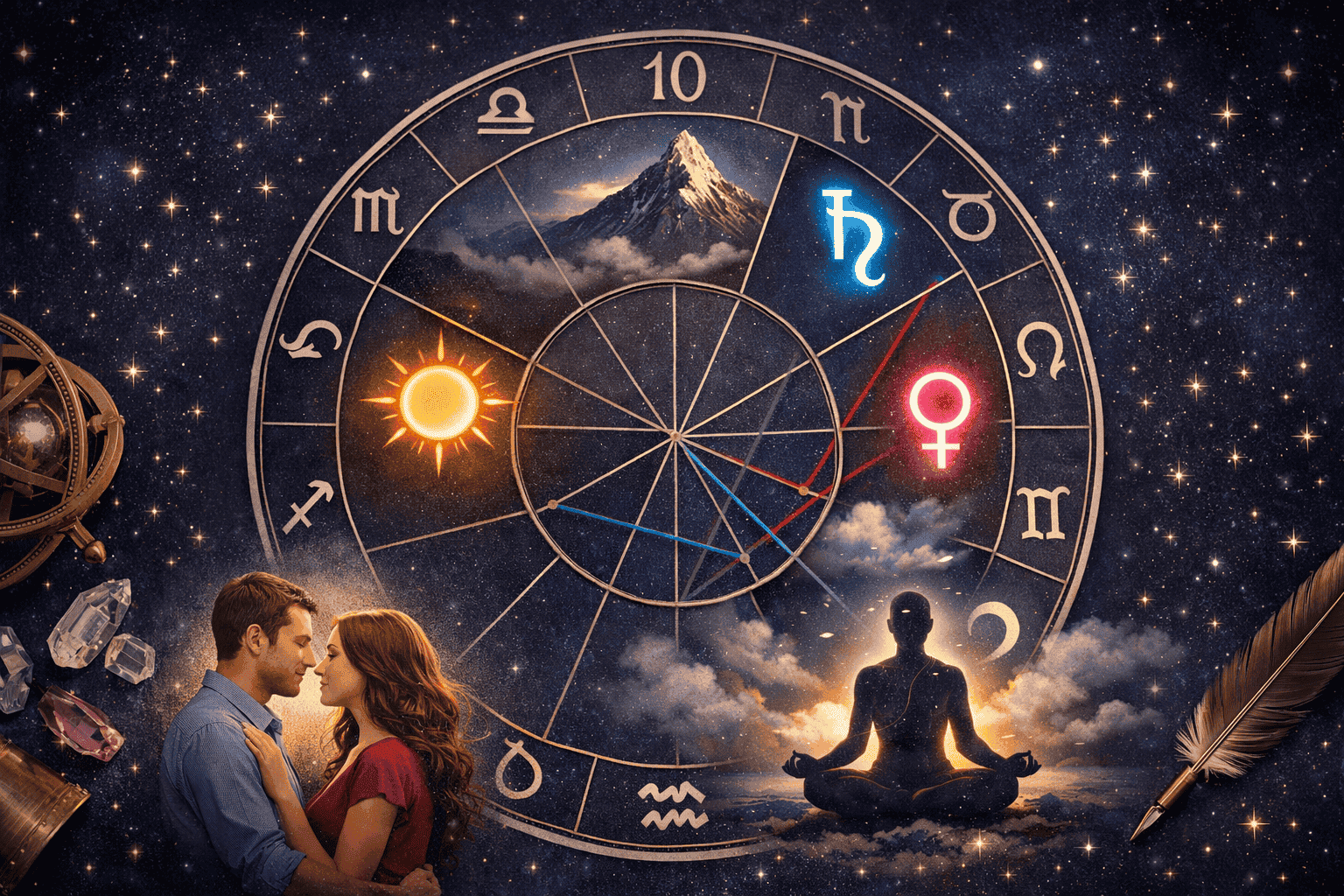
7th House — Partnerships and One-on-One Relationships
The 7th House is the house of “the other.” It governs committed partnerships (romantic and business), open enemies, and how you relate in one-on-one dynamics. The Descendant sits here, directly opposite your Ascendant.
- Rules: Marriage, business partnerships, contracts, known opponents
- Natural sign ruler: Libra
- Common mistake: People assume the 7th House only covers romance. It covers any significant one-on-one relationship, including close business partners and even rivals.
8th House — Transformation, Shared Resources, and Depth
The 8th House is one of the most misunderstood in astrology. Yes, it covers death — but more broadly, it governs transformation, shared finances (like inheritances or a partner’s money), sexuality, and psychological depth. Planets here push you toward profound change.
- Rules: Death and rebirth, shared assets, taxes, sexuality, the occult, psychology
- Natural sign ruler: Scorpio
9th House — Philosophy, Higher Learning, and Long Travel
The 9th House expands your worldview. It rules higher education, foreign travel, religion, philosophy, publishing, and the search for meaning. This is where you ask the big “why” questions. With Uranus entering Gemini in April 2026, 9th House themes around belief systems and long-distance connections are being disrupted for many charts.
- Rules: Higher education, travel abroad, religion, law, publishing, beliefs
- Natural sign ruler: Sagittarius
10th House — Career, Public Reputation, and Life Goals
The 10th House is your most public house. It describes your career, public reputation, and the legacy you build. The Midheaven (MC) sits here, and planets near the MC are often visible to the world. For career-focused chart work, understanding the Midheaven in your natal chart is essential reading.
- Rules: Career, public image, authority figures, achievements, social status
- Natural sign ruler: Capricorn
11th House — Community, Friendships, and Collective Goals
The 11th House is about your tribe. It governs friendships, social networks, group memberships, hopes for the future, and causes you champion. It’s also associated with technology and innovation in modern astrology.
- Rules: Friends, groups, social causes, future hopes, networks
- Natural sign ruler: Aquarius
12th House — Spirituality, Solitude, and the Hidden Self
The 12th House is the most private and mysterious of all. It rules what’s hidden — including unconscious patterns, self-sabotage, spiritual retreats, and karma. Planets here often operate below conscious awareness and can represent both your greatest challenges and your deepest spiritual gifts [6].
- Rules: Solitude, spirituality, hidden enemies, karma, institutions, the unconscious
- Natural sign ruler: Pisces
Quick Reference: All 12 Houses at a Glance
| House | Life Area | Natural Ruler | Key Themes |
|---|---|---|---|
| 1st | Identity | Aries | Self, appearance, beginnings |
| 2nd | Resources | Taurus | Money, values, self-worth |
| 3rd | Communication | Gemini | Siblings, speech, local travel |
| 4th | Home | Cancer | Family, roots, private life |
| 5th | Creativity | Leo | Romance, children, play |
| 6th | Health | Virgo | Routines, work, wellness |
| 7th | Partnerships | Libra | Marriage, contracts, others |
| 8th | Transformation | Scorpio | Shared assets, depth, change |
| 9th | Philosophy | Sagittarius | Travel, beliefs, higher learning |
| 10th | Career | Capricorn | Reputation, ambition, legacy |
| 11th | Community | Aquarius | Friends, groups, future goals |
| 12th | Spirituality | Pisces | Hidden self, karma, solitude |
How Do Planets in Houses Work? A Practical Overview
When a planet occupies a house in your natal chart, it energizes that life area with its specific qualities. The planet is the actor, the sign is the costume, and the house is the stage [4].
Practical examples:
- Venus in the 7th House: Partnerships tend to be harmonious, beauty-focused, and socially motivated. You likely attract partners who are charming or artistic.
- Mars in the 10th House: Career is pursued aggressively and competitively. You’re driven to lead and may clash with authority figures.
- Neptune in the 12th House: Spiritual sensitivity is heightened. There may be a pull toward meditation, solitude, or creative retreat — but also a risk of escapism.
What about empty houses?
An empty house is not a problem. It simply means no natal planet occupies that space. The sign on the house cusp still describes that life area’s tone, and transiting planets will activate it throughout your life [5].
Choose this approach if… you’re reading a chart for the first time: identify which houses hold the most planets (called a stellium) — that cluster reveals where life energy concentrates. For more on stelliums, see natal chart stellium in Aries.
Common Mistakes When Interpreting the 12 Houses
Even experienced readers make these errors:
- Ignoring house cusps. The sign on a house cusp colors the entire house, even if no planet sits there.
- Treating the 8th House as only about death. It’s primarily about transformation and shared resources.
- Confusing the 6th and 10th Houses. The 6th is daily work and health habits; the 10th is career identity and public status.
- Overlooking the 12th House. Planets here are active — they just operate unconsciously or in private contexts.
- Using the wrong house system. Placidus and Whole Sign can place the same planet in different houses. Know which system your chart uses.
FAQ: The 12 Astrological Houses Explained
Q: What is the most important house in a natal chart? A: There’s no single “most important” house, but the angular houses — 1st, 4th, 7th, and 10th — carry the most visible influence. The 1st House (Ascendant) is often prioritized because it shapes how the entire chart is structured.
Q: Does every house need a planet to be active? A: No. Every house is active regardless of whether a planet occupies it. The sign on the house cusp describes the energy of that life area, and transiting planets will activate it over time [5].
Q: What is the difference between a house and a sign? A: A zodiac sign describes how energy expresses (personality style, qualities). A house describes where in life that energy operates (which domain or circumstance). They work together but are distinct layers of the chart [4].
Q: Why does birth time matter for houses? A: The houses are calculated based on the exact position of the horizon at your birth time and location. Even a 15-minute difference can shift house cusps, especially the Ascendant. An accurate birth time is essential for house-based chart reading [1].
Q: What does it mean to have many planets in one house? A: Three or more planets in one house form a stellium, concentrating significant life energy in that area. It often means that life domain is a major focus, source of complexity, or area of intense development.
Q: What is the 12th House really about? A: The 12th House governs the unconscious mind, hidden patterns, solitude, karma, and spiritual retreat. It’s associated with what’s behind the scenes — including self-undoing behaviors and deep spiritual gifts [6].
Q: Can transiting planets change my house themes? A: Transiting planets move through your natal houses over time, temporarily activating those life areas. For example, Jupiter transiting your 2nd House often brings financial opportunity, while Saturn there may bring financial restructuring.
Q: What is a house ruler? A: Each house has a ruling planet determined by the sign on its cusp. For example, if Scorpio is on your 8th House cusp, Mars and Pluto (Scorpio’s rulers) become the 8th House rulers. Their condition in your chart describes how that house functions.
Q: Are some houses considered “bad”? A: Traditional astrology labeled the 6th, 8th, and 12th Houses as “cadent” or challenging houses. Modern astrology views them as complex rather than bad — they deal with health, transformation, and the unconscious, which are demanding but deeply meaningful areas of life.
Q: What is the difference between the 5th and 7th Houses for romance? A: The 5th House covers dating, flirtation, and romantic fun — the early, playful stage of love. The 7th House covers committed partnerships, marriage, and long-term one-on-one bonds.
Q: How do I find my Rising Sign? A: Your Rising Sign (Ascendant) is determined by the zodiac sign on the eastern horizon at your exact birth time and location. You can calculate it using any free birth chart tool — just enter your birth date, time, and place. You can also discover your birth chart here.
Q: What happens when a planet is on a house cusp? A: A planet sitting very close to a house cusp (within a few degrees) influences both houses it borders. This is called being “on the cusp” and can blend the themes of both houses.
Conclusion: Your Next Steps for Reading the 12 Houses
Understanding the 12 astrological houses explained across this guide gives you the foundational map for reading any natal chart. The houses show where life unfolds — and once you know the terrain, every planetary placement becomes far more meaningful.
Actionable next steps:
- Pull your natal chart using your exact birth date, time, and location. Discover your birth chart here.
- Identify your Ascendant and note which sign rules each of your 12 houses.
- Find your most populated house (the one with the most planets) — this is a key life focus area.
- Read each house cusp sign before analyzing planetary placements. The sign sets the tone.
- Track current transits to see which houses are being activated right now. Resources like planetary transits can help you follow live planetary movements through your chart.
- Study the angular houses first (1st, 4th, 7th, 10th) — they’re the most immediately visible in your life.
The 12 houses aren’t abstract symbols. They’re a practical map of your life, and learning to read them is one of the most grounding skills in all of astrology.
References
[1] 12 Zodiac Houses – https://astrostyle.com/astrology/12-zodiac-houses/ [2] The 12 Houses In Astrology – https://www.chani.com/blogs/the-12-houses-in-astrology [3] The Astrology Houses The Ultimate Guide To The 12 Houses Of The Horoscope – https://debrasilvermanastrology.com/the-astrology-houses-the-ultimate-guide-to-the-12-houses-of-the-horoscope/ [4] Understanding The 12 Houses In Astrology – https://www.belacrowder.com/articles/understanding-the-12-houses-in-astrology [5] The 12 Houses – https://alicebell.substack.com/p/the-12-houses [6] 12 Houses Astrology Explained – https://astrologyhub.com/12-houses-astrology-explained/