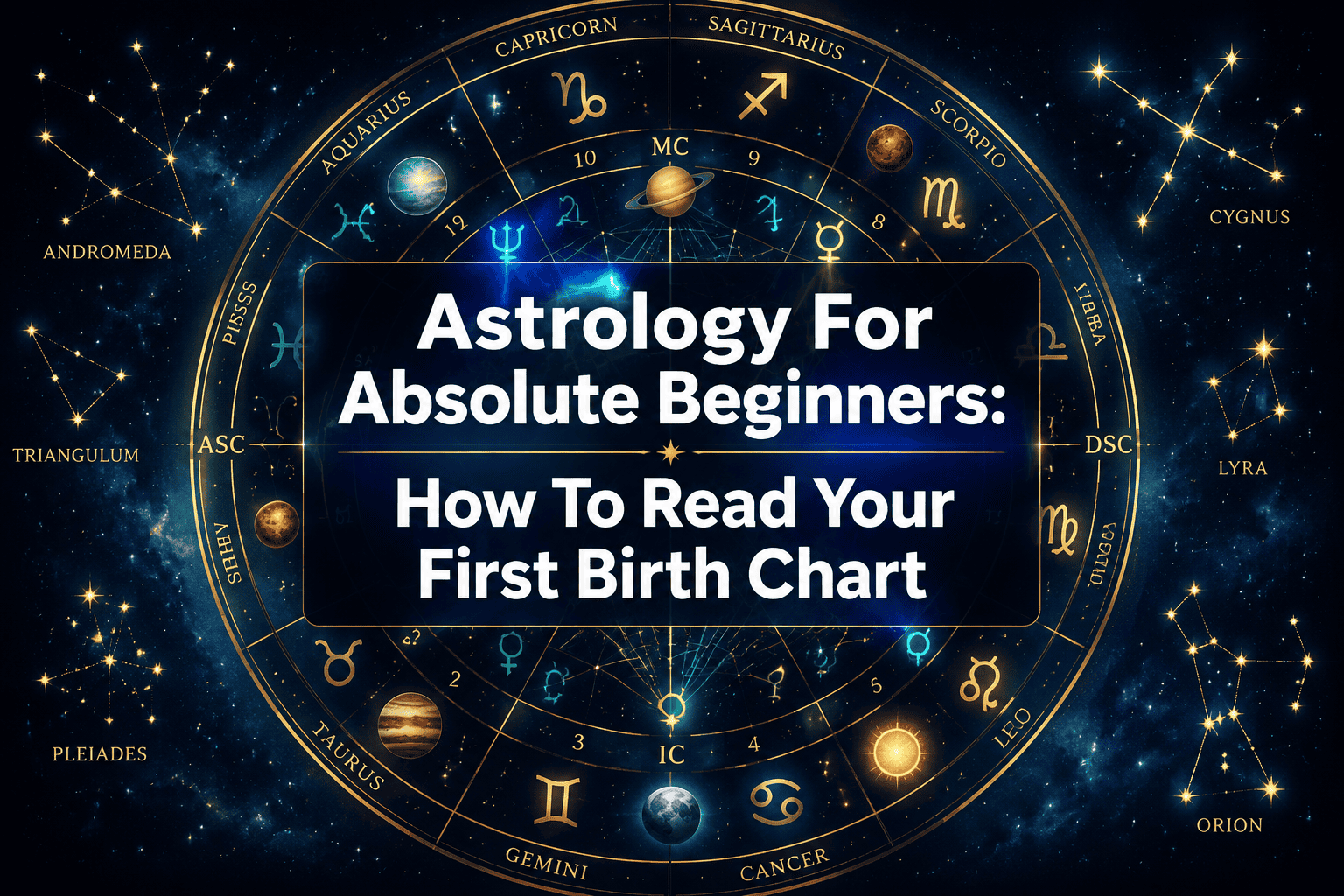
A birth chart is a snapshot of the sky at the exact moment you were born, showing where the Sun, Moon, and planets were positioned across 12 zodiac signs and 12 life areas called houses. Reading your first birth chart without getting overwhelmed means starting with just three things: your Sun sign, Moon sign, and Rising sign. Once those click, everything else falls into place naturally.
- Key Takeaways
- What Is a Birth Chart and Why Does It Matter for Absolute Beginners?
- How Do You Get Your Birth Chart? (Step-by-Step for New Learners)
- The Big Three: Sun, Moon, and Rising Sign Explained Simply
- What Are the 12 Houses and What Does Each One Govern?
- How Do Elements and Modalities Add Meaning to Your Chart?
- How Do You Actually Read a Birth Chart Without Getting Lost?
- What Are the Most Common Beginner Mistakes When Reading a Birth Chart?
- FAQ: Astrology for Absolute Beginners
- Conclusion: Your First Birth Chart Reading, Step by Step
Key Takeaways
- 🌟 Your birth chart needs three pieces of information: date of birth, exact time of birth, and place of birth.
- ☀️ The Sun sign shows your core identity and ego — it’s the sign most people already know.
- 🌙 The Moon sign reveals your emotional inner world and instinctive reactions.
- ⬆️ The Rising sign (Ascendant) describes how others see you and shapes your life path.
- 🏠 The 12 houses map specific life areas, from self-image to career to relationships.
- 🔥 Four elements (Fire, Earth, Air, Water) and three modalities (Cardinal, Fixed, Mutable) add texture to every placement.
- 📊 Planets are the “what,” signs are the “how,” and houses are the “where.”
- 🛑 Common beginner mistake: trying to interpret every placement at once. Start with the Big Three, then expand.
- 🆓 Free birth chart tools like Astro.com generate your chart instantly once you enter your birth data.
- 📖 Astrology is a symbolic language — fluency comes with practice, not memorization.
What Is a Birth Chart and Why Does It Matter for Absolute Beginners?
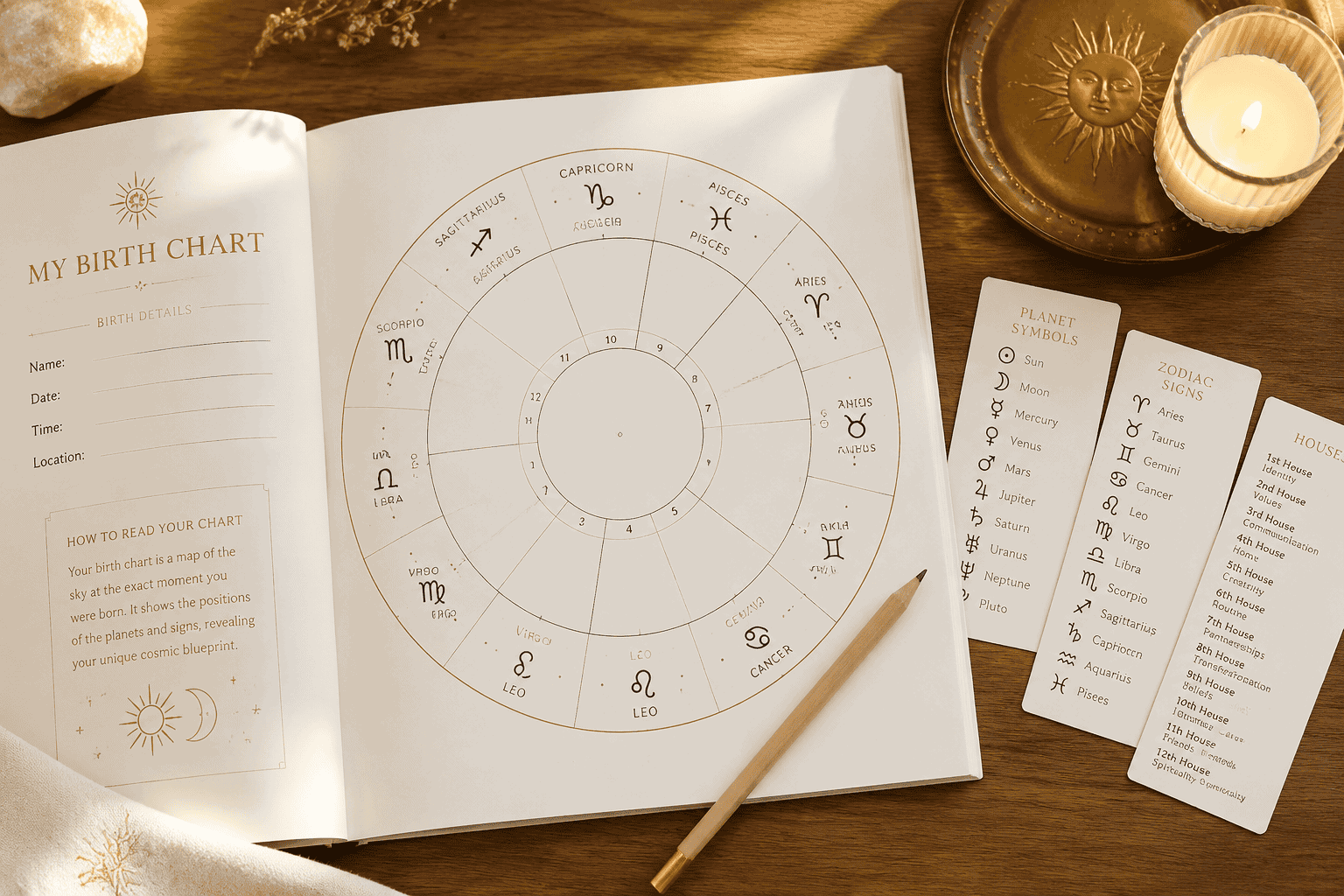
A birth chart (also called a natal chart) is a circular map divided into 12 sections, showing exactly where every major planet sat in the sky the moment you were born. For anyone exploring astrology for absolute beginners, this chart is the starting point for everything — personality insights, life themes, relationship patterns, and timing cycles.
Think of it like a personal blueprint. Two people born on the same day but in different cities or at different times can have noticeably different charts, because the Rising sign and house positions shift throughout the day.
Why it matters:
- It goes far deeper than just your Sun sign (the one from your birthday).
- It shows the full picture of your personality, not just one slice.
- It gives context for why you might feel different from others born under the same Sun sign.
“Knowing only your Sun sign is like reading the title of a book. The birth chart is the whole story.”
For a solid foundation on what astrology actually is and where it comes from, the complete guide to astrology basics is a great companion read before diving into chart interpretation.
How Do You Get Your Birth Chart? (Step-by-Step for New Learners)
Getting your birth chart takes about two minutes. You need three things: your date of birth, your exact time of birth, and your place of birth.
Step-by-step:
- Find your birth time. Check your birth certificate — it’s usually listed there. If you can’t find it, ask a parent or check hospital records. An unknown birth time makes the Rising sign and house placements unreliable.
- Go to a free chart calculator. Astro.com is the most widely used free tool. You can also generate your birth chart here.
- Enter your data. Input your full birth date (day, month, year), exact time, and city of birth.
- Download or screenshot your chart. You’ll see a circular wheel with symbols, lines, and numbers.
- Don’t panic. The chart looks complex at first. You’ll only focus on a few things to start.
Common mistake: Guessing your birth time. Even a 15-minute difference can shift your Rising sign and change which house your planets fall in. If you genuinely can’t find your birth time, use noon as a placeholder but know that your Rising sign and houses won’t be accurate.
The Big Three: Sun, Moon, and Rising Sign Explained Simply
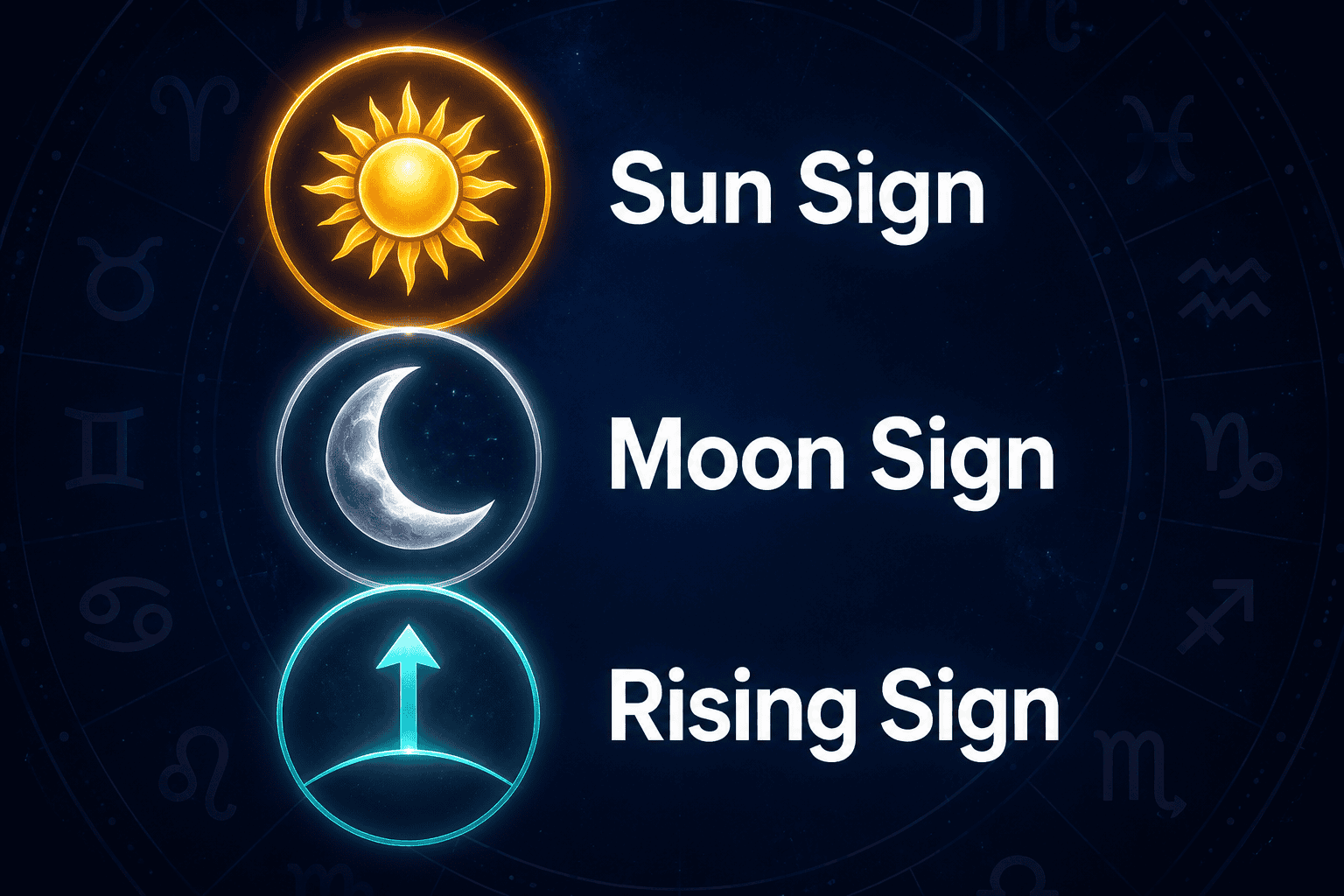
The Big Three are the most important starting point in astrology for absolute beginners reading their first birth chart. Every other placement builds on these three.
☀️ Sun Sign — Your Core Identity
Your Sun sign is determined by the date you were born. It represents your conscious self, your ego, and the qualities you’re here to develop. Most people already know this one.
Choose this as your starting focus if: you want to understand your core motivations and life purpose.
🌙 Moon Sign — Your Emotional World
Your Moon sign is determined by where the Moon was when you were born. It changes signs roughly every 2.5 days, so two people born the same week can have different Moon signs. This placement governs your emotions, instincts, and what makes you feel safe.
For a deeper look at how Moon sign energy works in everyday life, the Cancer Moon sign traits guide and the Libra Moon sign guide show real examples of Moon sign expression.
⬆️ Rising Sign — Your Public Face
Your Rising sign (also called the Ascendant) is the zodiac sign that was rising on the eastern horizon at the moment of your birth. It changes roughly every two hours, which is why birth time matters so much. The Rising sign shapes your appearance, first impressions, and the overall “lens” through which you experience life.
The Rising sign guide for beginners breaks down every Ascendant sign in plain language.
| Placement | Determined By | Represents |
|---|---|---|
| Sun Sign | Birth date | Core identity, ego, life purpose |
| Moon Sign | Birth date + time | Emotions, instincts, inner needs |
| Rising Sign | Birth date + time + location | Appearance, first impressions, life lens |
What Are the 12 Houses and What Does Each One Govern?
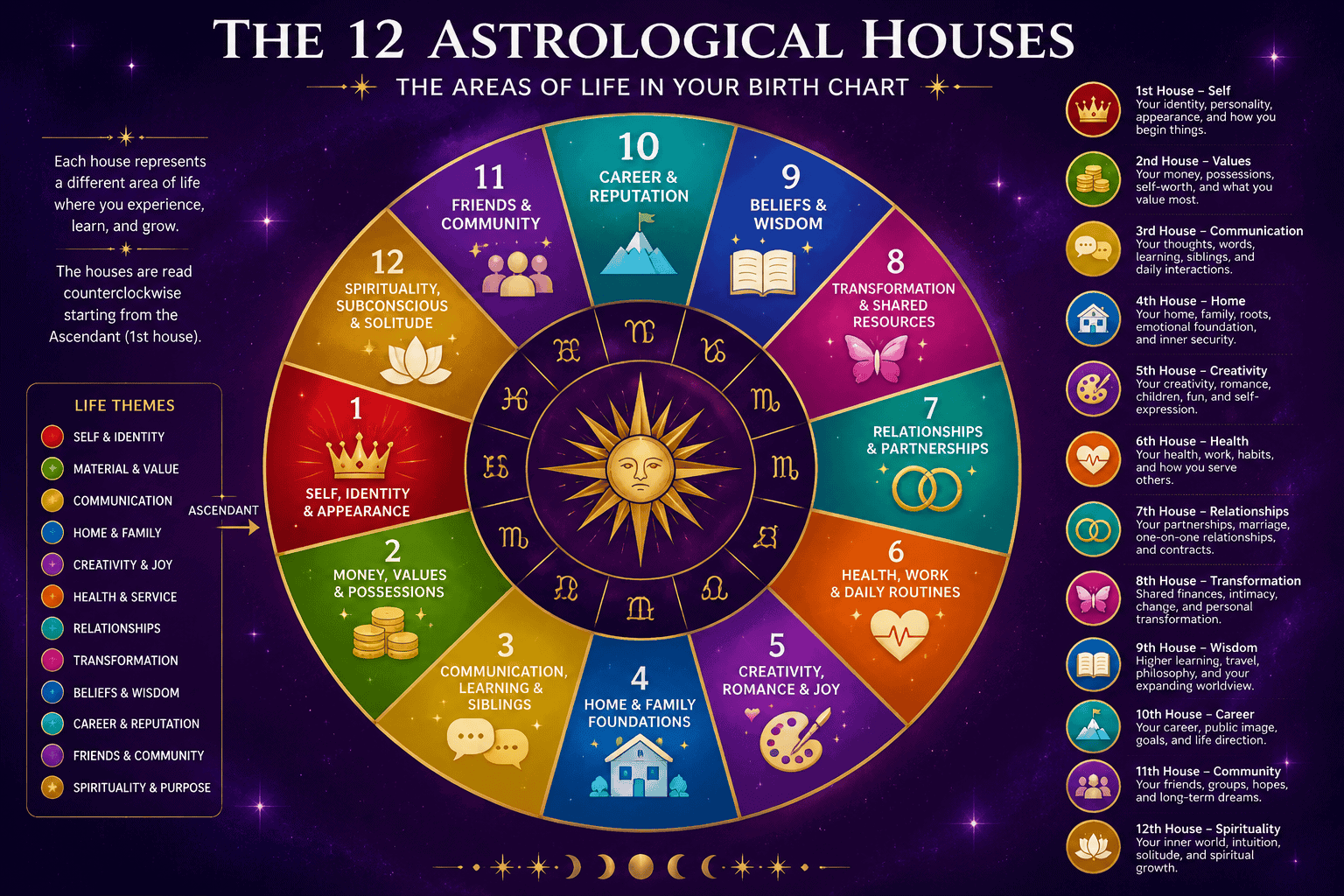
The 12 houses are the 12 sections of your birth chart, each representing a different area of life. Planets that fall inside a house bring their energy to that life area. A house with no planets isn’t empty or bad — it just means that area of life runs more quietly.
The 12 houses at a glance:
| House | Life Area | Key Themes |
|---|---|---|
| 1st | Self | Identity, appearance, first impressions |
| 2nd | Money | Income, possessions, self-worth |
| 3rd | Communication | Siblings, local travel, learning |
| 4th | Home | Family, roots, private life |
| 5th | Creativity | Romance, children, fun, self-expression |
| 6th | Health | Daily routines, work, wellness |
| 7th | Partnerships | Marriage, business partners, open enemies |
| 8th | Transformation | Shared resources, death, sexuality, the occult |
| 9th | Expansion | Travel, higher education, philosophy, beliefs |
| 10th | Career | Public reputation, ambitions, authority |
| 11th | Community | Friendships, groups, hopes, social causes |
| 12th | Spirituality | Hidden matters, solitude, karma, the unconscious |
For a thorough breakdown of every house and what it means for your personal chart, the 12 astrological houses explained guide is the most complete beginner resource available.
Edge case: When multiple planets cluster in one house (called a stellium), that life area becomes a major theme in your life. If you have three or more planets in the same house, expect that area to feel intense, busy, or especially important.
How Do Elements and Modalities Add Meaning to Your Chart?
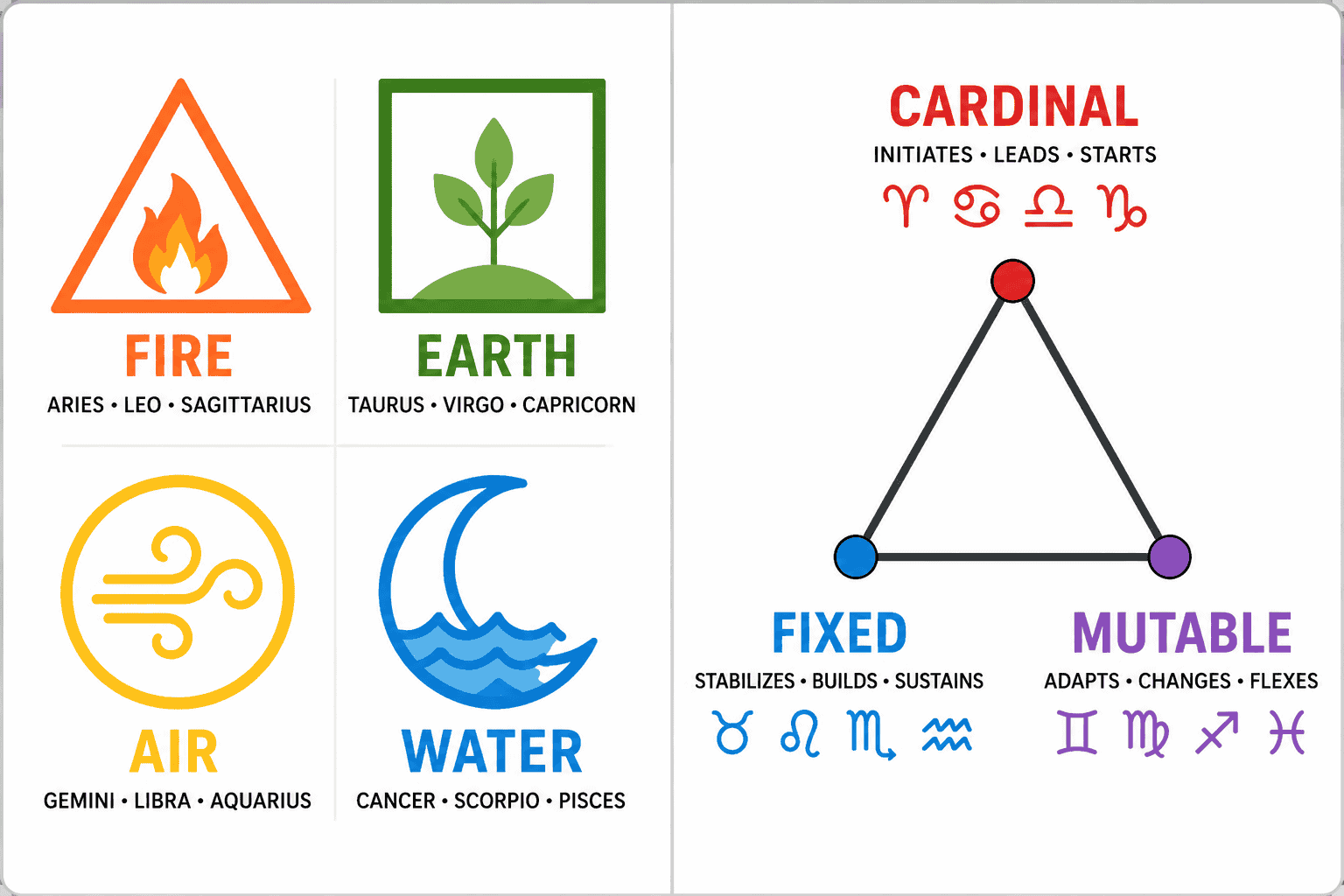
Elements and modalities are the building blocks behind every zodiac sign. Understanding them makes reading a birth chart far less about memorizing 12 separate sign descriptions and far more about recognizing patterns.
The Four Elements
Each of the 12 signs belongs to one of four elements:
- 🔥 Fire (Aries, Leo, Sagittarius): Enthusiastic, bold, action-oriented, sometimes impulsive
- 🌍 Earth (Taurus, Virgo, Capricorn): Practical, grounded, patient, sometimes stubborn
- 💨 Air (Gemini, Libra, Aquarius): Intellectual, social, curious, sometimes scattered
- 💧 Water (Cancer, Scorpio, Pisces): Emotional, intuitive, empathetic, sometimes overwhelmed
If most of your planets fall in Water signs, emotions and intuition drive you. A chart heavy in Earth signs suggests someone who values stability and tangible results.
The Three Modalities
Each sign also belongs to one of three modalities, which describe how that sign operates:
- Cardinal (Aries, Cancer, Libra, Capricorn): Initiators. They start things.
- Fixed (Taurus, Leo, Scorpio, Aquarius): Sustainers. They build and hold.
- Mutable (Gemini, Virgo, Sagittarius, Pisces): Adapters. They shift and transition.
Quick example: A person with Sun in Aries (Cardinal Fire) and Moon in Scorpio (Fixed Water) will initiate boldly but hold on emotionally far longer than their fiery exterior suggests.
How Do You Actually Read a Birth Chart Without Getting Lost?
Reading a birth chart for the first time in astrology for absolute beginners works best as a layered process. Trying to interpret every symbol at once is the fastest route to confusion.
A beginner’s reading order:
- Identify your Big Three (Sun, Moon, Rising). Write them down.
- Note which element dominates your chart. Count how many planets fall in Fire, Earth, Air, and Water signs.
- Find where your Sun and Moon sit by house. For example, Sun in the 10th house suggests a career-focused identity. Moon in the 4th house points to deep emotional ties to home and family.
- Look for any stelliums (three or more planets in one sign or house). These are major life themes.
- Check your chart ruler. The planet that rules your Rising sign is called your chart ruler and acts as a kind of guide for your whole chart. For example, if your Rising sign is Virgo, your chart ruler is Mercury.
- Save aspects for later. The lines drawn across the center of the chart (called aspects) show how planets interact. These are important but complex — beginners should tackle them after the basics are solid.
“You don’t need to read the whole chart in one sitting. Even professional astrologers take their time with a new chart.”
For a broader look at natal placements and how they work together, the beginner’s guide to birth charts and natal placements walks through this layered approach in detail.
What Are the Most Common Beginner Mistakes When Reading a Birth Chart?
Most beginners make the same handful of mistakes. Knowing them in advance saves a lot of frustration.
Mistake 1: Treating every placement in isolation Signs, houses, and planets interact. A Venus in Scorpio in the 7th house reads differently than Venus in Scorpio in the 12th house. Context always matters.
Mistake 2: Assuming placements are fixed personality sentences Astrology describes tendencies, not destinies. A Mars in Pisces doesn’t mean someone is weak — it means their drive expresses through intuition and creativity rather than aggression.
Mistake 3: Ignoring the Rising sign because they don’t know their birth time The Rising sign changes every two hours. Without it, house placements are unreliable. If birth time is truly unavailable, focus only on Sun and Moon sign interpretations.
Mistake 4: Skipping the elements and modalities Beginners who jump straight to planet-by-planet interpretation often feel overwhelmed. Learning the four elements first gives a shortcut to understanding any sign quickly.
Mistake 5: Over-identifying with negative placements A Saturn in the 1st house or a challenging aspect doesn’t define someone as limited. In astrology, every placement has a constructive expression. Saturn in the 1st house, for example, often produces people with exceptional discipline and long-term staying power.
For those interested in how natal charts interact with current planetary events, the natal astrology vs. synastry guide explains how to use your chart beyond self-understanding.
FAQ: Astrology for Absolute Beginners
Q: Do I need to know math or astronomy to read a birth chart? No. Free tools like Astro.com do all the calculations. You only need to interpret the symbols, which is a skill learned gradually.
Q: What if I don’t know my birth time? Use noon as a placeholder. Your Sun sign will still be accurate. Your Moon sign will likely be correct too, unless you were born near a Moon sign change. Your Rising sign and house placements, however, will be unreliable without an exact time.
Q: Is my Sun sign the most important placement? The Sun is important, but many astrologers consider the Rising sign equally significant because it shapes the entire chart structure. The Moon sign is often the most personally felt placement in daily emotional life.
Q: How long does it take to learn to read a birth chart? Most beginners can interpret their Big Three and a few key house placements within a few weeks of casual study. Fluency with aspects and transits takes months to years of practice.
Q: Why does my birth chart description feel more accurate than my Sun sign horoscope? Because a birth chart uses your exact birth data, it reflects a unique combination of placements. Generic Sun sign horoscopes apply to roughly 1/12 of the population at once.
Q: What’s the difference between a natal chart and a transit chart? A natal chart is fixed — it shows the sky at your birth. A transit chart shows where planets are right now and how they interact with your natal placements. Transits explain timing and current life themes.
Q: Can two people have the same birth chart? Only if they were born at the exact same time in the exact same location. Even twins have slightly different charts because of the time gap between births.
Q: What is a chart ruler? The chart ruler is the planet that rules your Rising sign. It acts as a guide for your whole chart and is worth looking up once you know your Rising sign.
Q: Are some birth chart placements better than others? No placement is inherently good or bad. Each has constructive and challenging expressions depending on awareness and life circumstances.
Q: Where can I explore astrology basics further? The astrology basics discovery section is a good place to keep building knowledge after mastering the fundamentals.
Conclusion: Your First Birth Chart Reading, Step by Step
Reading a birth chart for the first time doesn’t require memorizing hundreds of symbols or spending hours decoding complex diagrams. Astrology for absolute beginners: how to read your first birth chart without getting overwhelmed comes down to one principle — start small and layer knowledge gradually.
Actionable next steps:
- Get your chart today using a free tool. You need your birth date, time, and place.
- Write down your Big Three: Sun sign, Moon sign, and Rising sign.
- Identify your dominant element by counting planetary placements in Fire, Earth, Air, and Water.
- Find which houses your Sun and Moon occupy and read those house themes.
- Bookmark a reliable beginner resource and return to it as questions come up.
- Give yourself time. Astrology is a symbolic language. Every chart reading teaches you something new.
The birth chart isn’t a verdict — it’s an invitation to understand yourself more clearly. The more you engage with it, the more useful it becomes.
Meta Title: Astrology for Absolute Beginners: Read Your First Birth Chart
Meta Description: Learn how to read your first birth chart without overwhelm. Discover your Sun, Moon, and Rising signs, the 12 houses, elements, and key beginner steps in 2026.