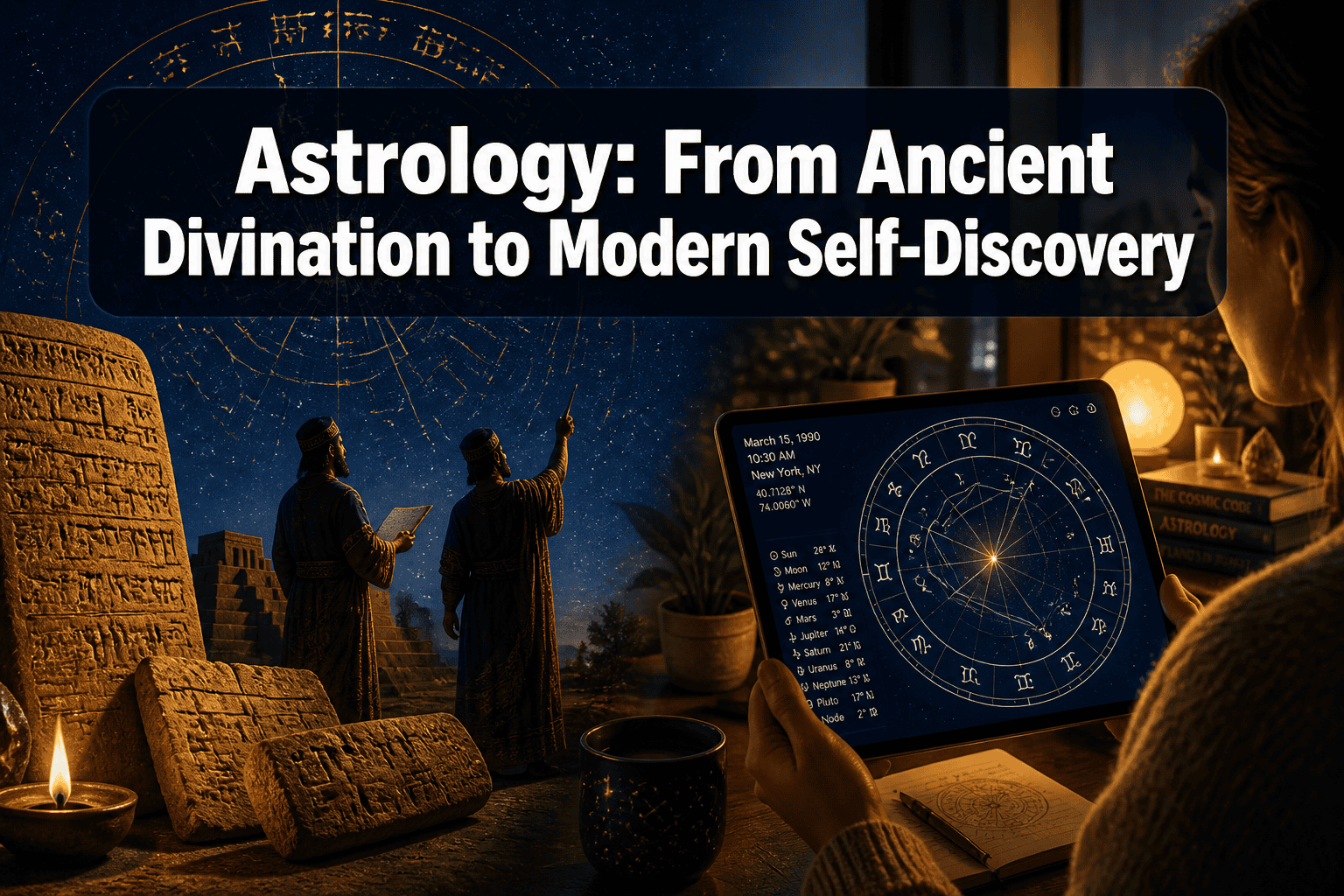
Astrology is a symbolic system that interprets the positions and movements of celestial bodies — the Sun, Moon, and planets — as meaningful reflections of human experience and personality. It originated in ancient Mesopotamia around the second millennium B.C. and has evolved from a royal divination tool into a widely used framework for self-awareness, psychological insight, and personal growth. Astrology is not a science, but it functions as a rich symbolic language that millions of people use to better understand themselves and the world around them.
- Key Takeaways
- What Is the Astrology Definition and Meaning, Exactly?
- Where Did Astrology Come From? A Look at Its Ancient Roots
- How Does a Birth Chart Work? The Core Components Explained
- Astrology vs. Astronomy: What's the Actual Difference?
- Why Is Astrology Experiencing a Major Cultural Comeback in 2026?
- How Is Astrology Used as a Self-Discovery Tool Today?
- What Are the Most Common Misconceptions About Astrology's Definition and Meaning?
- FAQ: Astrology Definition and Meaning — Common Questions Answered
- Conclusion: Actionable Next Steps for Exploring Astrology
- References
Key Takeaways
- Astrology’s core definition: A system that assigns symbolic meaning to planetary positions and their relationship to human life — distinct from astronomy, which studies the physical universe.
- Ancient origins: Astrology began in Mesopotamia around 2000 B.C. and gave rise to the Western zodiac, a 12-sign system tied to the Sun’s yearly path through the sky. [4]
- Not the same as astronomy: Astronomy explains how celestial bodies move; astrology interprets what those movements mean symbolically.
- Three key chart components: Sun sign (core identity), Moon sign (emotional nature), and Rising sign (outward persona) form the foundation of any birth chart reading.
- 2026 is a pivotal year: Saturn entered Aries on February 13, 2026, and Neptune re-entered Aries on January 26, 2026 — a generational shift not seen for thousands of years. [1][2]
- Cultural shift underway: Gen Z and younger millennials are using astrology as a language for identity and psychological grounding, not just entertainment. [3]
- Astrology is for self-reflection: It works best as a tool for asking better questions about yourself, not as a fixed prediction system.
- The birth chart is the map: Your natal chart captures the sky at the exact moment of your birth and serves as a personal blueprint for exploration.
What Is the Astrology Definition and Meaning, Exactly?
Astrology is the study of how the positions of the Sun, Moon, and planets at a given moment in time carry symbolic meaning for human beings and earthly events. It is not a science in the empirical sense — it does not make falsifiable predictions about the physical world. Instead, it operates as a symbolic language, one that has been refined over thousands of years across multiple cultures.
The word itself comes from the Greek astrologia, combining astron (star) and logia (study of). But the practice predates the Greeks by centuries. Astronomers in ancient Mesopotamia were the first to systematically track planetary movements, initially to mark agricultural seasons and later to interpret omens for kings and kingdoms. [4]
What astrology is:
- A symbolic framework for understanding personality, timing, and life themes
- A tool for self-reflection and psychological exploration
- A cultural and philosophical tradition with deep historical roots
What astrology is not:
- A branch of science (it cannot be tested the way physics or chemistry can)
- A fixed fortune-telling system that predicts specific events with certainty
- A replacement for medical, psychological, or financial advice
💡 “Astrology works best when treated as a mirror, not a map — it reflects patterns worth examining, not a predetermined destiny.”
Where Did Astrology Come From? A Look at Its Ancient Roots
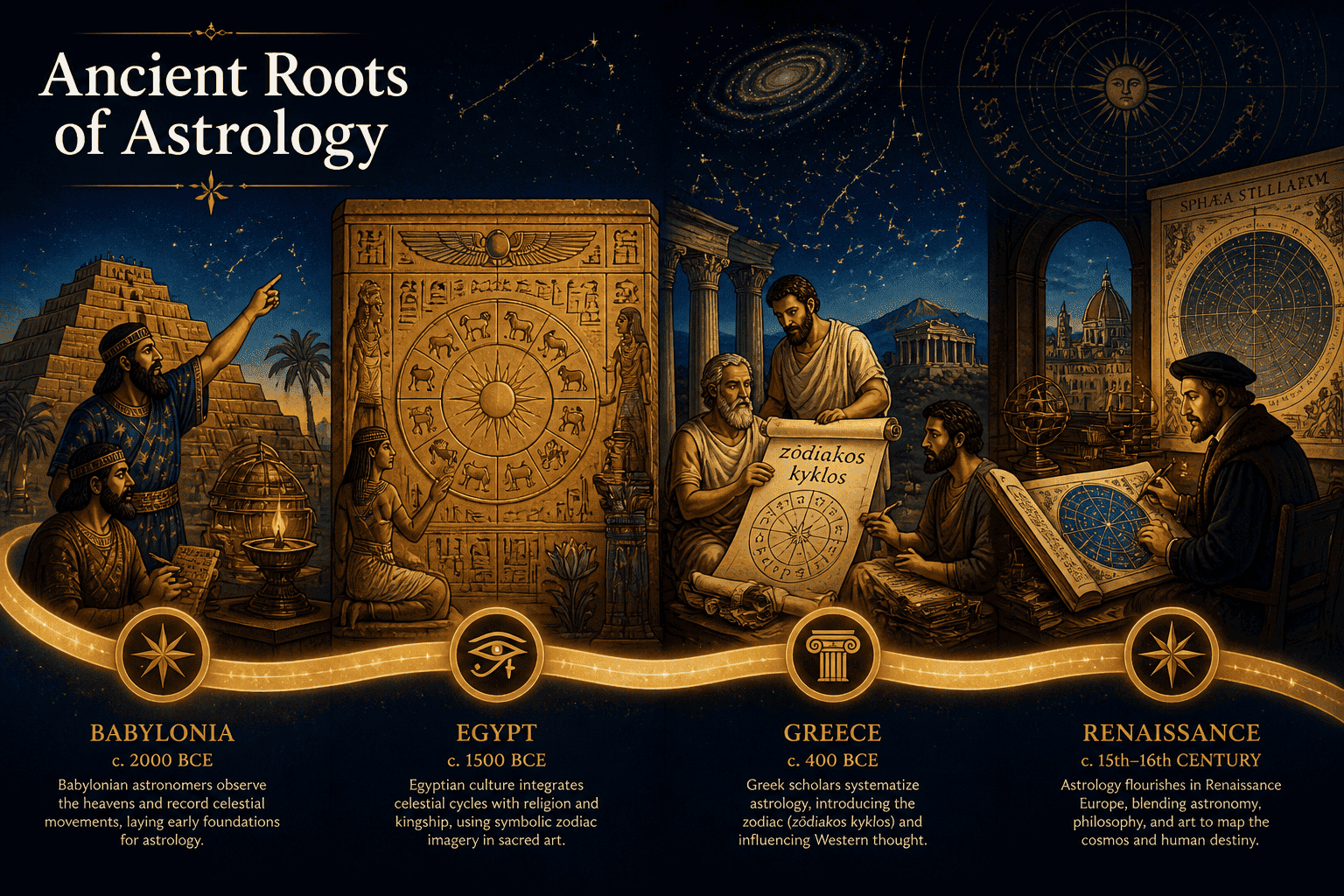
Astrology originated in ancient Mesopotamia in the second millennium B.C., where Babylonian astronomers tracked the movements of planets to interpret signs for rulers and nations. [4] These early practitioners weren’t separating what we now call astronomy from astrology — both were part of the same sacred knowledge system.
From Mesopotamia, astrological ideas spread to Egypt, Greece, and eventually Rome. The Greeks formalized the 12-sign zodiac system — derived from the phrase zōdiakos kyklos, meaning “circle of animals” — by mapping the Sun’s apparent path through the sky (the ecliptic) against 12 constellations. [4] Each sign was assigned qualities, ruling planets, and symbolic meanings that have remained largely consistent for over two millennia.
Key milestones in astrology’s history:
| Era | Development |
|---|---|
| ~2000 B.C. | Babylonian sky-watching and omen interpretation |
| ~400 B.C. | Greek zodiac formalized; horoscopic astrology emerges |
| ~100 A.D. | Ptolemy’s Tetrabiblos codifies Western astrology |
| Medieval period | Astrology taught in European universities alongside medicine |
| 17th century | Astronomy splits from astrology as a separate scientific discipline |
| 20th–21st century | Psychological astrology rises; pop culture and digital platforms expand its reach |
The split between astronomy and astrology became definitive during the Scientific Revolution. Astronomy moved toward explaining the physical properties of space — gravitational laws, orbital mechanics, axial tilt. Astrology retained the symbolic dimension: what do these movements mean for human beings? [4]
For a deeper look at how astrology’s foundational concepts apply today, the astrology basics guide at Youstro is a solid starting point.
How Does a Birth Chart Work? The Core Components Explained
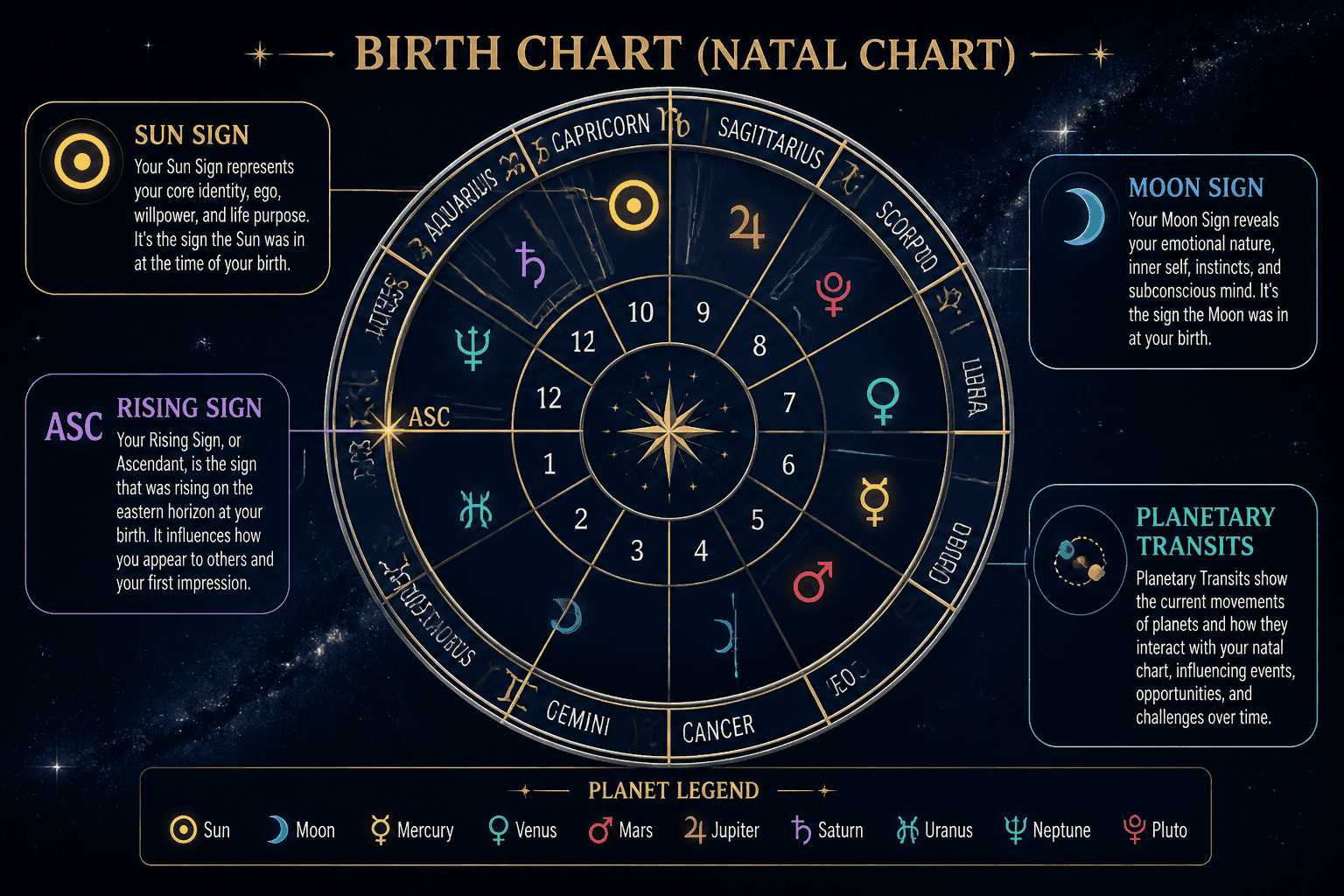
A birth chart (also called a natal chart) is a snapshot of the sky at the exact moment and location of a person’s birth. It serves as the primary tool in personal astrology and contains three foundational layers that most people encounter first.
The three core placements:
Sun Sign — The sign the Sun occupied on your birthday. This represents your core identity, ego, and life purpose. It’s what most people refer to when they say “I’m a Scorpio” or “I’m a Gemini.”
Moon Sign — The sign the Moon occupied at your birth. This governs emotional nature, instincts, and how you process feelings. The Moon changes signs roughly every 2.5 days, making it more personal than the Sun sign.
Rising Sign (Ascendant) — The zodiac sign that was rising on the eastern horizon at your birth time. This shapes your outward personality, first impressions, and physical appearance.
Beyond these three, a full chart includes 10 planets, 12 houses, and the aspects (angular relationships) between planets. Each layer adds nuance.
For example, someone with a Libra Sun, Scorpio Moon, and Aries Rising will express their Libra desire for harmony through an emotionally intense Scorpio inner world, while projecting a bold, direct Aries energy to the world. These combinations make every chart unique.
To explore how the 12 houses map out different life areas in your chart, see this detailed guide on the 12 astrological houses explained.
If you’re brand new to reading your own chart, the beginner’s guide to birth charts and natal placements breaks down each component clearly.
Astrology vs. Astronomy: What’s the Actual Difference?
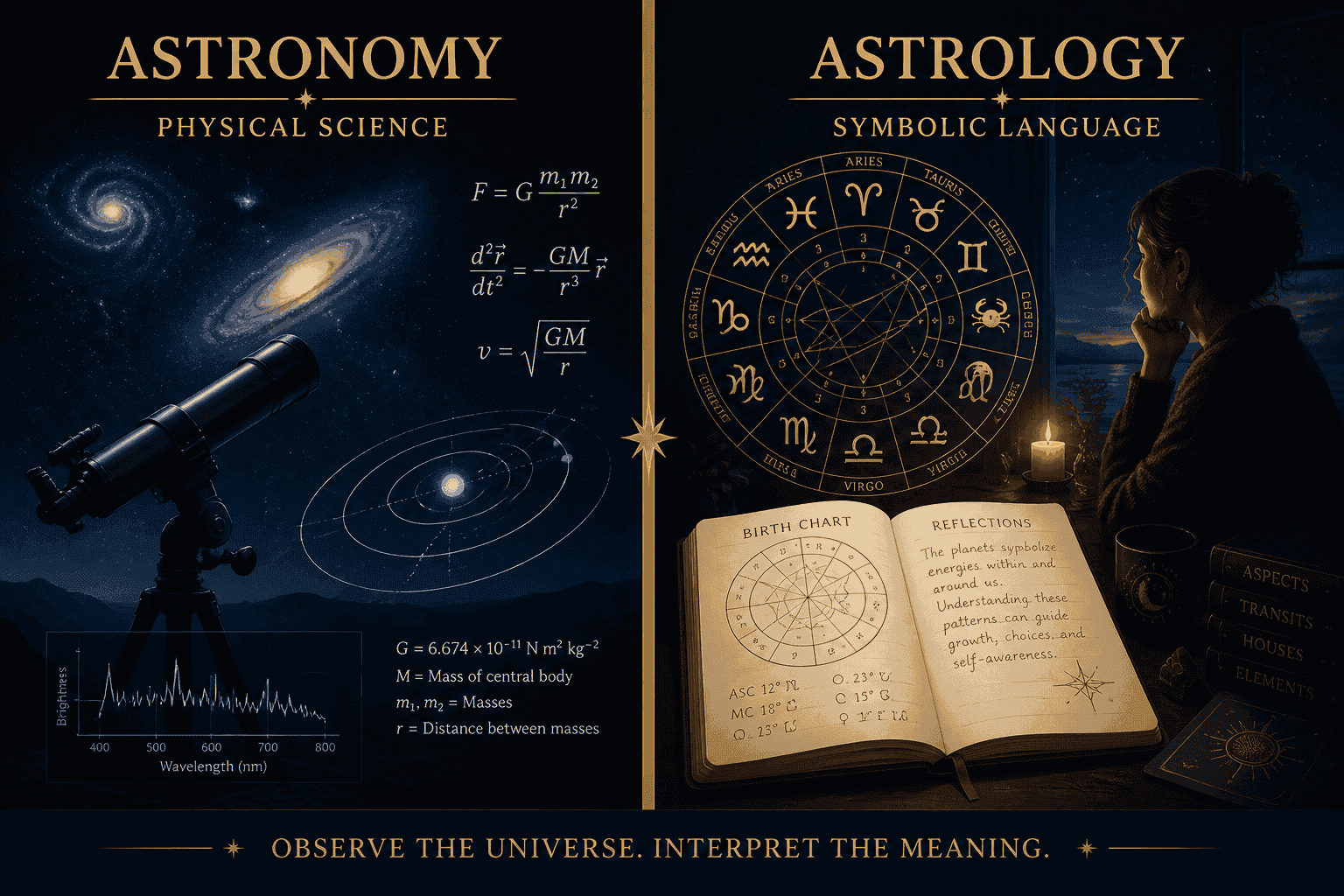
Astronomy and astrology share the same ancient roots but diverged into very different disciplines. Astronomy is a natural science: it studies the physical properties, movements, and origins of celestial objects using mathematics, physics, and observation. Astrology assigns symbolic meaning to those same movements and interprets them in relation to human experience. [4]
A quick comparison:
| Feature | Astronomy | Astrology |
|---|---|---|
| Type of discipline | Natural science | Symbolic/interpretive system |
| Core question | How do celestial bodies move and why? | What do those movements mean for us? |
| Method | Observation, measurement, hypothesis | Interpretation, chart analysis, tradition |
| Verifiability | Empirically testable | Not empirically falsifiable |
| Goal | Understand the physical universe | Understand human experience symbolically |
Common mistake: Many people assume that because astrology uses real planetary positions, it must make scientifically valid predictions. It doesn’t — and that’s okay. Astrology’s value lies in its symbolic framework, not in predicting stock prices or election outcomes.
Choose astrology if you’re looking for a reflective tool for self-understanding, timing awareness, or exploring personality patterns.
Choose astronomy if you want to understand the physical cosmos, study space science, or track celestial events with precision.
The two can coexist. Knowing that Saturn entered Aries on February 13, 2026 [2] is an astronomical fact. What that transit means for themes of discipline, identity, and new beginnings — that’s astrology’s territory.
Why Is Astrology Experiencing a Major Cultural Comeback in 2026?
Astrology is more culturally visible in 2026 than at any point in recent decades. Gen Z and younger millennials are approaching it not as entertainment but as a language for understanding identity at a deeper level. [3] Several forces are driving this shift.
Key reasons for astrology’s resurgence:
- Psychological framing: Modern astrology borrows heavily from Jungian psychology. Concepts like the shadow self, archetypes, and the unconscious map naturally onto astrological symbols.
- Digital accessibility: Apps, social media, and platforms like Youstro have made birth chart interpretation available to anyone with a smartphone.
- Identity exploration: In an era of rapid social change, astrology offers a structured vocabulary for discussing personality, values, and emotional patterns.
- Luxury and mainstream culture: Brands are now using astrological symbolism in product storytelling and marketing campaigns, signaling astrology’s move into mainstream commercial culture. [3]
2026 also carries significant astrological weight. Numerologically, 2+0+2+6 = 10 = 1, making this a “Year One” — a marker of new beginnings. [1] Astronomically and astrologically, both Neptune (re-entering Aries on January 26, 2026, for the first time in roughly 165 years) and Saturn (entering Aries on February 13, 2026) have shifted into the same sign simultaneously — an event astrologers describe as a “genesis moment.” [1][2]
Neptune will remain in Aries until 2038–2039, spending approximately 14 years in each sign. [2] The shift from Pisces to Aries marks what some astrologers call a “cosmic fissure”: an ending and a beginning happening at once, bringing spiritual insight alongside uncertainty. [1]
For those curious about what these transits mean specifically, the Saturn in Aries 2026 transit guide and Uranus enters Gemini in 2026 offer detailed breakdowns.
How Is Astrology Used as a Self-Discovery Tool Today?
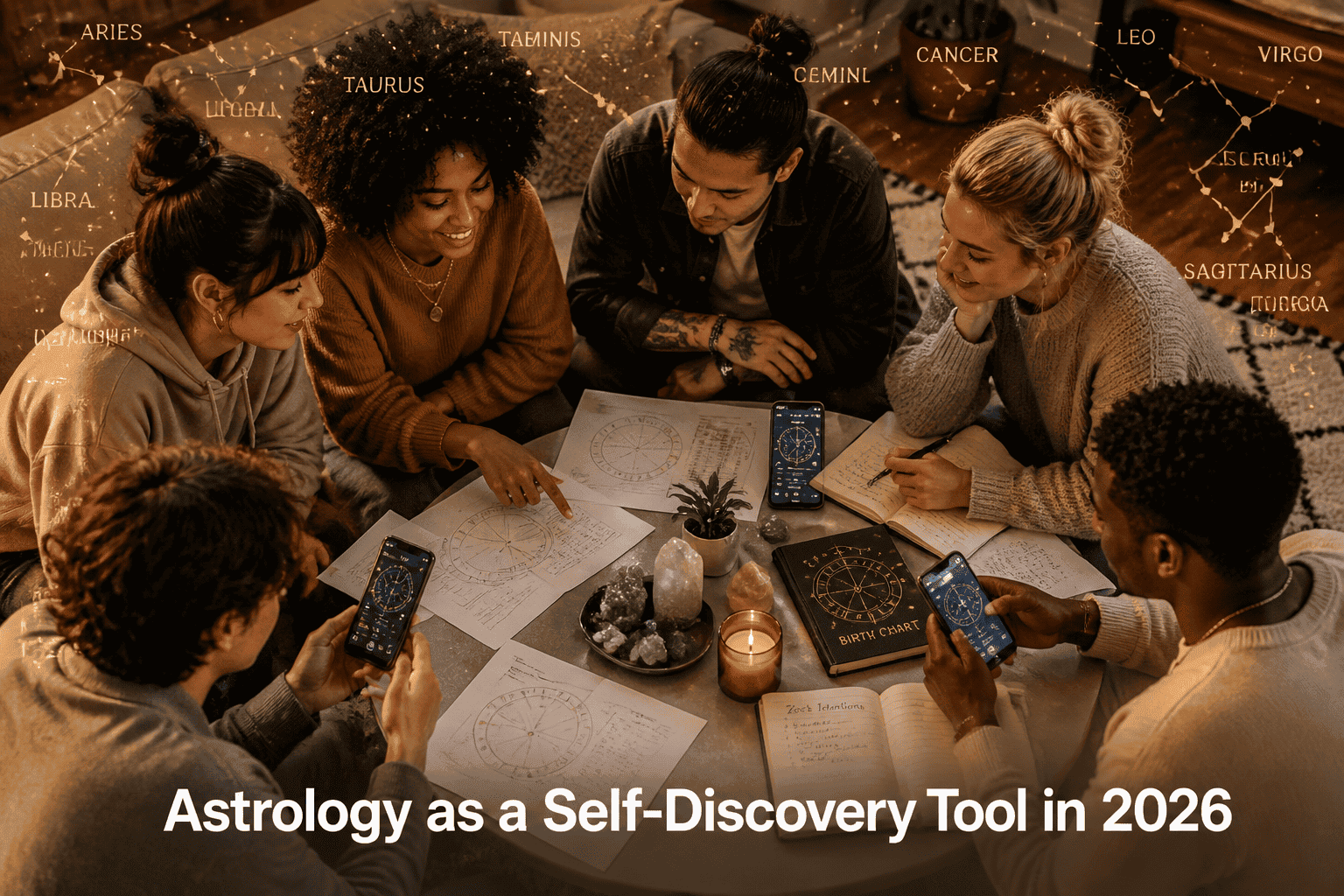
Astrology functions as a self-discovery tool by giving people a structured way to examine their own patterns, motivations, and blind spots. It’s most useful not as a prediction engine but as a reflective framework — a set of questions dressed in symbolic language.
Practical ways people use astrology for self-discovery:
- Identifying core strengths and challenges through Sun, Moon, and Rising sign analysis
- Understanding relationship dynamics by comparing birth charts (a practice called synastry)
- Tracking emotional cycles using the Moon’s monthly journey through the zodiac
- Timing decisions around planetary transits — for example, avoiding major launches during Mercury retrograde or using Jupiter transits to expand
- Exploring career themes through the Midheaven and 10th house placements
💡 Astrology doesn’t tell you what to do. It tells you what energies are in play — and invites you to decide how to work with them.
For relationship-focused applications, natal astrology vs. synastry explains how personal charts and compatibility charts work together. Those interested in romantic timing in 2026 can also explore the best dates for love in 2026.
Who benefits most from astrology as a self-discovery tool:
- People in transitional life phases (career changes, relationship shifts, identity questions)
- Those who enjoy symbolic and narrative frameworks for self-reflection
- Anyone curious about psychology who wants an accessible entry point
Who may find it less useful:
- Those seeking concrete, empirically verifiable answers
- People who prefer purely data-driven decision-making frameworks
What Are the Most Common Misconceptions About Astrology’s Definition and Meaning?
Several persistent misunderstandings get in the way of understanding what astrology actually is and what it can reasonably offer.
Misconception 1: “Your Sun sign is your whole chart.” The Sun sign is one placement among dozens. A full birth chart includes the Moon, Rising sign, 8 other planets, 12 houses, and multiple aspects. Reducing astrology to Sun signs is like judging a book by its first sentence.
Misconception 2: “Astrology claims to predict the future with certainty.” Serious astrologers describe transits and cycles as themes and tendencies, not guaranteed outcomes. Free will, context, and individual circumstances all shape how a transit manifests.
Misconception 3: “Astrology and astronomy are the same thing.” They share historical roots but are now entirely separate. Astronomy is a science; astrology is a symbolic interpretive system. [4]
Misconception 4: “Astrology is only for spiritual or New Age people.” In 2026, astrology is used by therapists as a conversation tool, by brands for storytelling [3], by writers for character development, and by millions of people with no particular spiritual affiliation.
Misconception 5: “Mercury retrograde ruins everything.” Mercury retrograde (when Mercury appears to move backward from Earth’s perspective) is associated with communication slowdowns and tech glitches in astrological tradition. But it happens three to four times a year and is better understood as a period for review and reflection, not catastrophe.
FAQ: Astrology Definition and Meaning — Common Questions Answered
Q: What is the simplest definition of astrology? Astrology is a symbolic system that interprets the positions of the Sun, Moon, and planets as meaningful for human personality and experience. It is a reflective tool, not a science.
Q: What’s the difference between Western astrology and Vedic astrology? Western astrology uses the tropical zodiac (based on the seasons and the Sun’s position relative to Earth). Vedic (Jyotish) astrology uses the sidereal zodiac (based on the actual positions of constellations). This creates a roughly 23-degree difference in sign placements between the two systems.
Q: Is astrology a religion? No. Astrology is not a religion and does not require belief in any deity. It is a philosophical and symbolic framework. Some people integrate it with spiritual practice; others use it purely as a psychological tool.
Q: What is a natal chart? A natal chart (birth chart) is a diagram of the sky at the exact moment of your birth. It maps the positions of the Sun, Moon, and planets across the 12 zodiac signs and 12 houses, serving as a personal symbolic blueprint.
Q: Why do some people with the same Sun sign seem so different? Because Sun sign is just one of dozens of chart factors. Two Leos born in different years, at different times of day, will have different Moon signs, Rising signs, and planetary placements — creating very different personalities.
Q: Can astrology predict specific events? Astrology can identify themes and timing windows, but it does not predict specific events with certainty. A Jupiter transit through your 10th house might correlate with career opportunities, but it won’t tell you which job offer to accept or guarantee a promotion.
Q: What does it mean that Saturn and Neptune are both in Aries in 2026? Saturn entered Aries on February 13, 2026, and Neptune re-entered Aries on January 26, 2026 — both for the first time in generations. [1][2] Astrologers interpret this as a period of restructuring identity, dissolving old frameworks, and building new foundations. It’s considered one of the most significant astrological shifts of the 21st century.
Q: Is astrology the same as horoscopes in magazines? Not exactly. Newspaper and magazine horoscopes are simplified Sun-sign forecasts written for mass audiences. They represent a very surface-level application of astrology. Full astrological practice involves complete birth chart analysis, transit tracking, and nuanced interpretation.
Q: How do I get started with astrology? Start by pulling your free birth chart (you’ll need your birth date, time, and location). Identify your Sun, Moon, and Rising signs. Then explore what each placement means before diving into planets and houses.
Conclusion: Actionable Next Steps for Exploring Astrology
Astrology’s definition and meaning has never been static. It began as a royal divination tool in ancient Mesopotamia, became a cornerstone of Greek and Roman intellectual life, survived centuries of skepticism, and has re-emerged in 2026 as one of the most widely engaged symbolic systems on the planet. [1][3][4]
Whether someone approaches it as a psychological mirror, a cultural tradition, or simply a curious framework for self-reflection, astrology offers something genuinely useful: a structured way to ask better questions about who you are and what you value.
Here’s how to start:
- Pull your free birth chart. Use your birth date, time, and location. Many free tools are available online.
- Learn your Big Three. Sun sign, Moon sign, and Rising sign are the foundation. Understand what each represents before going deeper.
- Explore the 12 houses. Each house governs a different life area — from identity to relationships to career. The 12 astrological houses guide is a great next step.
- Track current transits. In 2026, Saturn and Neptune in Aries, Uranus in Gemini, and Jupiter’s movements are all shaping collective themes. [1][2] Following planetary transits adds a real-time dimension to your practice.
- Use it as a reflective tool, not a rulebook. The best use of astrology is asking “what might this mean for me?” — not “what will happen to me?”
Astrology doesn’t require belief in fate. It requires curiosity about yourself. And that’s a quality worth cultivating in any year — especially one as astrologically charged as 2026.
References
[1] The Astrology Of 2026 A Powerful New Start And Reset – https://soulguidedcoach.com/the-astrology-of-2026-a-powerful-new-start-and-reset/
[2] The 7 Major Shifts Happening In 2026 – https://www.chani.com/blogs/the-7-major-shifts-happening-in-2026
[3] Cultural Astrology Trends For 2026 – https://www.belindamatwali.com/blog/cultural-astrology-trends-for-2026
[4] Whats Written In The Stars For 2026 A Guide To Astrology And The Possibilities Of The Zodiac – https://www.catlinspeak.com/speak/whats-written-in-the-stars-for-2026-a-guide-to-astrology-and-the-possibilities-of-the-zodiac