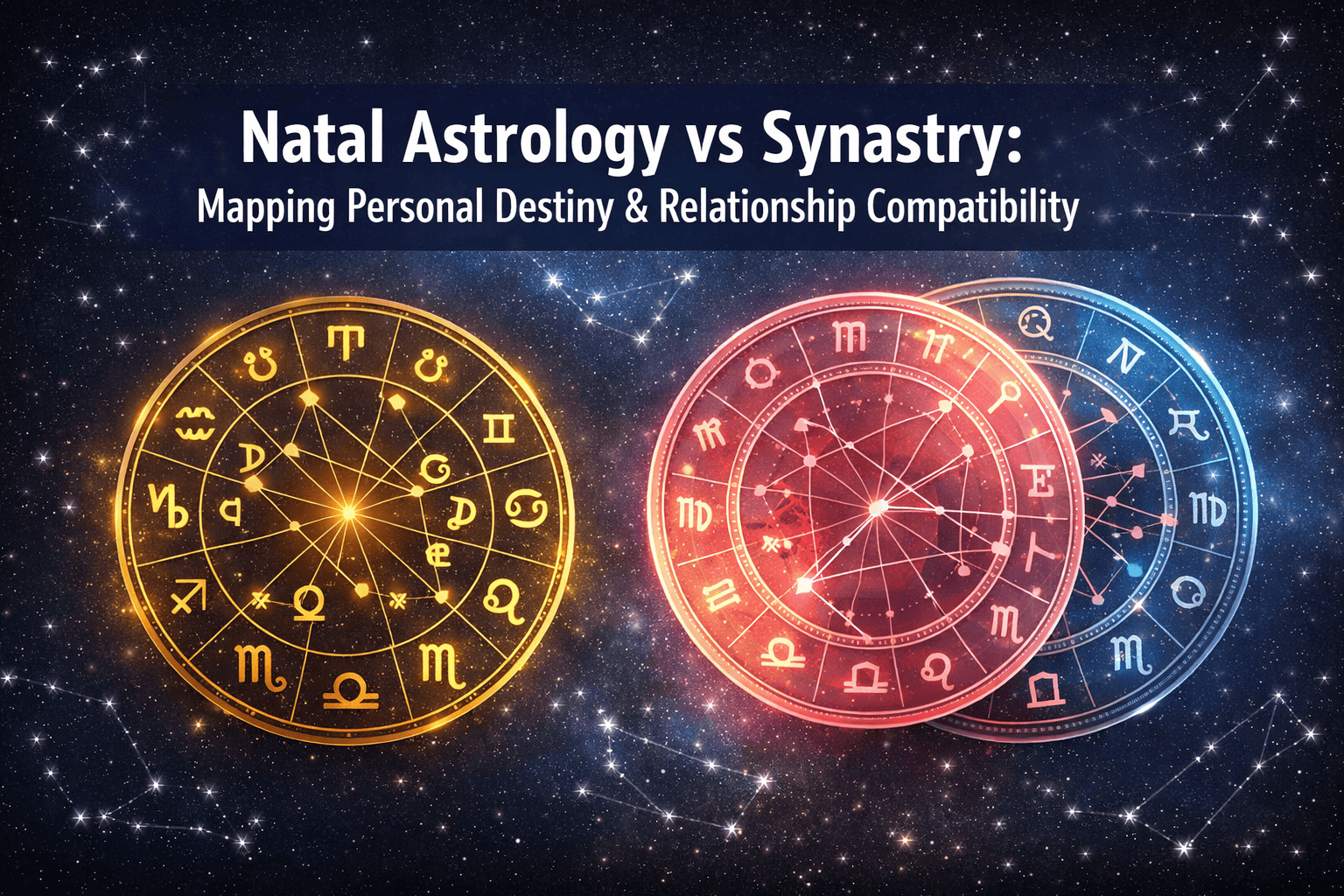
Natal astrology uses a single birth chart to map one person’s personality, strengths, and life path. Synastry compares two birth charts side by side to reveal how two people interact, clash, and connect romantically or platonically. Both tools are valuable, but they answer different questions: natal astrology asks who are you?, while synastry asks how do you work together?
- Key Takeaways
- What Is Natal Astrology and What Does a Birth Chart Show?
- What Is Synastry and How Does Relationship Compatibility Work?
- Natal Astrology vs Synastry: Mapping Personal Destiny and Relationship Compatibility for Beginners — Core Differences Explained
- How Do You Read a Natal Chart as a Beginner? Step-by-Step
- How Do You Run a Synastry Reading for Two People?
- Natal Astrology vs Synastry: Mapping Personal Destiny and Relationship Compatibility for Beginners — Common Mistakes to Avoid
- FAQ: Natal Astrology vs Synastry for Beginners
- Conclusion: Your Next Steps in Natal and Synastry Astrology
- References
Key Takeaways
- 🌟 A natal chart is a snapshot of the sky at your exact birth moment — it describes your core personality, emotional needs, and life themes.
- 💑 Synastry overlays two natal charts to show where two people’s energies align, tension, or complement each other.
- 🔑 Both techniques use the same raw ingredients (planets, signs, houses, aspects) but apply them differently.
- 📍 Free tools like astro.com let beginners generate both natal and synastry charts at no cost.
- ⚖️ Neither chart type is “better” — they serve different purposes and work best together.
- 🪐 Key planets to watch in synastry: Venus (attraction), Mars (drive and desire), Moon (emotional bonding), and Saturn (long-term commitment).
- 📚 Beginners should master their own natal chart first before jumping into synastry readings.
- 🔄 Synastry is not a compatibility verdict — it shows dynamics, not destiny.
- 🌙 Understanding your Moon sign vs Sun sign is a great first step before reading any synastry.
What Is Natal Astrology and What Does a Birth Chart Show?
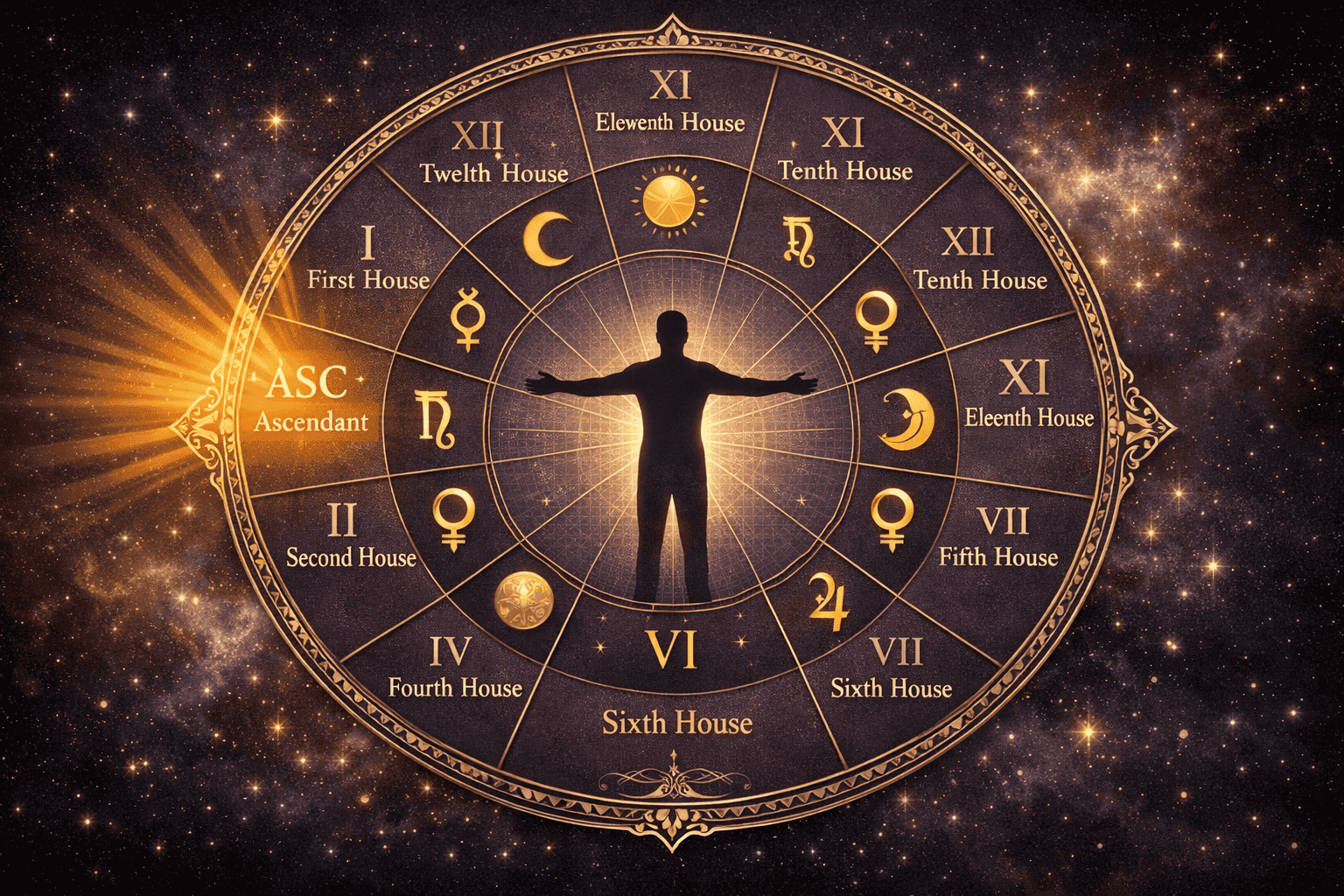
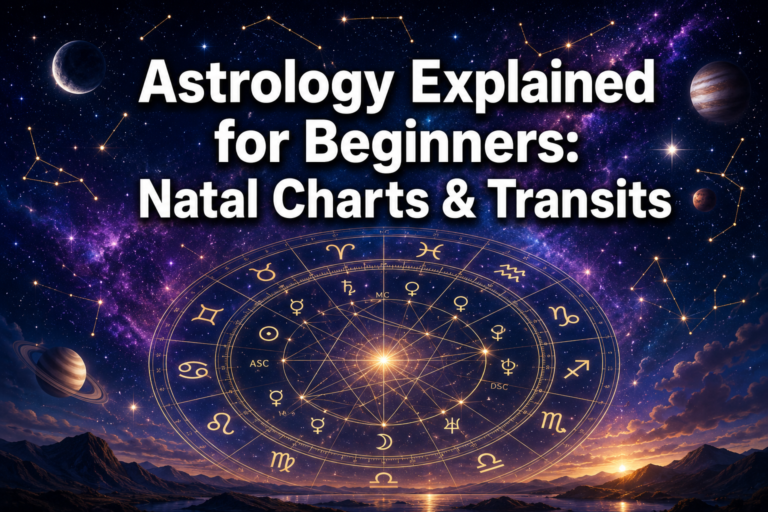
Natal astrology is the study of a person’s birth chart — a circular map of exactly where every planet sat in the sky the moment you were born. It covers personality, emotional patterns, communication style, career tendencies, and major life themes.
A natal chart is divided into:
- 12 houses — areas of life (relationships, career, home, finances, etc.)
- 12 zodiac signs — the quality or style of energy
- 10+ planets — the what (Sun = identity, Moon = emotions, Venus = love style, etc.)
- Aspects — the angles between planets, showing how they interact within your own chart
The three most important starting points for beginners:
| Placement | What It Represents |
|---|---|
| Sun Sign | Core identity and ego expression |
| Moon Sign | Emotional needs and instincts |
| Rising Sign (Ascendant) | How others see you; your outer personality |
💬 “Your natal chart doesn’t tell you what will happen — it shows you the terrain you’re working with.”
For a thorough walkthrough of these placements, the beginner’s guide to birth charts and natal placements is an excellent starting point. You can also explore the full astrology basics library for foundational concepts.
Common mistake: Many beginners stop at their Sun sign and assume that’s the whole chart. In reality, your Sun sign is just one of dozens of placements. Someone with a Scorpio Sun and a Libra Moon will behave very differently from a Scorpio Sun with an Aries Moon.
What Is Synastry and How Does Relationship Compatibility Work?
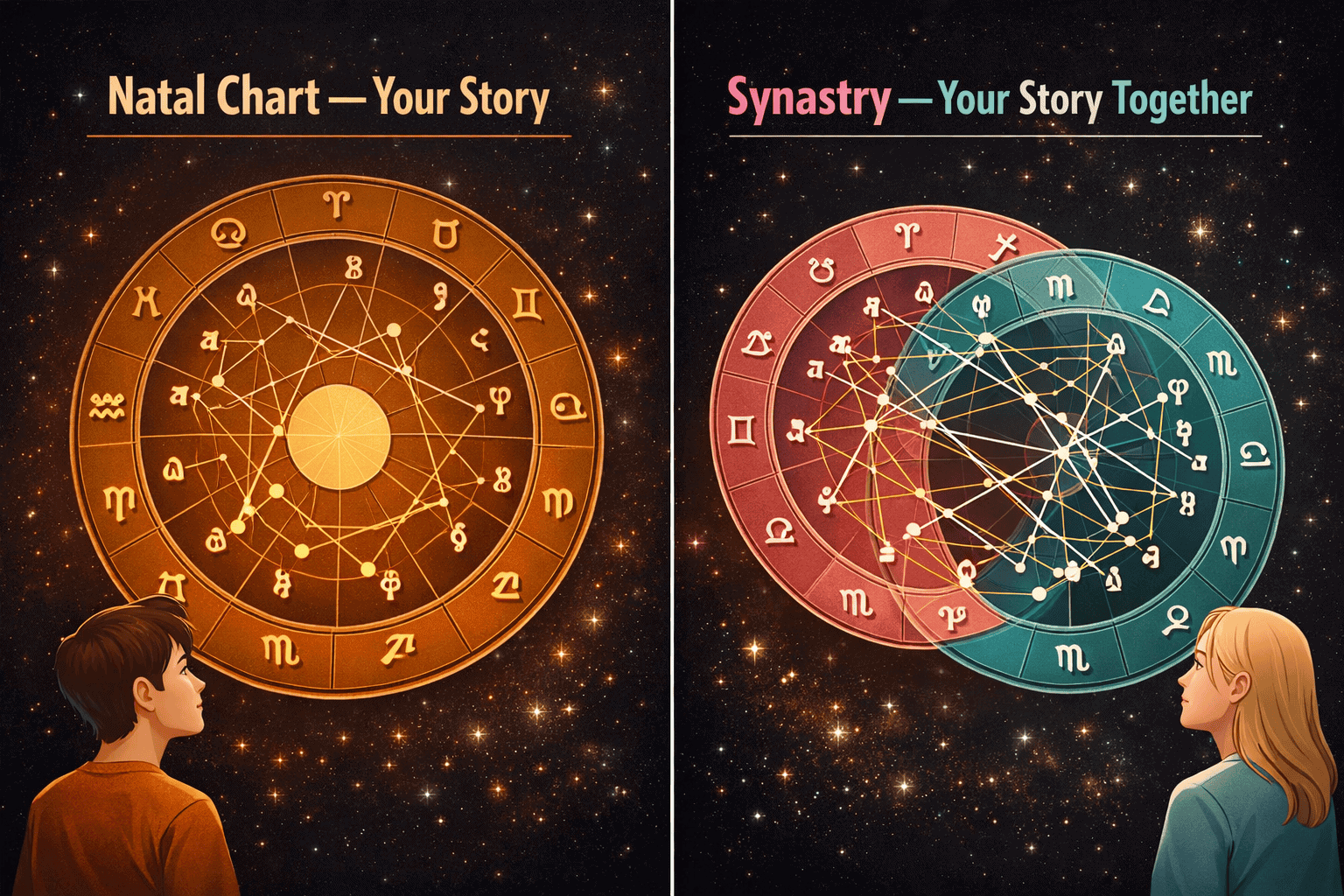
Synastry is the practice of comparing two birth charts to understand how two people relate to each other. It’s one of the most popular tools in relationship astrology, used for romantic partners, close friends, family members, and even business partnerships.
In a synastry reading, an astrologer (or a free tool like astro.com) places both charts on the same wheel and draws lines — called aspects — between the planets of Person A and the planets of Person B.
Key synastry aspects to know:
- Conjunction (0°): Planets merge energy — intense, can be magnetic or overwhelming
- Trine (120°): Easy, flowing connection — natural harmony
- Sextile (60°): Supportive, cooperative energy
- Square (90°): Friction and tension — challenging but growth-producing
- Opposition (180°): Polarity — attraction through difference, but also conflict
The most telling planet overlays in synastry:
- Venus–Mars contacts: Physical attraction and romantic chemistry
- Moon–Moon or Moon–Sun contacts: Emotional understanding and comfort
- Saturn contacts: Long-term potential, but also restriction or duty
- Venus–Jupiter: Joy, generosity, and mutual appreciation
For those curious about how 2026’s planetary activity is affecting relationship dynamics, the Venus Retrograde 2026 guide explains how current transits interact with synastry patterns.
Choose synastry if: You already understand your own natal chart and want to explore a specific relationship dynamic.
Natal Astrology vs Synastry: Mapping Personal Destiny and Relationship Compatibility for Beginners — Core Differences Explained
Understanding Natal Astrology vs Synastry: Mapping Personal Destiny and Relationship Compatibility for Beginners comes down to one key distinction: natal astrology is internal, synastry is relational. Both use the same chart language, but they answer completely different questions.
Here’s a direct comparison:
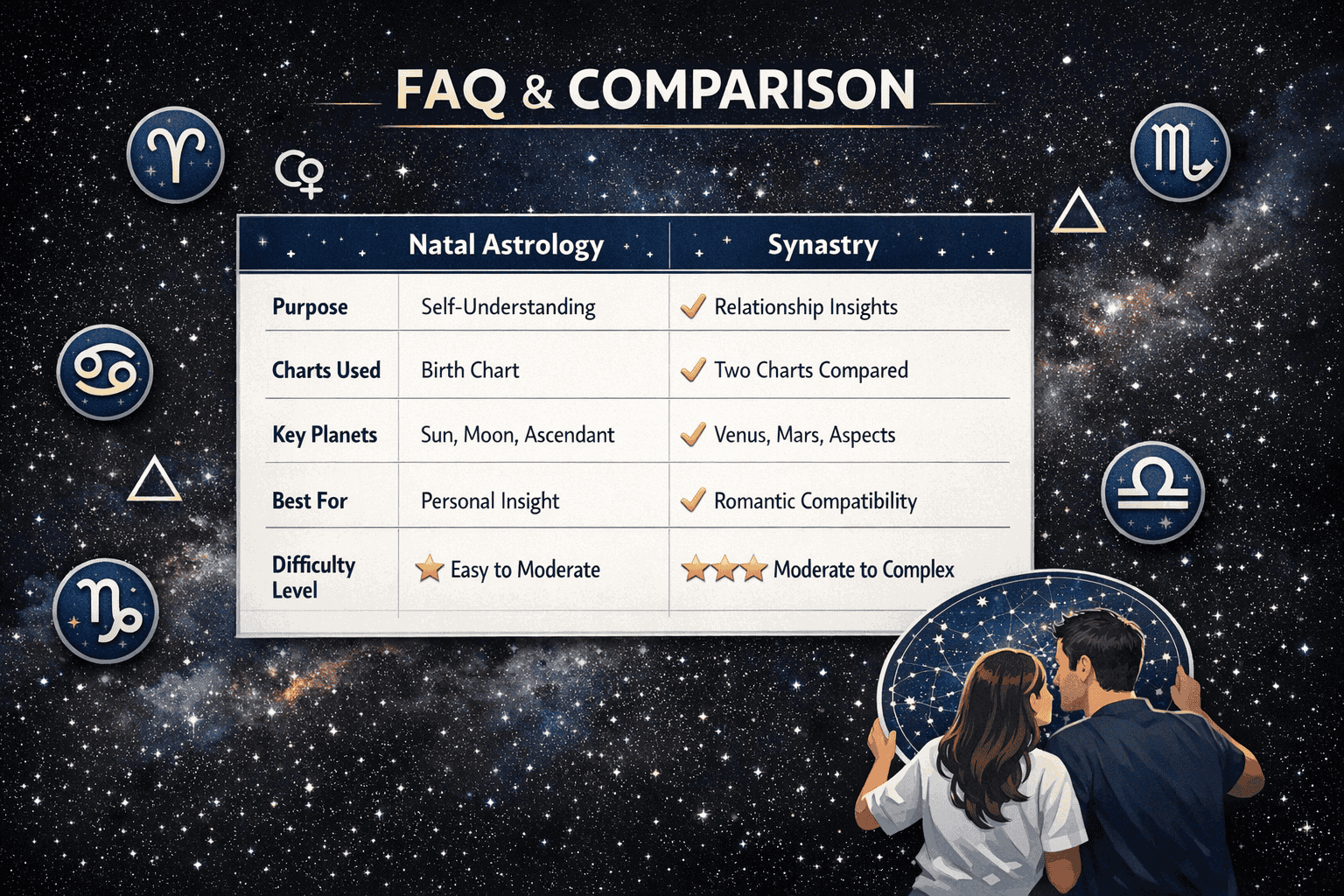
| Feature | Natal Astrology | Synastry |
|---|---|---|
| Charts used | One birth chart | Two birth charts overlaid |
| Primary question | Who am I? | How do we interact? |
| Focus | Individual traits, life path | Relationship dynamics |
| Key technique | House and planet analysis | Inter-chart aspects |
| Best for | Self-understanding, life planning | Romantic/friendship compatibility |
| Difficulty level | Beginner-friendly | Intermediate (requires two charts) |
| Free tool | astro.com natal chart | astro.com synastry chart |
A quick example:
Say Person A has Venus in Gemini (loves variety, witty romance) and Person B has Venus in Scorpio (craves depth and intensity). In their individual natal charts, each person’s Venus describes their own love style. In synastry, an astrologer would look at how Person A’s Venus aspects Person B’s planets — for instance, if Person A’s Venus trines Person B’s Moon, there’s likely emotional warmth and affection flowing naturally between them, even if their Venus signs differ.
This is why reading both charts matters. The natal chart sets the stage; synastry shows the play.
How Do You Read a Natal Chart as a Beginner? Step-by-Step
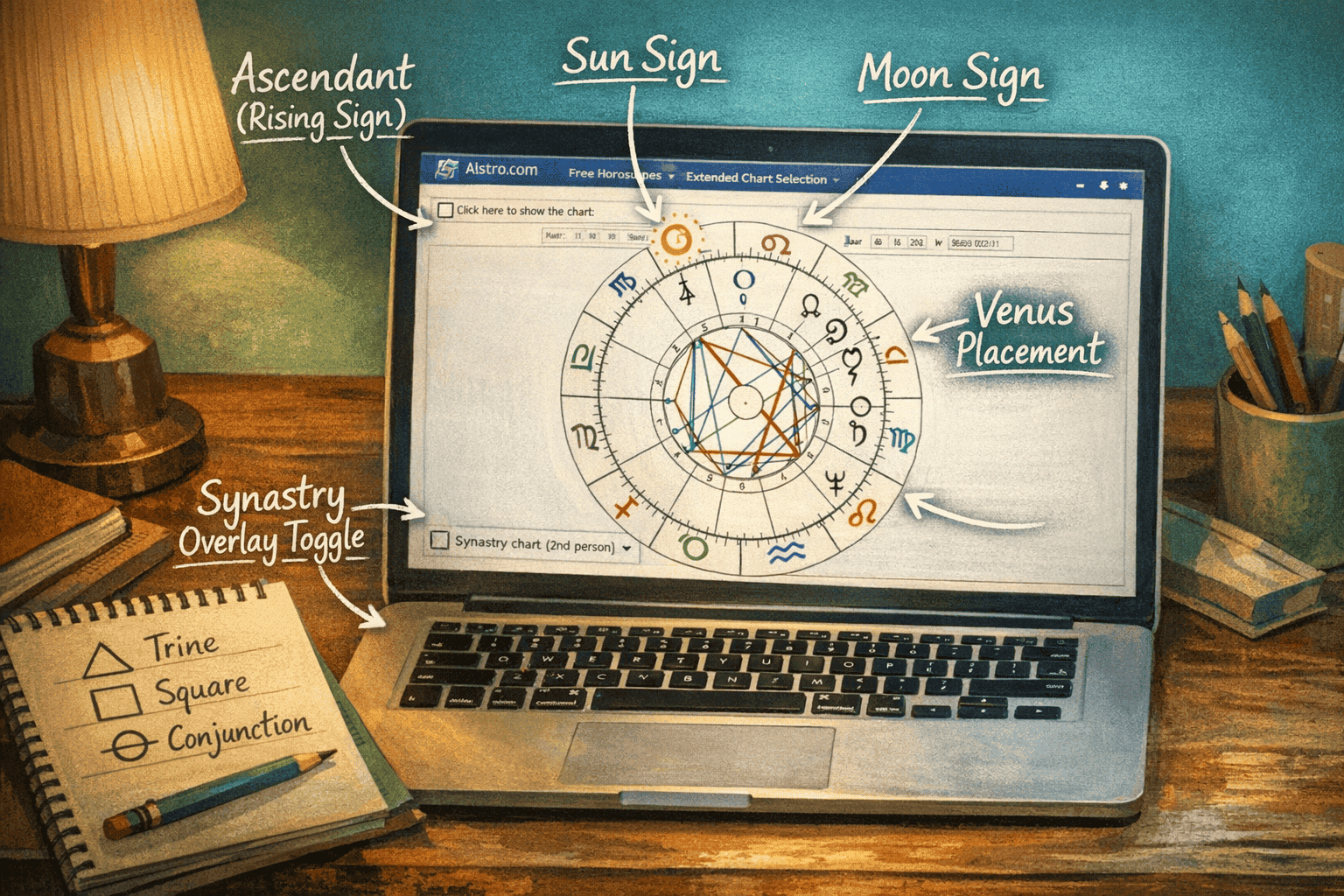
Reading a natal chart for the first time is manageable when broken into clear steps. Start simple, then build complexity over time.
Step 1: Generate your chart Go to astro.com → Extended Chart Selection → enter your birth date, exact time, and city. Download or screenshot the wheel.
Step 2: Find your Big Three Locate your Sun sign, Moon sign, and Rising sign (Ascendant). These three placements form the backbone of your chart interpretation.
Step 3: Note which houses are active Each of the 12 houses covers a life area. If you have several planets in your 7th house (partnerships), relationships will be a major theme in your life.
Step 4: Look at your Venus and Mars
- Venus sign: How you attract and what you value in love
- Mars sign: How you pursue, assert, and express desire
Step 5: Spot major aspects Look for bold lines in the center of your chart wheel. Trines (blue) are easy; squares (red) are challenging. Both are important.
Step 6: Read house cusps The sign on each house cusp adds flavor to that life area. For example, Scorpio on the 2nd house cusp suggests an intense, all-or-nothing approach to finances and self-worth.
For a deeper look at how career destiny shows up in your chart, the Midheaven in your natal chart guide covers the 10th house and MC in detail.
How Do You Run a Synastry Reading for Two People?
Running a synastry comparison follows a similar process to natal chart reading, but adds a second layer of analysis.
Step 1: Generate both natal charts separately Each person needs their birth date, exact birth time, and birth city. Accuracy matters — even a 4-minute difference can shift house cusps.
Step 2: Use a synastry chart tool On astro.com: Extended Chart Selection → Chart type → “Synastry chart.” Enter Person 1 as the main chart and Person 2 as the comparison.
Step 3: Identify the major inter-chart aspects Focus on the aspects between the two charts’ personal planets first (Sun, Moon, Mercury, Venus, Mars). Outer planet aspects (Jupiter through Pluto) add background themes but are less personal.
Step 4: Check house overlays Where do Person B’s planets fall in Person A’s houses? If Person B’s Venus lands in Person A’s 7th house, Person B may feel like an ideal partner to Person A — naturally.
Step 5: Look for Saturn contacts Saturn aspects in synastry often indicate longevity and commitment, but also responsibility and limitation. A Saturn–Venus conjunction can feel stabilizing or restricting depending on other chart factors.
Step 6: Consider the whole picture No single aspect makes or breaks a relationship. A square between Sun signs might create tension, but a Moon–Moon trine can create deep emotional safety. Balance the full chart.
For timing-based insights on when relationship energy peaks in 2026, the best dates for love in 2026 pairs well with synastry work.
Natal Astrology vs Synastry: Mapping Personal Destiny and Relationship Compatibility for Beginners — Common Mistakes to Avoid
Even experienced beginners make predictable errors when first exploring Natal Astrology vs Synastry: Mapping Personal Destiny and Relationship Compatibility for Beginners. Knowing these pitfalls saves a lot of frustration.
Mistake 1: Judging compatibility by Sun signs alone Sun sign compatibility (e.g., “Aries and Libra clash”) is a massive oversimplification. A full synastry reading involves dozens of planetary interactions. Two people with “incompatible” Sun signs may have deeply compatible Moon and Venus placements.
Mistake 2: Treating synastry as a pass/fail test Synastry shows dynamics, not destiny. A chart full of squares doesn’t mean a relationship is doomed — it often means there’s growth and passion. A chart full of trines doesn’t guarantee harmony if both people lack self-awareness.
Mistake 3: Skipping the natal chart Trying to read synastry without understanding each person’s natal chart is like trying to understand a conversation without knowing the speakers. Always read both natal charts first.
Mistake 4: Ignoring the Moon The Moon governs emotional needs and daily comfort. Moon compatibility in synastry is often more telling for long-term relationships than Venus or Sun contacts.
Mistake 5: Using an incorrect birth time House placements and the Ascendant shift every two hours. An unknown birth time makes house-based readings unreliable. Use a “noon chart” as a placeholder, but note its limitations.
For those exploring compatibility beyond astrology, numerology birth date compatibility offers a complementary perspective.
FAQ: Natal Astrology vs Synastry for Beginners
Q: Do I need my exact birth time to get a natal chart? An exact birth time gives the most accurate chart, including your Rising sign and house placements. Without it, you can still get a partial reading using a “solar chart” (Sun on the Ascendant), but house-based interpretations won’t be reliable.
Q: Is synastry only for romantic relationships? No. Synastry works for any two-person relationship — friends, siblings, business partners, parent and child. The planets you focus on may shift (Venus/Mars for romance, Mercury/Saturn for professional dynamics), but the technique is the same.
Q: What’s the difference between synastry and a composite chart? Synastry overlays two separate charts to show how two individuals interact. A composite chart creates a single “relationship chart” by finding the midpoints between both people’s planets — it represents the relationship as its own entity.
Q: Can synastry predict if a relationship will last? No chart can predict outcomes with certainty. Synastry shows potential strengths and challenges. Saturn contacts often correlate with longevity, but free will, timing, and personal growth all play major roles.
Q: Which planets matter most in synastry for romance? Venus (love style and attraction), Mars (desire and drive), Moon (emotional needs), and the Sun (core identity) are the most important for romantic synastry. Saturn adds a long-term lens.
Q: What is a “double whammy” in synastry? A double whammy occurs when the same aspect appears in both directions — for example, Person A’s Venus conjuncts Person B’s Mars AND Person B’s Venus conjuncts Person A’s Mars. These mutual contacts tend to feel especially intense and significant.
Q: Is astro.com really free? Yes. Astro.com offers free natal charts, synastry charts, and composite charts. A paid subscription unlocks additional features, but the core chart tools are free and highly accurate.
Q: Should I learn natal astrology before synastry? Yes, strongly recommended. Understanding your own chart — especially your Moon, Venus, and Mars — makes synastry readings far more meaningful and accurate.
Q: What’s a “good” synastry score? There’s no universal scoring system in traditional astrology. Some software tools assign numerical scores, but most professional astrologers don’t use them. Focus on the quality and nature of key aspects rather than a total score.
Q: How does the current astrology of 2026 affect synastry readings? Transiting planets in 2026 — like Venus Retrograde and major outer planet shifts — can activate dormant synastry aspects between two people, bringing old connections back or testing existing relationships. Timing matters.
Q: Can I do a synastry reading for myself and a celebrity? Technically yes, but it’s more of a fun exercise than a practical one. Without the other person’s actual birth time, accuracy is limited — and the relationship exists only on one side.
Q: What’s the easiest synastry aspect to spot for beginners? Look for conjunctions first — they’re the easiest to identify (two planets within 8 degrees of each other across both charts) and the most immediately felt in the relationship.
Conclusion: Your Next Steps in Natal and Synastry Astrology
The distinction between natal astrology and synastry is simple at its core: one maps who you are, the other maps how you connect. Both are worth learning, and both reward patience and practice.
Actionable next steps for beginners in 2026:
- Generate your natal chart at astro.com using your exact birth date, time, and location.
- Identify your Big Three (Sun, Moon, Rising) and read about each placement separately.
- Study your Venus and Mars placements to understand your love and desire styles.
- Once comfortable, run a synastry chart with someone important to you — a partner, close friend, or family member.
- Focus on Moon contacts first in synastry — they reveal the emotional foundation of any relationship.
- Avoid snap judgments — read the full chart before drawing conclusions about compatibility.
- Use current transits as context — check how 2026’s planetary activity (like the Full Moon in Libra or upcoming Venus Retrograde) might be activating your synastry patterns right now.
Astrology is a language. Natal astrology teaches you your own vocabulary; synastry teaches you how to have a conversation. Start with yourself, and the rest follows naturally.
References
[1] Watch – https://www.youtube.com/watch?v=iL6YF5YGO90 [3] 2026 Astrology Forecast Reality Shifting Transits Karmic Turning Points A New Era Unfolding – https://www.astrologywithheather.com/blog/2026-astrology-forecast-reality-shifting-transits-karmic-turning-points-a-new-era-unfolding [7] This Month In Astrology April 2026 – https://cafeastrology.com/this-month-in-astrology-april-2026/