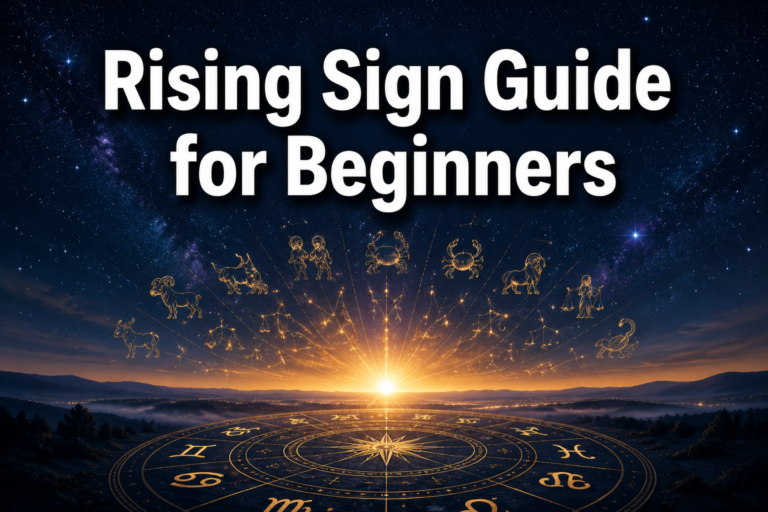
Your rising sign (also called the Ascendant) is the zodiac sign that was on the eastern horizon the moment you were born. It acts as your astrological “mask” — shaping how others see you, how you carry yourself, and how you instinctively approach new situations. Unlike your sun sign, which reflects your core identity, your rising sign governs your outer presentation and sets the entire framework of your birth chart [1].
- Key Takeaways
- What Exactly Is a Rising Sign and How Do You Find Yours
- How Different Is Your Rising Sign from Your Sun Sign
- Can Your Rising Sign Change Over Time or Is It Fixed
- How Much Do Rising Signs Really Impact Your Personality
- What Does Your Rising Sign Mean for Your Career Path
- Which Rising Signs Are Most Compatible in Relationships
- Are Rising Signs Scientific or Just Astrology Pseudoscience
- How Do Rising Signs Differ Between Western and Vedic Astrology
- Can You Have a Good First Impression If Your Rising Sign Isn't Traditionally Charismatic
- What Are the Most Challenging Rising Signs to Have
- How to Calculate Your Rising Sign Without an Exact Birth Time
- What Mistakes Do People Often Make When Interpreting Their Rising Sign
- Which Celebrities Share Your Rising Sign
- FAQ: Rising Signs Explained
- Conclusion: Your Next Steps with Your Rising Sign
- References
Key Takeaways
- 🌅 The rising sign changes roughly every two hours, making your exact birth time essential for accurate calculation [2].
- 🎭 Think of the Ascendant as a mask you wear in public — it’s the first layer of personality others encounter before they know your deeper self [4].
- 🏠 The Ascendant marks the cusp of the first house in your natal chart, anchoring the entire house system [5].
- 🪐 The planet that rules your rising sign is called your chart ruler and adds another layer of nuance to how your Ascendant expresses itself [2].
- 🔍 Rising signs are fixed at birth and do not change over your lifetime.
- 🌍 Western astrology and Vedic astrology both use the Ascendant, but calculate it differently — leading to different rising sign results for the same person [6].
- 💼 Your rising sign influences career style, relationship dynamics, and even physical appearance, not just first impressions [3].
- ❓ If you don’t know your exact birth time, rectification techniques or birth record requests can help narrow it down.
What Exactly Is a Rising Sign and How Do You Find Yours
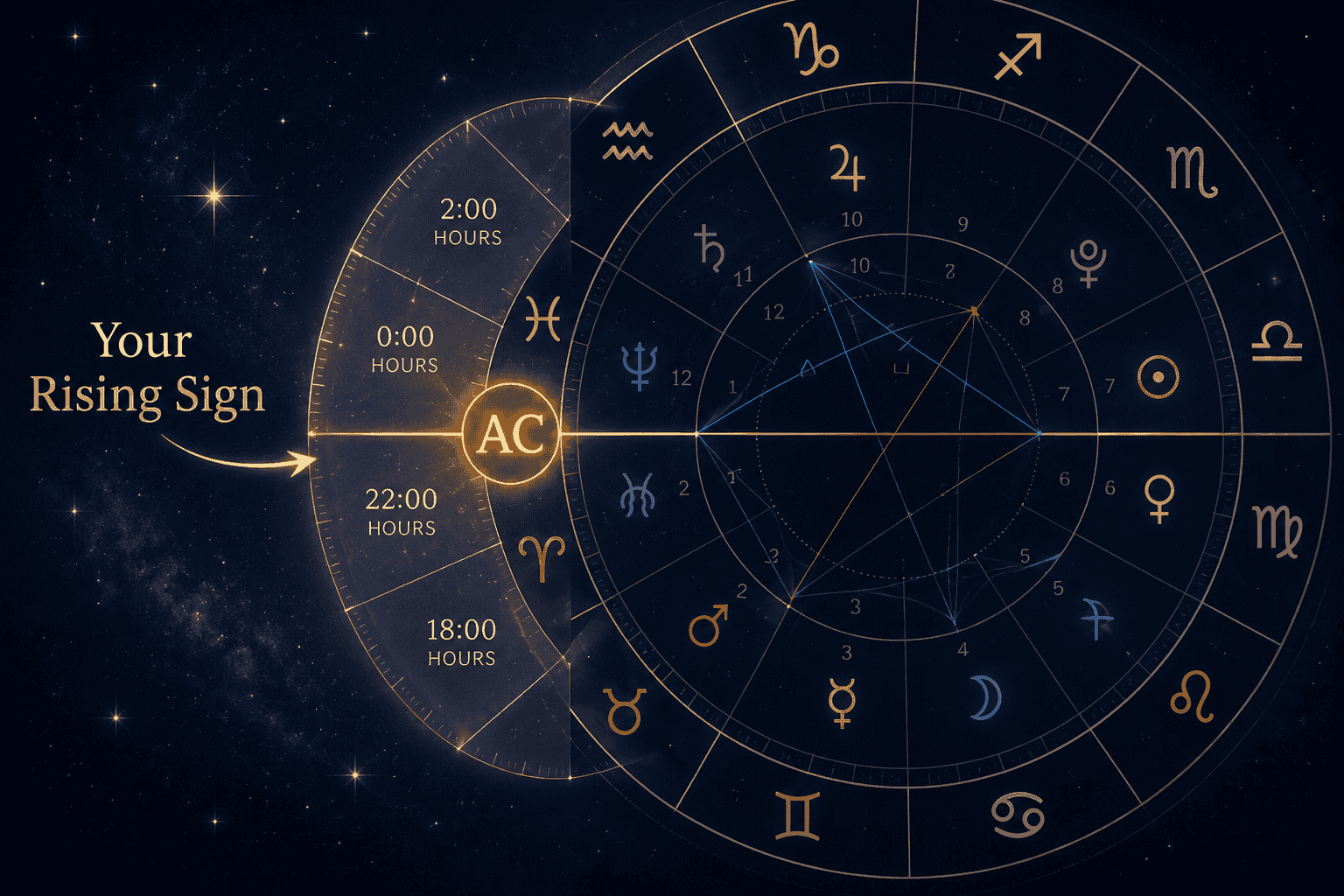
Your rising sign is the zodiac sign that was ascending on the eastern horizon at the exact moment and location of your birth [1]. Because the Earth rotates continuously, a new sign crosses the horizon approximately every two hours, cycling through all 12 signs in roughly 24 hours [2].
To find your rising sign, you need three things:
- Your date of birth
- Your exact time of birth (as precise as possible — even 15 minutes can shift the result)
- Your city or location of birth
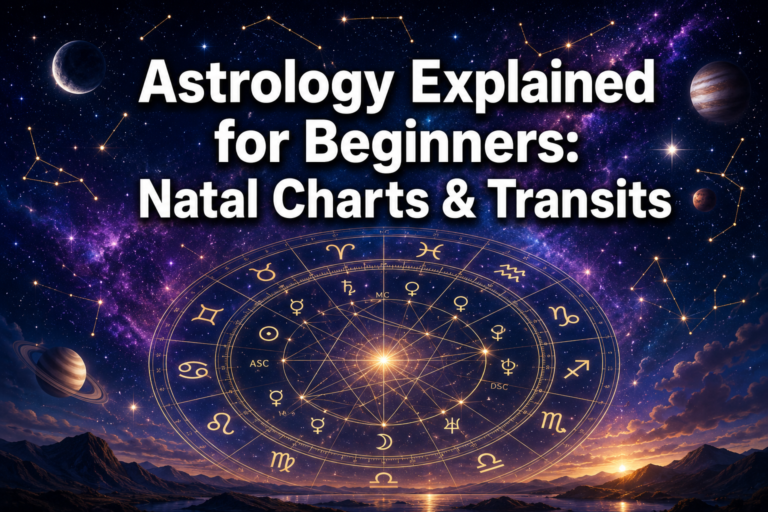
With those details, plug them into a free birth chart calculator (Astro.com and Café Astrology are reliable options). The result will show your Ascendant listed as “AC” or “ASC” on the left-hand side of the chart wheel [5].
💡 Pro tip: Your birth certificate is the most reliable source for birth time. Hospital records, baby books, and family memory can all work too, but accuracy matters here.
If you’re new to reading a birth chart, the beginner’s guide to reading your first birth chart walks through exactly where to find your Ascendant and what the chart layout means.
How Different Is Your Rising Sign from Your Sun Sign
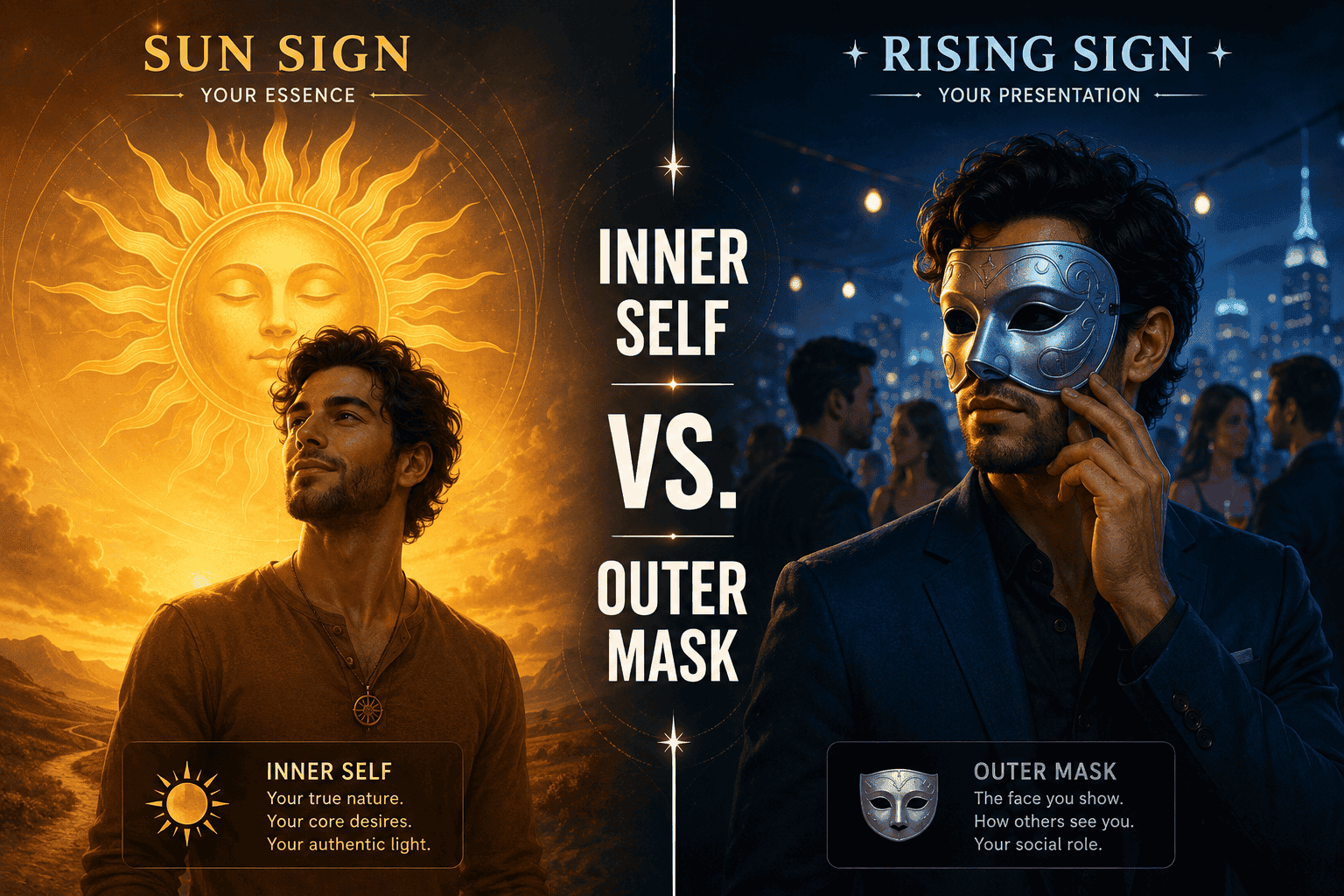
Your sun sign and rising sign describe two very different parts of who you are. The sun sign reflects your core identity, ego, and life purpose — it’s who you are when you’re comfortable and fully yourself. The rising sign is how you present to the world before people get to know you — your social face, your body language, and your instinctive reactions [4].
A useful way to frame it:
| Feature | Sun Sign | Rising Sign |
|---|---|---|
| What it reflects | Inner self, core identity | Outer persona, first impression |
| How it’s calculated | Date of birth only | Date + exact time + location |
| Changes how often | Once per month | Every ~2 hours |
| Visible to others | Over time, in close relationships | Immediately, on first meeting |
| Rules in the chart | Ego and life force | The first house and chart structure |
Someone with a Scorpio sun and Sagittarius rising, for example, may come across as open, adventurous, and easy-going at first — but reveal deeper intensity and complexity as the relationship develops. The sun sign is who you are; the rising sign is who you seem to be.
For a deeper breakdown of all three major placements, the Moon Sign vs Sun Sign vs Rising Sign guide is an excellent companion read.
Can Your Rising Sign Change Over Time or Is It Fixed
Your rising sign is fixed at birth and does not change. Because it’s calculated from the exact moment you were born, it remains the same throughout your life — no transit, progression, or planetary shift alters the sign itself [1].
What can change is how consciously you express it. Many astrologers note that people “grow into” their rising sign over time, especially as they become more self-aware. A shy Aries rising teenager might not display the bold, assertive energy associated with that placement until their twenties or thirties.
Common misconception: Some people confuse progressed charts with the natal chart. In a progressed chart (a predictive technique), the Ascendant does shift slowly over years — but this is a separate forecasting tool, not a change to your birth chart.
How Much Do Rising Signs Really Impact Your Personality
The Ascendant has a measurable influence on personality — particularly in how you initiate contact with the world, respond to new environments, and carry yourself physically [1][3].
Key areas where the rising sign shows up clearly:
- Body language and physical presentation: Aries rising tends toward direct eye contact and quick movements; Taurus rising often projects calm, steady energy; Libra rising frequently displays a natural grace and social ease [3].
- Spontaneous reactions: When something unexpected happens, your rising sign governs your gut response — before your sun sign’s reasoning kicks in.
- Physical appearance: While not deterministic, the rising sign is traditionally associated with certain physical traits and overall “vibe.” Scorpio rising, for instance, is often described as having an intense, penetrating gaze [4].
- First-house themes: Because the Ascendant rules the first house (the house of self), it colors how you approach beginnings — new jobs, new relationships, new cities [5].
🎭 The Ascendant is often called the “mask” of the chart — not because it’s fake, but because it’s the version of you that the world sees first, before they get to the real story underneath.
For a detailed look at one of the most striking rising sign expressions, the article on Scorpio Rising traits and outer persona is worth exploring.
What Does Your Rising Sign Mean for Your Career Path
Your rising sign influences your career style more than most people realize. It shapes how you come across in interviews, how you handle authority, and what kind of work environment feels natural to you [1].
Career tendencies by rising sign element:
- Fire rising (Aries, Leo, Sagittarius): Drawn to leadership, visibility, and roles with autonomy. Thrive in fast-paced, high-stakes environments.
- Earth rising (Taurus, Virgo, Capricorn): Excel in structured roles requiring reliability, precision, and long-term planning.
- Air rising (Gemini, Libra, Aquarius): Natural communicators and connectors; suited to roles in media, law, design, or community-focused work.
- Water rising (Cancer, Scorpio, Pisces): Intuitive and empathetic; often drawn to healing, creative, or behind-the-scenes roles.
The chart ruler (the planet ruling your rising sign) adds further detail. A Gemini rising with Mercury in the 10th house, for example, may find their career strongly tied to communication, writing, or teaching [2].
Career astrology is also shaped by current planetary transits. The 2026 planetary transit guide covers how major shifts this year interact with each rising sign’s career house.
Which Rising Signs Are Most Compatible in Relationships
Rising sign compatibility in relationships works differently than sun sign compatibility. Because the Ascendant governs how you present yourself and what you instinctively project, it affects the initial attraction and the social dynamic of a relationship — not just the deeper emotional bond [4].
Generally harmonious rising sign pairings:
- Same-element risings (e.g., two fire risings) often feel immediately comfortable together — they move at a similar pace and share instinctive reactions.
- Opposite risings (e.g., Aries rising + Libra rising) create a classic polarity dynamic: each person naturally expresses what the other lacks, which can be magnetic but also challenging.
- Complementary elements (fire + air, earth + water) tend to support each other’s energy without overwhelming it.
Important caveat: Rising sign compatibility is just one layer. Sun sign, moon sign, Venus, and Mars placements all contribute to relationship dynamics. For a fuller picture, synastry (chart comparison) is the most reliable tool. The natal astrology vs. synastry guide explains how to use both approaches together.
Are Rising Signs Scientific or Just Astrology Pseudoscience
Rising signs are part of astrology, which is not a science in the empirical sense — no peer-reviewed study has established that the zodiac sign on the eastern horizon at birth reliably predicts personality traits or life outcomes. This is worth stating clearly.
That said, astrology functions as a symbolic language and self-reflection tool for millions of people. The Ascendant concept dates back to ancient Greece, where the term horoskopos (meaning “hour marker”) was used to denote the rising sign’s role in structuring the horoscope [6]. Its longevity across cultures — including Vedic, Hellenistic, and modern Western traditions — speaks to its enduring psychological resonance, even if not to scientific validity.
Practical takeaway: Use rising signs as a framework for self-exploration and interpersonal insight, not as a predictive system for concrete outcomes. Many people find the descriptions genuinely useful for understanding their social patterns — and that utility has value regardless of the metaphysical debate.
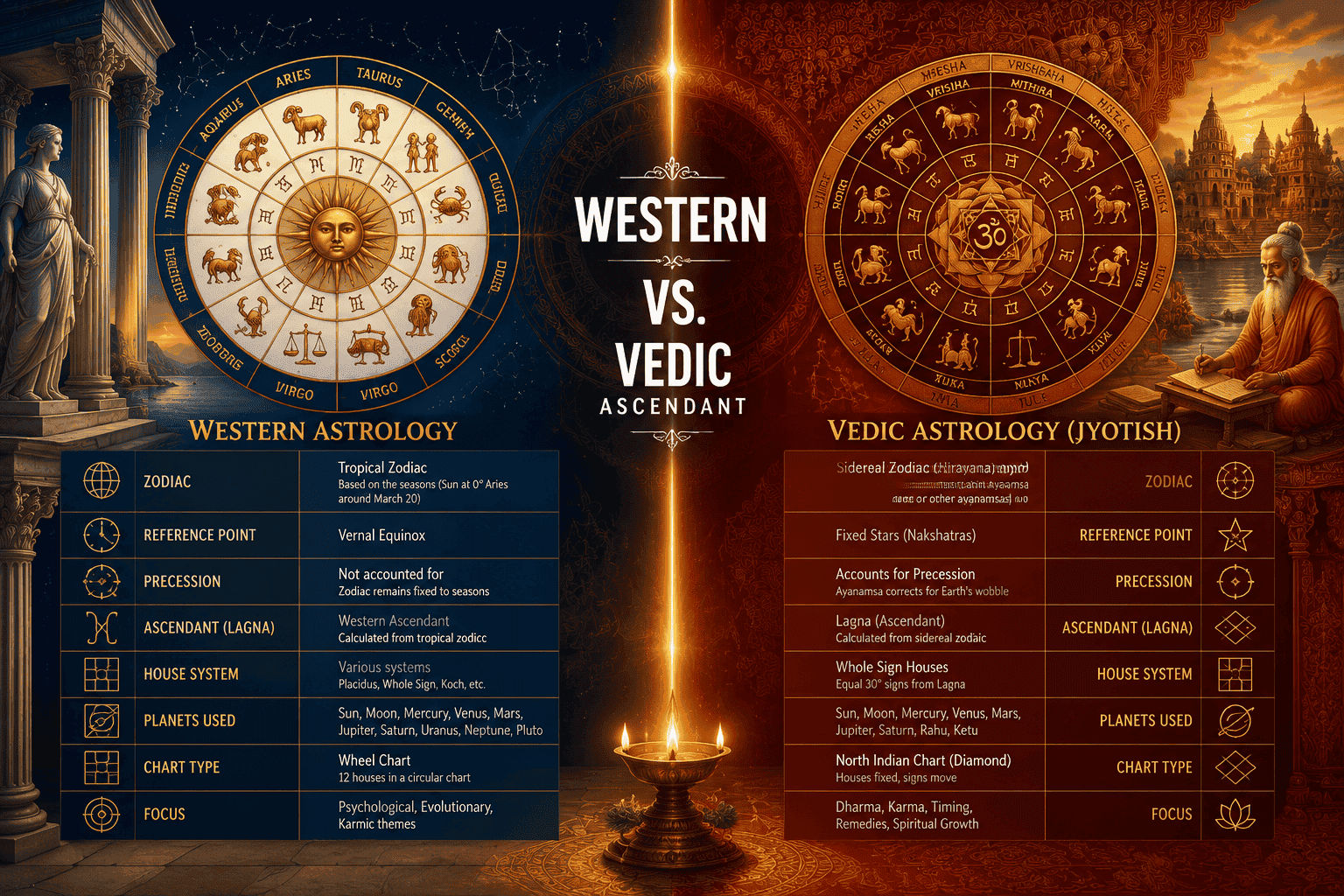
How Do Rising Signs Differ Between Western and Vedic Astrology
Western and Vedic astrology both use the Ascendant as the foundation of the birth chart, but they calculate it using different zodiac systems — and this often produces a different rising sign for the same person [6].
| Feature | Western Astrology | Vedic Astrology (Jyotish) |
|---|---|---|
| Zodiac system | Tropical (aligned to seasons) | Sidereal (aligned to fixed stars) |
| Ascendant name | Rising sign / Ascendant | Lagna |
| Degree difference | — | ~23–24 degrees behind Western |
| Resulting rising sign | Often different from Vedic result | Often one sign earlier than Western |
| Primary focus | Psychological self-expression | Destiny, karma, life themes |
Because of the roughly 23–24 degree difference between the two systems (called the ayanamsa), someone with a 5-degree Scorpio rising in Western astrology would likely have a Libra Lagna in Vedic astrology. Neither system is “wrong” — they answer slightly different questions [6].
Choose Western if you’re exploring psychological self-understanding and personality expression. Choose Vedic if you’re interested in karmic life themes, timing systems (dashas), and destiny-oriented interpretation.

Can You Have a Good First Impression If Your Rising Sign Isn’t Traditionally Charismatic
Yes — every rising sign has genuine strengths in social settings, even those not typically labeled “charismatic.” The idea that only Leo or Libra rising people make strong first impressions is a common oversimplification.
Every rising sign projects something distinct:
- Capricorn rising: Projects competence and reliability — people immediately sense they can trust you.
- Virgo rising: Comes across as thoughtful and detail-oriented — others feel you’re genuinely paying attention.
- Pisces rising: Radiates warmth and empathy — people feel emotionally safe around you quickly.
- Aquarius rising: Exudes originality — you’re memorable precisely because you don’t fit a standard mold.
The key is understanding what your rising sign naturally projects, then leaning into it rather than trying to perform a different energy. A Scorpio rising who tries to be bubbly and light will feel inauthentic — but one who leans into their natural depth and focus can be extraordinarily compelling [4].
For a complete breakdown of how each rising sign behaves in social situations, the Rising Sign Guide for Beginners covers all 12 signs in detail.
What Are the Most Challenging Rising Signs to Have
No rising sign is objectively “bad,” but some placements do come with social friction or internal tension that takes more conscious effort to work with.
Rising signs that often require extra self-awareness:
- Scorpio rising: The intensity can feel intimidating to others before they know you. People may project suspicion or guardedness onto you that you didn’t intend [4].
- Capricorn rising: The reserved, serious exterior can read as cold or unapproachable, even when you’re genuinely warm inside.
- Aquarius rising: The detached, unconventional energy can make emotional connection feel harder to establish quickly.
- Aries rising: The directness and speed can come across as impatient or aggressive in cultures that value more indirect communication styles.
Edge case: Rising signs that are considered “challenging” in one cultural context may be highly valued in another. Capricorn rising’s seriousness is a liability at a casual social gathering but an asset in a corporate boardroom.
How to Calculate Your Rising Sign Without an Exact Birth Time
Without an exact birth time, you cannot calculate your rising sign with certainty — because the Ascendant shifts every two hours, even a one-hour uncertainty can mean two possible rising signs [2].
Steps to take if you don’t know your birth time:
- Check your birth certificate. Many countries record birth time on the original certificate, even if it’s not on a short-form copy.
- Contact the hospital. Labor and delivery records often include birth time.
- Ask family members. Parents, grandparents, or siblings who were present may remember.
- Use birth time rectification. An experienced astrologer can work backward from major life events to estimate the Ascendant. This is not perfectly precise but can narrow it down significantly.
- Try a noon chart. If all else fails, some astrologers use noon as a default birth time and treat the rising sign as unknown, focusing on sun, moon, and planetary placements instead.
⚠️ Avoid guessing. A wrong rising sign leads to an incorrect house system, which affects every other interpretation in the chart.
What Mistakes Do People Often Make When Interpreting Their Rising Sign
The most common mistake is treating the rising sign as a separate personality from the sun sign, rather than as one layer of a unified whole. The Ascendant, sun, moon, and all planetary placements work together — no single factor overrides the others [5].
Other frequent errors:
- Ignoring the chart ruler. The planet ruling your rising sign modifies how the Ascendant expresses itself. A Libra rising with Venus in Aries will present very differently from a Libra rising with Venus in Pisces [2].
- Assuming the rising sign is always visible. In close relationships, the sun and moon signs often become more prominent. The rising sign is most obvious to strangers and new acquaintances.
- Over-identifying with the rising sign. Some people, after discovering their Ascendant, shift entirely to reading horoscopes for that sign. Sun sign horoscopes still apply to your core identity; rising sign horoscopes apply to your circumstances and environment.
- Dismissing it entirely. Equally, people who find their rising sign description doesn’t resonate sometimes ignore it. It’s worth checking whether the chart ruler’s placement explains the disconnect.
Which Celebrities Share Your Rising Sign
Celebrity rising signs are a popular way to understand how a placement manifests in real life — though it’s worth noting that celebrity birth times are sometimes unverified or disputed.
Some commonly cited examples (based on publicly available birth data):
| Rising Sign | Frequently Cited Celebrities |
|---|---|
| Scorpio Rising | Ryan Gosling, Beyoncé |
| Leo Rising | Madonna, Princess Diana |
| Libra Rising | Britney Spears, Kim Kardashian |
| Aries Rising | Angelina Jolie, Marlon Brando |
| Capricorn Rising | Brad Pitt, Michelle Obama |
| Pisces Rising | Marilyn Monroe, Keanu Reeves |
Use celebrity examples as illustrations, not proof. The goal is to see how a rising sign’s energy can manifest across different personalities — not to assume your life will mirror a celebrity’s.
FAQ: Rising Signs Explained
Q: Is my rising sign more important than my sun sign? Neither is more important — they serve different functions. The sun sign describes who you are; the rising sign describes how you appear and how your chart is structured. Both matter for a complete picture.
Q: Can two people born on the same day have different rising signs? Yes. If they were born in different cities or at different times of day, their rising signs can differ entirely — even if their sun signs are identical.
Q: Why does my rising sign description not feel accurate? Check your birth time accuracy first. If the time is correct, look at your chart ruler’s placement — it significantly modifies how the Ascendant expresses. Also, the rising sign is most visible to others, not always to yourself.
Q: Do rising signs affect physical health? Traditional astrology associates each rising sign with certain body areas and health tendencies. For example, Aries rising is linked to the head and face. This is covered in more depth in medical astrology basics, though it should not replace medical advice.
Q: How does the North Node interact with my rising sign? The North Node points toward your karmic growth direction. When it activates your first house or rising sign area, it often signals a period of significant identity development. The North Node enters Aquarius in July 2026 — a shift that affects every rising sign differently.
Q: Can I have the same rising sign and sun sign? Yes — this is called a “double” placement (e.g., Taurus sun and Taurus rising). It intensifies the traits of that sign and means the sun rules or strongly influences the first house.
Q: Does my rising sign change during Mercury retrograde or other transits? No. Transits affect how planets move through your chart’s houses, but they do not alter your natal rising sign.
Q: How long does it take to learn to interpret a rising sign properly? Most people can grasp the basics in an afternoon with a good guide. Nuanced interpretation — factoring in the chart ruler, house placements, and aspects — takes more time and practice.
Conclusion: Your Next Steps with Your Rising Sign
Rising Signs Explained: How Your Ascendant Shapes First Impressions and Life Path comes down to one core insight: the Ascendant is your astrological interface with the world. It’s not a mask in the deceptive sense — it’s the genuine energy you lead with before people know your full story.
Actionable next steps:
- Get your exact birth time from a birth certificate or hospital record if you don’t already have it.
- Calculate your rising sign using a reliable free tool like Astro.com — input date, time, and city.
- Identify your chart ruler (the planet ruling your rising sign) and note its sign and house placement.
- Read about your rising sign with the chart ruler in mind — this combination is more accurate than the rising sign alone.
- Observe your rising sign in action — notice how strangers respond to you versus how close friends see you. The gap often reveals the Ascendant at work.
- Explore the full picture by reading about your moon sign, sun sign, and rising sign together — the three form the core of your astrological identity.
Understanding your rising sign won’t change who you are — but it can clarify why you make the impressions you do, and how to work with your natural energy rather than against it. That’s a genuinely useful thing to know.
References
[1] Ascendant – https://www.astrolink.com/en/article/ascendant?utm_source=openai [2] Ascendant – https://zodiacroots.com/ascendant/?utm_source=openai [3] Rising Sign Appearance Physical Traits – https://www.celesian.com/blog/rising-sign-appearance-physical-traits?utm_source=openai [4] Rising Sign Personality Traits Astrology Ascendant Signs – https://www.allure.com/story/rising-sign-personality-traits-astrology-ascendant-signs?utm_source=openai [5] Ascendant – https://cafeastrology.com/ascendant.html?utm_source=openai [6] Ascendant – https://en.wikipedia.org/wiki/Ascendant?utm_source=openai