
Medical astrology links planetary placements in your birth chart to physical health tendencies, energy cycles, and wellness timing. Each zodiac sign rules specific body systems, each planet governs biological functions, and transiting planets can signal periods of vulnerability or vitality. This is a complementary framework for self-awareness, not a substitute for medical care.
- Key Takeaways 🌿
- What Is Medical Astrology and How Does It Work?
- Which Part of Your Birth Chart Relates to Health?
- The Zodiac Signs and Their Body Rulerships
- How Planetary Transits Affect Your Wellness Cycles
- How to Read Your Birth Chart for Health Patterns: A Step-by-Step Approach
- What the Elements Tell You About Health Tendencies
- Medical Astrology in Practice: Wellness Timing and Preventive Self-Care
- Is Medical Astrology Scientifically Valid?
- Frequently Asked Questions
- Conclusion: Your Next Steps with Medical Astrology Basics
- References
Key Takeaways 🌿
- Your birth chart is a snapshot of the sky at your birth, and medical astrology uses it to identify potential health strengths and vulnerabilities.
- Each of the 12 zodiac signs corresponds to a body region (Aries rules the head, Taurus rules the throat, and so on).
- The 6th house in your chart is the primary house of health and daily wellness habits.
- Planets like Saturn and Mars often correlate with chronic tension or inflammation, while Jupiter and Venus tend to link with abundance and circulation.
- Transiting planets (especially Saturn and Jupiter) can shift your energy and wellness cycles in meaningful ways.
- In 2026, Saturn’s move into Aries and Jupiter’s mid-year shift are considered significant for health patterns in astrological interpretation [1][2].
- Medical astrology works best as a self-reflection tool alongside conventional healthcare, not as a diagnostic system.
- You don’t need to be an astrology expert to start using your birth chart for basic wellness insights.
What Is Medical Astrology and How Does It Work?
Medical astrology is a centuries-old practice that maps planetary positions to the human body, using the birth chart as a guide to potential health tendencies and energy patterns. It doesn’t diagnose illness. Instead, it offers a symbolic language for understanding why certain body systems might need more attention, and when energy levels are likely to rise or dip.
The core idea is straightforward: the planets, signs, and houses in your natal chart each carry associations with specific body parts, organ systems, and physiological functions. When a planet transits a sensitive point in your chart, it can correlate with shifts in physical or emotional wellbeing.
Three layers make up a medical astrology reading:
- Natal placements — what your chart shows at birth (baseline tendencies)
- Transiting planets — where planets are moving right now (timing)
- Progressions — how your chart evolves over time (longer cycles)
“Medical astrology is less about predicting illness and more about understanding your body’s rhythms through a cosmic lens.”
For a solid foundation in how natal charts work generally, see this beginner’s guide to natal astrology vs. synastry.
Which Part of Your Birth Chart Relates to Health?
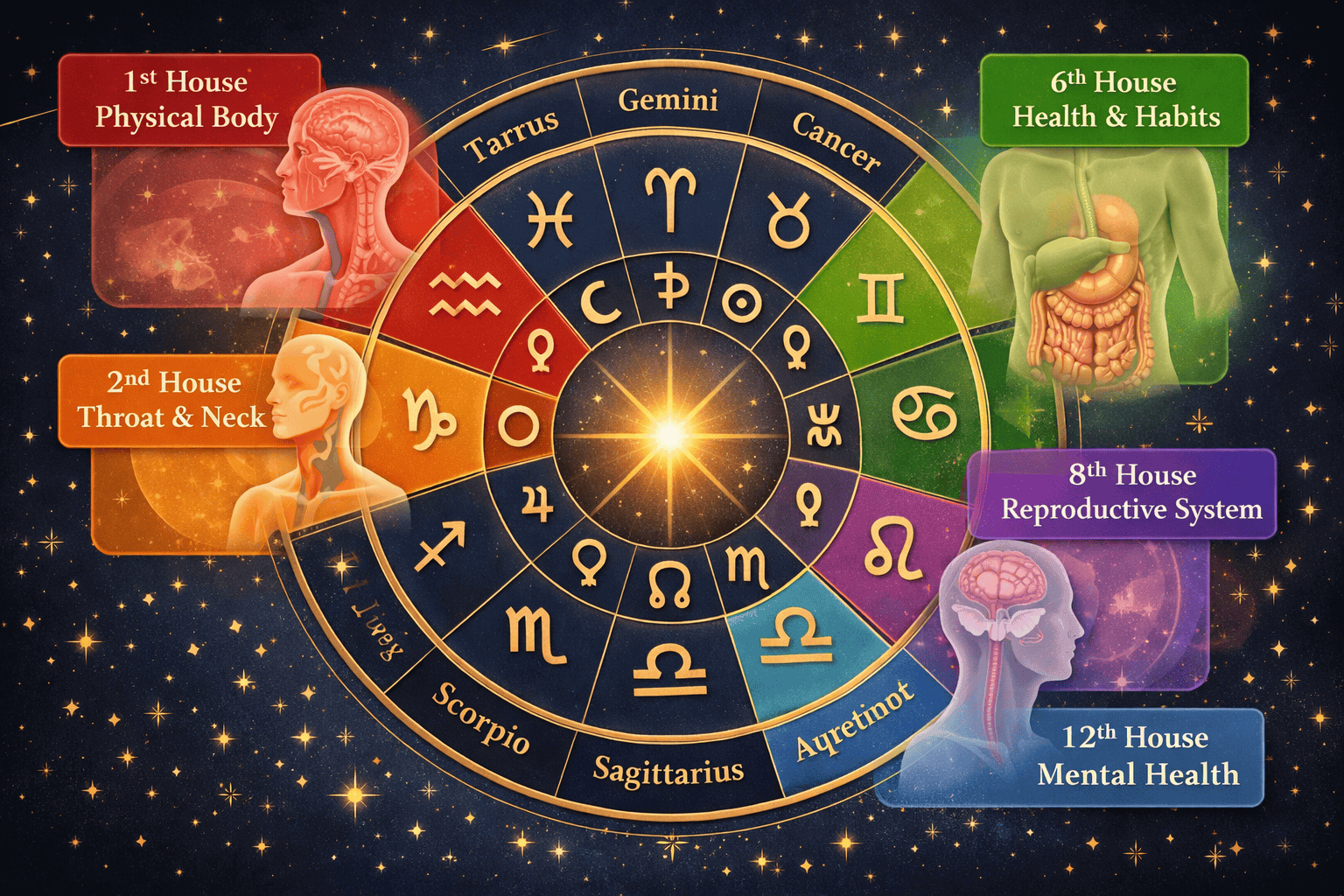
The 6th house is the primary zone for health in any birth chart. It governs daily routines, physical wellness habits, and the body’s response to stress. Whatever sign sits on the cusp of your 6th house, and whatever planets reside there, shapes your baseline health tendencies.
But health isn’t limited to one house. Several chart factors matter:
| Chart Factor | Health Association |
|---|---|
| 6th House | Daily health, illness, routines, diet |
| 1st House (Ascendant) | Physical body, vitality, overall constitution |
| 8th House | Chronic conditions, regeneration, surgery |
| 12th House | Hidden health issues, rest, recovery, mental health |
| Sun | Vitality and life force |
| Moon | Emotional health, digestion, hormonal cycles |
| Saturn | Chronic conditions, bones, teeth, discipline |
| Mars | Inflammation, fever, adrenal response |
| Jupiter | Liver, excess, circulation, growth |
Common mistake: Many beginners only check their 6th house and miss the 1st house Ascendant, which is equally important. The Ascendant sign describes the physical body’s overall constitution and resilience.
The Zodiac Signs and Their Body Rulerships
Every zodiac sign governs a specific region of the body. This is one of the most practical entry points into medical astrology basics, because you can immediately connect your Sun, Moon, Ascendant, or 6th house sign to a body area worth monitoring.
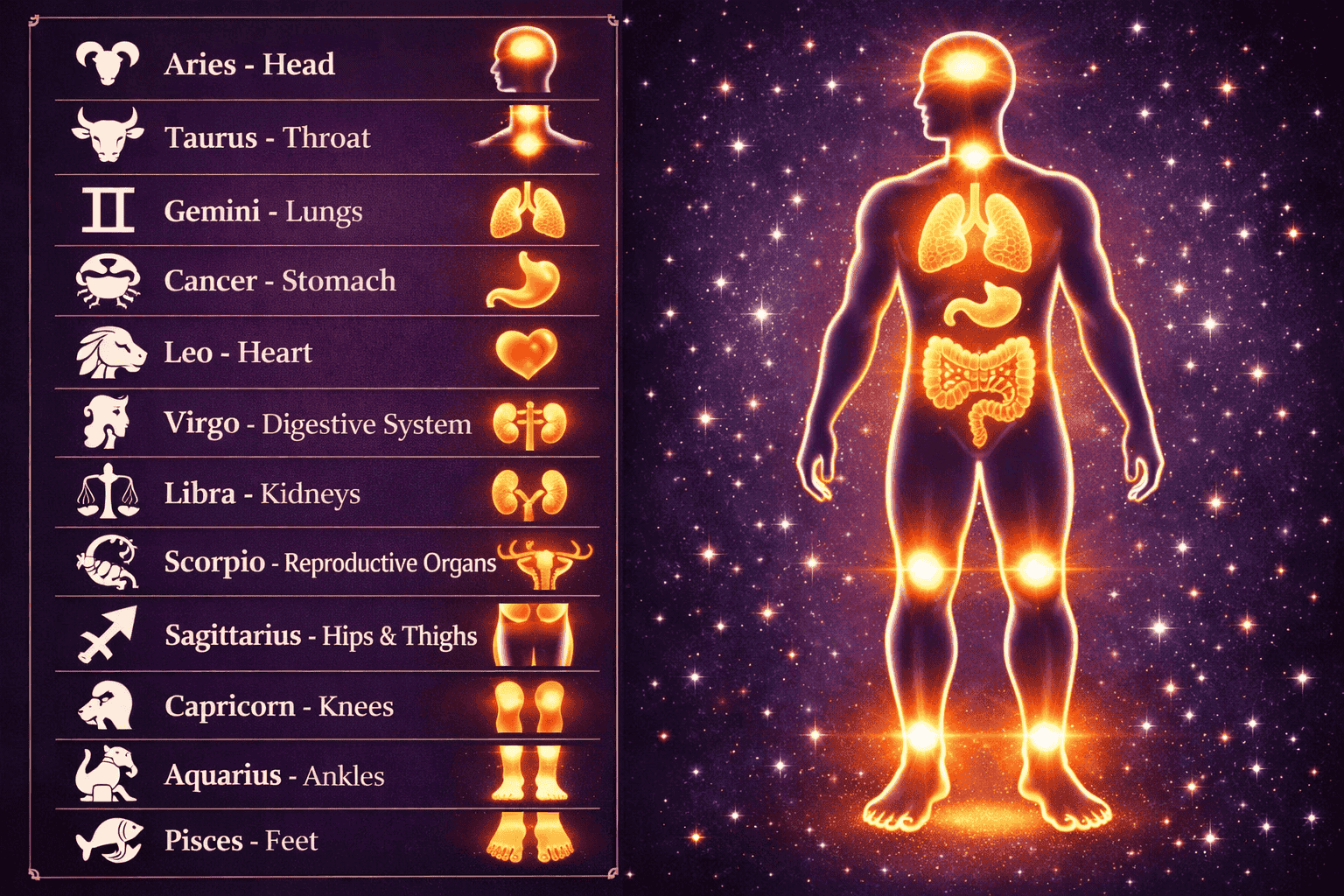
Zodiac sign body rulerships at a glance:
- ♈ Aries — Head, brain, face, eyes
- ♉ Taurus — Throat, neck, thyroid, vocal cords
- ♊ Gemini — Lungs, shoulders, arms, nervous system
- ♋ Cancer — Stomach, breasts, digestive system
- ♌ Leo — Heart, spine, upper back
- ♍ Virgo — Intestines, digestion, pancreas
- ♎ Libra — Kidneys, lower back, skin
- ♏ Scorpio — Reproductive organs, bladder, colon
- ♐ Sagittarius — Hips, thighs, liver, sciatic nerve
- ♑ Capricorn — Knees, bones, joints, teeth, skin
- ♒ Aquarius — Ankles, calves, circulatory system
- ♓ Pisces — Feet, lymphatic system, immune function
Choose this if… you have a planet in a sign that rules a body area you frequently experience issues with. That’s not coincidence — it’s a pattern worth exploring.
For example, someone with Saturn in Capricorn may notice recurring joint or bone-related challenges. Someone with Mars in Aries might be prone to headaches or inflammation in the head area.
How Planetary Transits Affect Your Wellness Cycles
Planetary transits are the current positions of planets as they move through the sky, and they interact with your natal chart in real time. This is where medical astrology basics get dynamic: your health energy isn’t static, it shifts with planetary cycles.
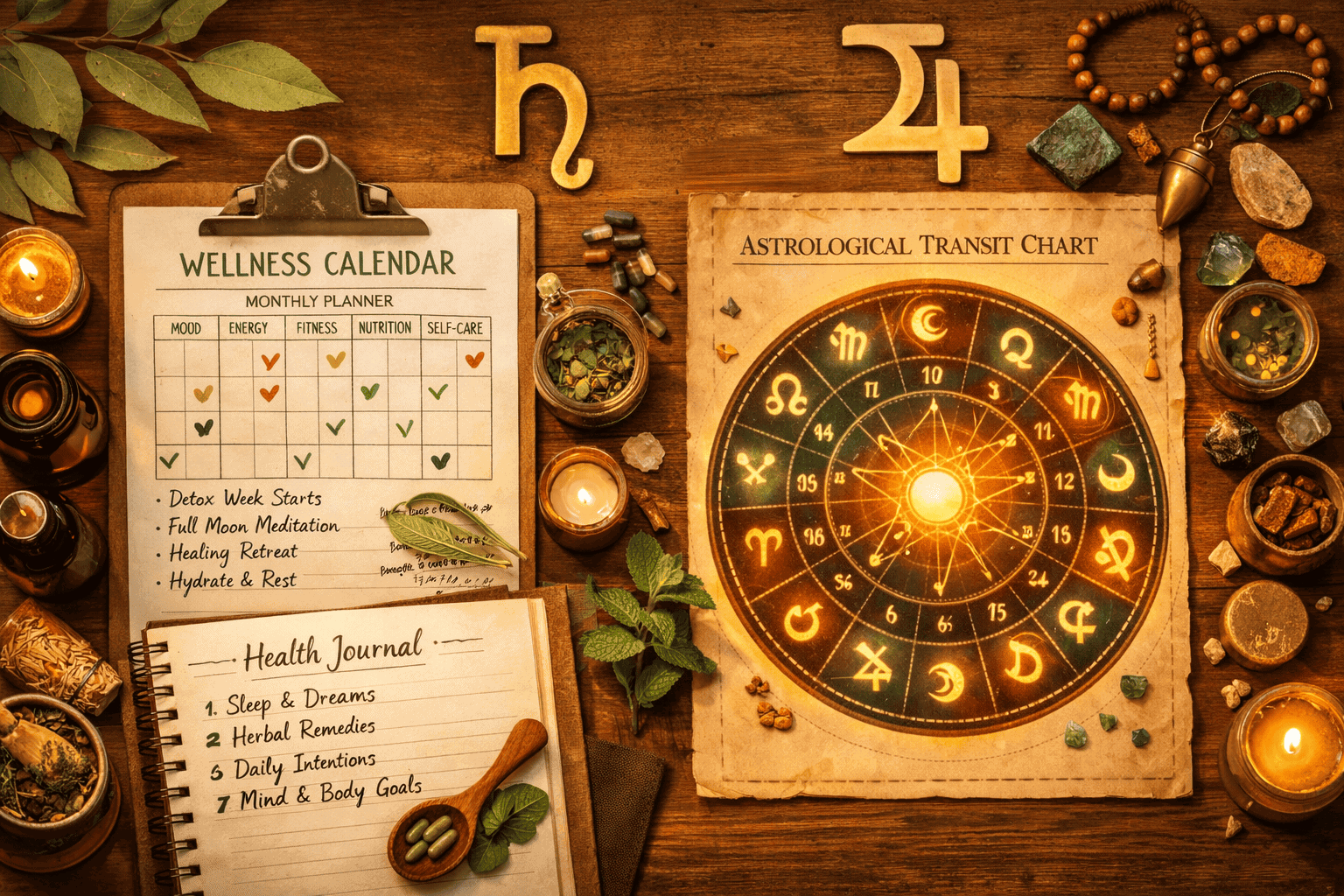
Key transits to watch for health timing:
- Saturn transits often bring periods of reduced energy, chronic stress, or the need for structural changes in health habits. Saturn’s lessons are slow but lasting.
- Mars transits can spike inflammation, accidents, or bursts of physical energy, depending on which house Mars is activating.
- Jupiter transits generally bring vitality and recovery, but can also indicate excess (overeating, overextension).
- Eclipse cycles (every 6 months) often mark turning points in health routines.
What’s happening in 2026: Saturn fully transitioned into Aries on February 13, 2026, where it will stay through April 2028. This is significant because Aries rules the head and adrenal system, so Saturn’s presence there may correlate with themes around stress management, headaches, and identity-based health patterns [2]. Meanwhile, Jupiter’s mid-year shift is believed to ease chronic health strains for many charts, according to Vedic astrological interpretation [1].
Neptune has also spent 15 years in Pisces (its home sign), encouraging a cultural emphasis on mental health, compassion, and creative therapies as healing modalities [2]. This aligns with the growing trend of psychological astrology being used for inner healing and intentional living, particularly among younger generations [3].
For more on how current transits interact with natal placements, the Chiron in Aries 2026 healing guide is especially relevant to health and identity themes this year.
How to Read Your Birth Chart for Health Patterns: A Step-by-Step Approach
Reading your birth chart for health insights doesn’t require years of study. Start with these focused steps.
Step 1: Get your birth chart Use a free tool (Astro.com or similar) with your birth date, exact time, and location. You can also discover your birth chart here.
Step 2: Identify your Ascendant (Rising Sign) This is your physical body’s signature. Look up what body areas that sign governs.
Step 3: Find your 6th house cusp sign This is your health and habits zone. Note any planets sitting inside the 6th house.
Step 4: Check your Saturn and Mars placements These two planets most commonly correlate with health challenges. Note their signs and houses.
Step 5: Look at your Moon sign The Moon governs digestion, emotional health, and hormonal patterns. A stressed Moon (square or opposition to Saturn or Pluto) often shows up as gut issues or emotional dysregulation.
Step 6: Note current transits Check where Saturn, Jupiter, and Mars are transiting right now. Are they crossing your 6th, 1st, or 8th house? That’s a window to pay attention to your body.
Edge case: If you don’t know your exact birth time, you won’t have an accurate Ascendant or house system. In that case, focus on your Sun and Moon signs and their body rulerships as a starting point.
For guidance on reading your natal houses more broadly, the post-Aries New Moon chart reading guide offers practical house-by-house interpretation tips.
What the Elements Tell You About Health Tendencies
The four classical elements (Fire, Earth, Air, Water) in your chart reveal broad constitutional tendencies that medical astrology has used for centuries.
| Element | Signs | Health Tendency | Watch Out For |
|---|---|---|---|
| 🔥 Fire | Aries, Leo, Sagittarius | High energy, strong metabolism | Burnout, inflammation, fever |
| 🌍 Earth | Taurus, Virgo, Capricorn | Steady, resilient constitution | Sluggishness, joint issues, skin |
| 💨 Air | Gemini, Libra, Aquarius | Active nervous system | Anxiety, respiratory issues, insomnia |
| 💧 Water | Cancer, Scorpio, Pisces | Sensitive, intuitive body | Digestive issues, fluid retention, mood |
If your chart is dominated by one element, those tendencies are amplified. A chart heavy in Air signs, for instance, may show a person prone to nervous system overstimulation and respiratory sensitivity. A Water-dominant chart often signals heightened emotional sensitivity that shows up physically as digestive or immune fluctuations.
Astrolada’s medical astrology curriculum specifically covers the correlation between elements and health issues as a core teaching module [6], which confirms how central elemental analysis is to this practice.
Medical Astrology in Practice: Wellness Timing and Preventive Self-Care
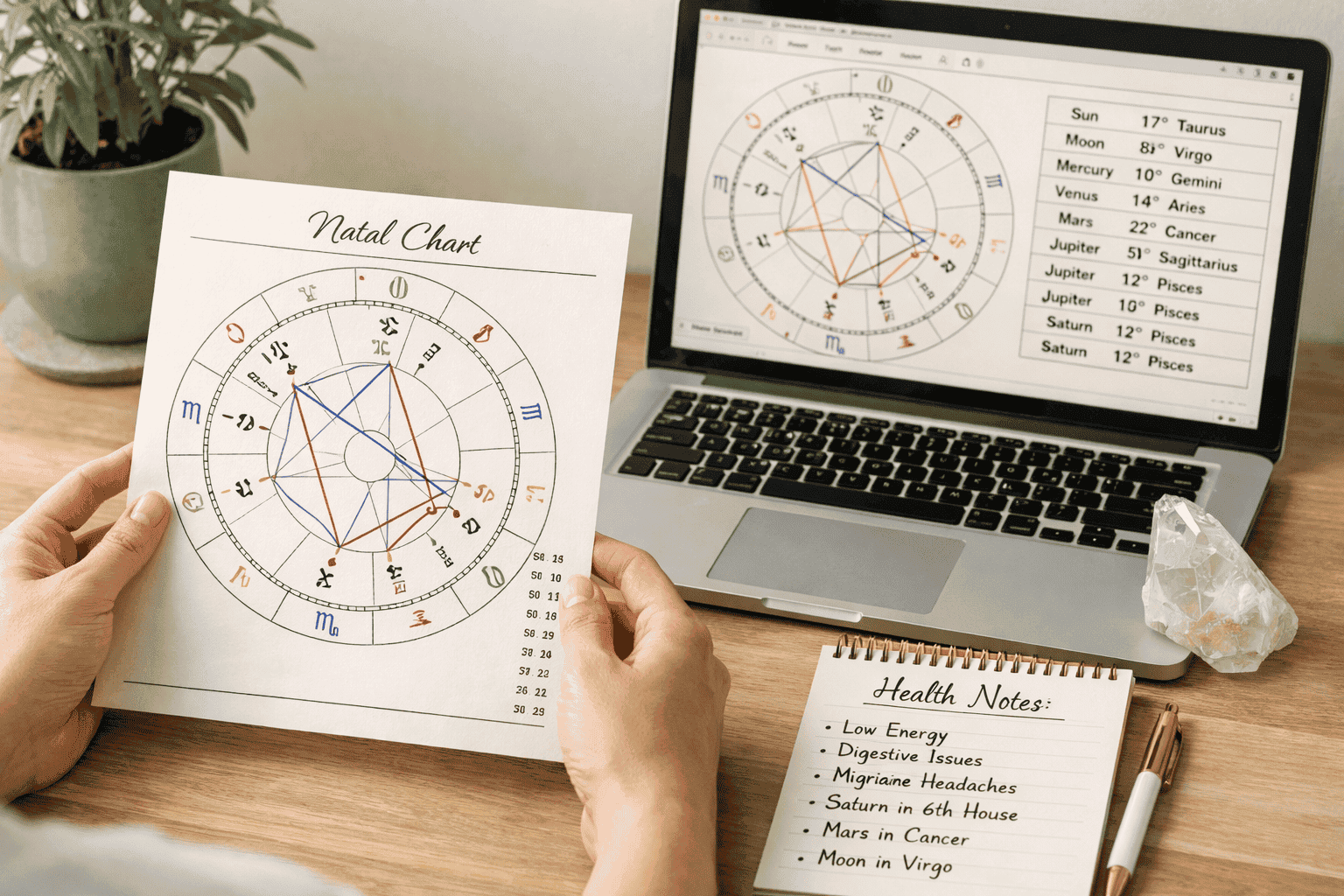
Medical astrology basics become most useful when applied to timing: knowing when to rest, when to push, and when to schedule health check-ins.
Practical wellness timing strategies:
- New and Full Moons: New Moons are good for starting health habits. Full Moons can heighten emotional and physical sensitivity.
- Saturn return (ages 28-30, 57-60): A major life restructuring period that often forces health reassessment.
- Mars return (every ~2 years): A reset of physical energy and drive. Good time to evaluate fitness routines.
- 6th house transits: When a slow-moving planet (Saturn, Jupiter, Pluto) crosses your 6th house, expect a 1-2 year period of significant health focus.
Seasonal rhythm tip: Many medical astrologers recommend scheduling preventive health check-ups during the Sun’s transit through your 6th house sign. This happens once a year and lasts about 30 days.
The Saturn-Neptune conjunction in Aries 2026 is particularly relevant for first house (physical body) themes this year, making 2026 an ideal time to reassess foundational health habits.
For those interested in how wellness intersects with broader life planning, natal charts for life events shows how the same chart-reading skills apply across major decisions.
Is Medical Astrology Scientifically Valid?
Medical astrology is not recognized by mainstream medicine and has no peer-reviewed clinical evidence supporting it as a diagnostic tool. That’s an important boundary to state clearly.
What it does offer is a symbolic and reflective framework — a way to notice patterns, build body awareness, and time wellness efforts. Many people find it useful as a complement to conventional care, not a replacement.
Who benefits most from medical astrology basics:
- People interested in mind-body connection and self-awareness
- Those who already use holistic wellness practices (yoga, meditation, herbalism)
- Anyone curious about cyclical patterns in their energy and mood
Who should be cautious:
- Anyone using it to delay or replace medical treatment
- People prone to health anxiety who might over-interpret chart placements
The growing trend in 2026 is toward psychological astrology as a language for self-understanding, not prediction [3]. That’s the spirit in which medical astrology works best.
Frequently Asked Questions
Q: Can my birth chart predict illness? No. Medical astrology identifies tendencies and timing patterns, not diagnoses. A Saturn placement in the 6th house doesn’t mean you’ll get sick — it suggests you may need more structure in your health habits.
Q: What’s the most important placement for health in a birth chart? The Ascendant (Rising Sign) and the 6th house are the two most important starting points. The Moon and Saturn placements follow closely.
Q: Do I need my exact birth time for medical astrology? Yes, ideally. Without an exact birth time, you can’t calculate your Ascendant or accurate house positions. If you don’t have it, focus on Sun, Moon, and Saturn signs as a starting point.
Q: What does Saturn in the 6th house mean for health? Saturn in the 6th house often correlates with a disciplined but sometimes rigid approach to health. It can indicate chronic low-level health challenges that respond well to consistent, structured self-care routines.
Q: Is 2026 a good year for health according to astrology? According to Vedic astrology interpretation, Jupiter’s mid-year shift in 2026 is expected to ease chronic health strains, while Saturn’s move into Aries brings lessons around stress and adrenal health [1][2].
Q: How does the Moon affect health in a birth chart? The Moon governs digestion, emotional wellbeing, and hormonal cycles. A well-aspected Moon supports emotional resilience and gut health. A stressed Moon (hard aspects to Saturn or Pluto) may correlate with digestive sensitivity or mood-related physical symptoms.
Q: Can medical astrology help with mental health? It can support self-awareness around emotional patterns. Neptune’s 15-year transit through Pisces has coincided with a cultural emphasis on mental health, compassion, and creative healing [2], and many practitioners use astrology as a reflective tool alongside therapy.
Q: What’s the difference between Western and Vedic medical astrology? Both use planetary rulerships for body parts, but Vedic (Jyotish) astrology uses a different zodiac system (sidereal) and places greater emphasis on the Moon and specific planetary periods called dashas for health timing.
Conclusion: Your Next Steps with Medical Astrology Basics
Medical astrology basics offer a genuinely useful lens for understanding health patterns and wellness cycles — as long as the boundaries are clear. It’s a reflective tool, not a medical system.
Here’s how to get started this week:
- Pull your birth chart using a free tool with your exact birth time. Discover your birth chart here.
- Identify your Ascendant and 6th house sign, then look up their body rulerships.
- Note your Saturn and Moon placements — these two planets most directly influence health patterns.
- Check current transits for Saturn and Jupiter to understand your wellness timing right now.
- Use this as a complement, not a replacement, for conventional healthcare and professional medical advice.
In 2026, with Saturn newly in Aries and Jupiter shifting mid-year, the cosmic backdrop is actively shaping health themes for many charts [1][2]. Understanding medical astrology basics — using your birth chart to understand health patterns and wellness cycles — gives you a personal map for navigating those shifts with more awareness and intention.
References
[1] 5 Remedies to Reduce Health Issues in 2026 – https://timesofindia.indiatimes.com/astrology/others/5-remedies-to-reduce-health-issues-in-2026/articleshow/126449959.cms
[2] Astrology Of 2026 – https://parade.com/astrology/astrology-of-2026
[3] Cultural Astrology Trends For 2026 – https://www.belindamatwali.com/blog/cultural-astrology-trends-for-2026
[6] Health And Remedies Medical Astrology – https://www.astrolada.com/courses/astrology-esoteric/health-and-remedies-medical-astrology.html