
Astrology has four classical branches: genethlialogy (natal astrology based on your birth chart), general astrology (forecasting events for nations and humanity), catarchic astrology (choosing the best time to act), and interrogatory astrology (answering specific questions from a chart). Understanding the four types of astrology explained here helps beginners pick the right method for their goals, whether that’s self-discovery, timing a big decision, or getting a direct answer to a pressing question.
- Key Takeaways
- What Exactly Is Genethlialogy Astrology and How Is It Different?
- How Do General Astrology and Natal Charts Work Differently?
- Can Catarchic Astrology Really Help You Make Better Decisions?
- What Are the Key Differences Between These Four Types of Astrology?
- Is Interrogatory Astrology Useful for Predicting Specific Events?
- Which Type of Astrology Is Best for Beginners to Start With?
- How Much Does a Professional Astrology Reading Typically Cost?
- What Are the Most Common Mistakes People Make When Learning Astrology?
- What Are the Scientific Perspectives on These Different Astrological Approaches?
- Can You Learn These Astrology Types Online for Free?
- What Personal Questions Can Each Type of Astrology Help You Answer?
- Conclusion: Choosing Your Path Through the Four Types of Astrology
- Frequently Asked Questions
- References
Key Takeaways
- Genethlialogy (natal astrology) is the oldest and most widely practiced branch, built around your birth chart and life path.
- General astrology (mundane astrology) connects major celestial events like eclipses and equinoxes to world affairs, nations, and collective trends.
- Catarchic astrology (electional astrology) helps you find the most auspicious moment to start something new, from a business launch to a wedding.
- Interrogatory astrology (horary astrology) casts a chart for the exact moment a question is asked and reads it for a specific answer.
- All four types share the same foundational tools: planets, zodiac signs, and houses.
- Modern astrologers use the terms natal, mundane, electional, and horary more often than the classical Greek names. [1][3]
- Beginners are almost always advised to start with natal astrology before exploring the other three branches.
- None of the four types has passed controlled scientific testing for predictive accuracy, so they’re best approached as reflective or symbolic tools.
- Professional readings range widely in cost, from free online tools to paid sessions starting around $50–$200+ per hour.
- All four types can be studied online for free through reputable introductory resources.
What Exactly Is Genethlialogy Astrology and How Is It Different?
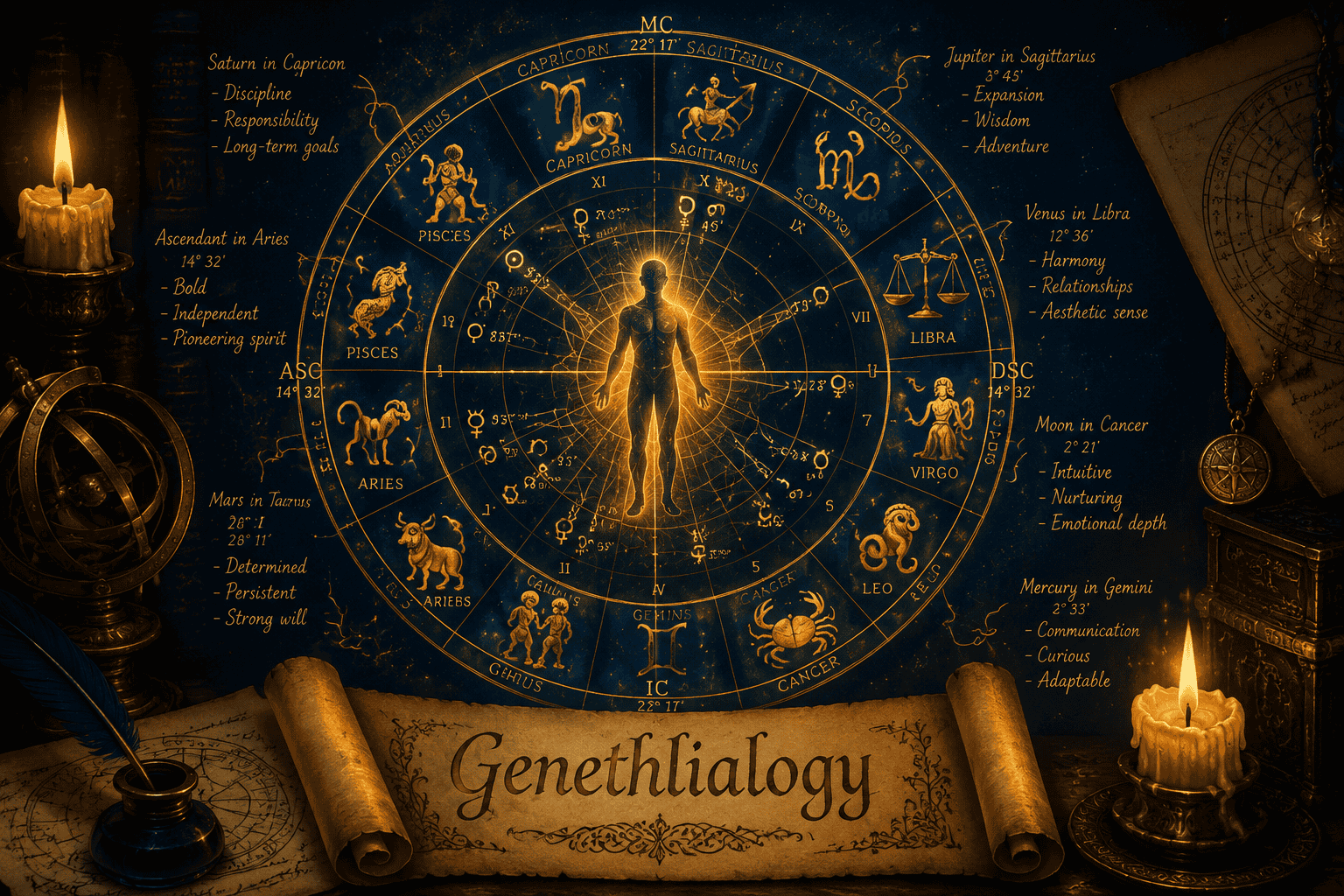
Genethlialogy is the branch of astrology that maps a person’s life potential from the moment of birth. It’s the oldest and most foundational type, and it’s what most people mean when they say “my astrology chart.” The Encyclopaedia Britannica defines genethlialogy as the practice of casting a birth chart (or “nativity”) to forecast the course of an individual’s life based on the positions of planets and signs at the exact time and place of birth. [3][4]
What makes genethlialogy distinct from the other three types is its personal, lifelong focus. While other branches answer specific questions or time specific actions, genethlialogy is about the whole person: personality, strengths, challenges, relationships, and life themes.
Key features of genethlialogy / natal astrology:
- Built around the birth chart (also called a natal chart or horoscope), a snapshot of the sky at the moment you were born
- Uses the 12 houses, planets, and zodiac signs to describe different life areas (career, love, family, etc.)
- Treats the chart as a fixed map that can be interpreted at any point in life
- Serves as the foundation for other techniques like transits and progressions
💡 Practical example: If someone wants to understand why they keep struggling with communication at work, a natal astrologer looks at Mercury’s sign and house placement in the birth chart for clues.
Historical sources note that from genethlialogy, “the fundamental techniques of astrology were developed,” making it the root from which all other branches grew. [3] For a deeper look at how birth charts work, see this beginner’s guide to birth charts and natal placements.
Choose genethlialogy if: You want self-understanding, long-term life guidance, or a foundation before exploring other astrology types.
How Do General Astrology and Natal Charts Work Differently?
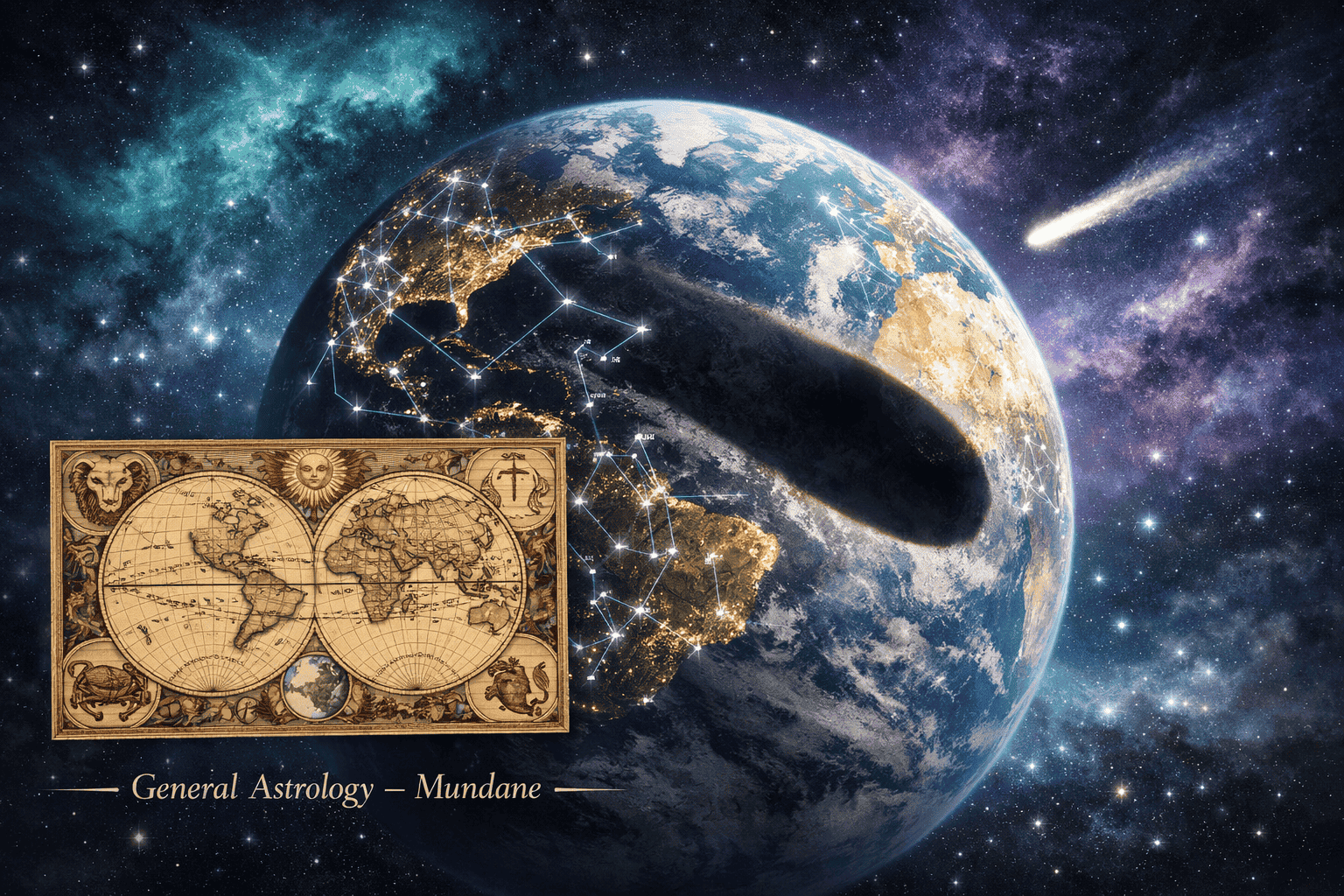
General astrology (also called mundane astrology) focuses on collective events rather than individuals. Instead of a personal birth chart, it uses charts cast for significant celestial moments, such as solar eclipses, planetary conjunctions, or the spring equinox, to forecast trends affecting nations, governments, economies, and humanity as a whole. [3]
Natal charts and general astrology share the same technical language, but their targets are completely different:
| Feature | Genethlialogy (Natal) | General Astrology (Mundane) |
|---|---|---|
| Subject | An individual person | Nations, groups, humanity |
| Chart trigger | Date, time, place of birth | Eclipses, equinoxes, conjunctions |
| Timeframe | Lifelong | Seasonal to multi-year cycles |
| Common use | Self-discovery, relationships | Political forecasting, world events |
| Modern name | Natal astrology | Mundane astrology |
Mundane astrology has ancient roots in Mesopotamia, where court astrologers tracked celestial omens for kings and kingdoms rather than private citizens. [1] Today, astrologers who practice this branch might analyze a solar eclipse chart to comment on geopolitical shifts, or study a Saturn-Neptune conjunction for clues about cultural changes. For context on how major planetary shifts affect collective energy, the complete guide to planetary transits in 2026 is a useful companion read.
Common mistake: Beginners sometimes confuse general astrology with sun sign horoscopes in magazines. Sun sign columns are a simplified, popularized form of natal astrology, not true mundane astrology.
Can Catarchic Astrology Really Help You Make Better Decisions?
Catarchic astrology (now usually called electional astrology) is specifically designed to help you choose the best moment to begin an action. According to Britannica, it determines “whether a chosen moment is astrologically conducive to the success of an undertaking.” [3] In practical terms, it’s timing-based: instead of asking “who am I?” it asks “when should I act?”
The name comes from the Greek word katarchē, meaning “beginning” or “inception.” [10] The idea is that the planetary conditions at the start of any venture influence how that venture unfolds, so picking a favorable chart moment gives the action the best symbolic start.
What catarchic/electional astrology is used for:
- Scheduling weddings, business launches, or contract signings
- Choosing a date to start a medical treatment or surgery
- Timing a move to a new home
- Launching a website, product, or creative project
Does it actually work? There’s no scientific evidence that timing actions by planetary positions changes real-world outcomes. [See the science section below.] That said, many practitioners find the process useful as a mindfulness tool: it encourages deliberate planning rather than impulsive action, which can have practical benefits regardless of the astrology itself.
⚠️ Edge case: Electional astrology assumes you have flexibility in your timing. If a deadline is fixed (a court date, a medical emergency), this branch simply doesn’t apply.
For those interested in how specific planetary moments shape decision-making energy, the article on the Mercury-Saturn conjunction and structured thinking offers a practical example of timing-based astrological thinking.
What Are the Key Differences Between These Four Types of Astrology?
The four types of astrology explained in this guide each answer a different kind of question. Genethlialogy asks “who am I?”, general astrology asks “what’s happening in the world?”, catarchic astrology asks “when should I act?”, and interrogatory astrology asks “what is the answer to this specific question?” [3]
Here’s a side-by-side comparison:
| Type | Classical Name | Modern Name | Core Question | Best For |
|---|---|---|---|---|
| 1 | Genethlialogy | Natal astrology | Who am I and what’s my life path? | Self-discovery, long-term guidance |
| 2 | General astrology | Mundane astrology | What’s happening collectively? | World events, political trends |
| 3 | Catarchic astrology | Electional astrology | When is the best time to act? | Timing decisions, planning |
| 4 | Interrogatory astrology | Horary astrology | What’s the answer to my question? | Specific yes/no or situational answers |
All four types use the same building blocks: the zodiac, planets, and houses. The difference is in the chart’s subject and purpose, not the technical tools. [3][10]
Semantic note: You’ll often see the terms natal, mundane, electional, and horary used in modern astrology communities. The classical Greek names (genethlialogy, catarchic, interrogatory) appear mostly in academic or historical contexts. Both sets of terms refer to exactly the same four branches. [3][10]

Is Interrogatory Astrology Useful for Predicting Specific Events?
Interrogatory astrology (horary astrology) casts a chart for the exact moment a question is asked and reads that chart for a direct answer. It’s the most question-focused of the four types, designed to address specific concerns like “Will I get this job?” or “Where are my lost keys?” rather than broad life themes. [3][5]
Unlike natal astrology, horary doesn’t need a birth date. The chart belongs to the question itself, not the person. The astrologer interprets planetary positions, aspects, and house rulers at the moment the question was sincerely asked and formed.
What horary astrology can address:
- Lost objects or missing people
- Relationship outcomes (“Will we reconcile?”)
- Career and financial decisions
- Travel and relocation questions
- Health concerns (though never as a substitute for medical advice)
How accurate is it? Horary has a devoted following among traditional astrologers who report consistent results, but controlled studies haven’t confirmed its predictive reliability beyond chance. [See the science section.] Its value may lie in its structured approach to decision-making: framing a question clearly and examining it from multiple symbolic angles can clarify thinking even without literal predictive accuracy.
Common mistake: Asking the same question multiple times hoping for a different answer. Traditional horary practice holds that a question should only be asked once sincerely, and re-asking the same question is considered a sign the querent isn’t ready to accept the answer.
Which Type of Astrology Is Best for Beginners to Start With?
Natal astrology (genethlialogy) is universally recommended as the starting point for beginners. It provides the foundational vocabulary (planets, signs, houses, aspects) that all other branches build on, and it’s the most personally relevant, making it easier to stay motivated while learning. [3][4]
A practical beginner path:
- Start with your natal chart. Get a free chart at any major astrology site using your birth date, time, and location.
- Learn the planets and what each one represents (Sun = identity, Moon = emotions, Mercury = communication, etc.).
- Study the 12 houses to understand which life areas each planet influences. The guide to the 12 astrological houses is an excellent starting resource.
- Add zodiac signs to understand how each planet expresses itself.
- Once comfortable, explore mundane astrology by following major transits, then move into electional or horary if those applications interest you.
Choose X if…
- Natal astrology if you want self-understanding and a long-term practice
- Mundane astrology if you’re drawn to world events and collective patterns
- Electional astrology if you’re a planner who wants to time decisions mindfully
- Horary astrology if you have specific, pressing questions and want direct symbolic answers
Understanding your moon sign is one of the best early steps after learning your sun sign, as it adds emotional depth to your natal chart reading.
How Much Does a Professional Astrology Reading Typically Cost?
Professional astrology readings vary widely in price depending on the type, the astrologer’s experience, and the session length. As a general estimate in 2026, beginners can expect to pay roughly $50–$100 for a basic natal chart reading from a newer practitioner, and $150–$300+ per hour for experienced or well-known astrologers. These are market estimates, not verified averages from a published study.
Cost breakdown by type:
- Natal chart reading: $50–$300 (most common entry point)
- Electional consultation: $75–$200 (often shorter, more focused)
- Horary reading: $40–$150 per question (typically a single-question session)
- Mundane/world astrology: Rarely sold as individual readings; more common in subscription newsletters or group webinars ($10–$50/month)
Free alternatives: Many beginners never pay for a reading at all. Free natal chart generators (such as those on Astro.com or Astro-Seek) produce detailed chart reports. YouTube, podcasts, and community forums like Reddit’s r/Advancedastrology offer substantial free learning. [9]
💡 Tip: Before paying for a reading, spend time with your free natal chart. The more you understand your own chart, the more useful a paid session becomes.
What Are the Most Common Mistakes People Make When Learning Astrology?
The biggest beginner mistake is treating sun signs as the whole picture. Sun sign horoscopes (the 12-sign columns in magazines and apps) are a tiny slice of natal astrology, and they have almost no connection to the other three branches. Relying on them exclusively gives a very incomplete view of what astrology actually involves. [1][3]
Other common mistakes:
- Skipping the basics: Jumping into horary or electional astrology without understanding natal chart fundamentals leads to confusion fast.
- Expecting literal predictions: All four types work best as symbolic frameworks, not fortune-telling machines.
- Ignoring birth time accuracy: Natal and electional charts depend heavily on the exact time of birth or action. An incorrect birth time shifts house placements significantly.
- Overcomplicating too soon: Beginners sometimes try to learn every asteroid, fixed star, and Arabic Part before mastering the ten main planets. Start simple.
- Confirmation bias: Remembering the hits and forgetting the misses inflates perceived accuracy in any branch.
For a grounded look at what astrology actually means and where it came from, the astrology definition and meaning guide is a helpful reality check.
What Are the Scientific Perspectives on These Different Astrological Approaches?
None of the four types of astrology has demonstrated reliable predictive accuracy in controlled scientific studies. This is a consistent finding across decades of research, and it applies equally to natal, mundane, electional, and horary astrology. The most cited test, Shawn Carlson’s double-blind study published in Nature in 1985, found that professional astrologers performed at chance levels when matching birth charts to personality profiles, though astrologers have disputed the methodology.
What science says about each branch:
- Genethlialogy/natal: No verified correlation between birth chart placements and personality traits or life outcomes beyond what chance would predict.
- General/mundane: No controlled evidence that eclipses or planetary conjunctions cause or reliably predict specific political or social events.
- Catarchic/electional: No peer-reviewed evidence that starting actions at “astrologically favorable” times improves outcomes.
- Interrogatory/horary: No controlled studies confirming accuracy above chance for specific predictions.
Why do people still find it useful? Many practitioners and users describe astrology’s value in psychological and reflective terms rather than predictive ones. The symbolic language of planets and houses can serve as a framework for self-reflection, similar to journaling prompts or personality assessments like the Myers-Briggs. This framing doesn’t require the predictions to be literally accurate to be personally meaningful.
Who should avoid taking astrology too seriously: Anyone making major medical, financial, or legal decisions should rely on qualified professionals in those fields, not astrological timing or chart readings. Astrology can be a complementary reflective tool, but it’s not a substitute for expert advice in high-stakes situations.
Can You Learn These Astrology Types Online for Free?
Yes, all four types of astrology can be studied online for free, with a wide range of quality resources available in 2026. Natal astrology has the most free content by far, but electional and horary astrology also have dedicated free communities and tutorials.
Free learning resources by type:
- Natal astrology: Free chart generators (Astro.com, Astro-Seek), YouTube channels, beginner podcasts, and Reddit communities like r/astrology
- Mundane astrology: Free newsletter archives, astrology blogs tracking world transits, and YouTube commentary on major planetary events
- Electional astrology: Dedicated forums, free articles from traditional astrology sites, and Project Hindsight’s publicly available materials [5]
- Horary astrology: Free tutorials on sites dedicated to traditional astrology, plus Chris Brennan’s academic work on horary’s historical roots [8]
Paid options worth considering: Structured courses from established astrologers typically run $100–$500 for a full beginner curriculum. These add accountability and structured progression that free resources don’t always provide.
What Personal Questions Can Each Type of Astrology Help You Answer?
Each of the four types of astrology addresses a different category of personal question. Knowing which branch matches your question saves time and sets realistic expectations.
| Your Question | Best Branch | Why |
|---|---|---|
| “Why do I keep attracting the same relationship patterns?” | Natal (Genethlialogy) | Venus and 7th house placement in birth chart |
| “What does the upcoming eclipse mean for my country?” | General (Mundane) | Collective event analysis |
| “When should I launch my new business?” | Catarchic (Electional) | Timing optimization for a new venture |
| “Will I get the job I just interviewed for?” | Interrogatory (Horary) | Specific yes/no question answered by chart cast now |
| “What are my emotional needs in relationships?” | Natal (Genethlialogy) | Moon sign and 4th house interpretation |
| “Is now a good time to sign a contract?” | Catarchic (Electional) | Mercury and 7th house conditions at chosen moment |
For those curious about emotional patterns specifically, exploring moon signs vs. sun signs adds useful context to natal chart interpretation.
Conclusion: Choosing Your Path Through the Four Types of Astrology
The four types of astrology explained in this guide, genethlialogy, general, catarchic, and interrogatory, each serve a distinct purpose. They share the same symbolic language but answer completely different questions. Natal astrology tells you about yourself. Mundane astrology tracks collective patterns. Electional astrology helps you time your actions. Horary astrology gives direct answers to specific questions.
Actionable next steps for beginners:
- Get your free natal chart using your birth date, time, and location. This is your foundation.
- Read about your rising sign and moon sign alongside your sun sign for a fuller picture. The moon sign mastery guide is a great starting point.
- Follow one major transit (like an upcoming eclipse or planetary ingress) through a mundane astrology lens to see how general astrology works in real time.
- Try one electional question: Next time you’re planning something important, look up what sign the Moon is in that day and whether any major planets are retrograde.
- Explore horary only after you’re comfortable with natal basics. Frame one clear, sincere question and see how the chart reads.
- Stay grounded: Use astrology as a reflective tool, not a decision-making authority for high-stakes choices.
Astrology’s real strength, across all four branches, is that it gives you a structured symbolic language to think about time, personality, and events. Whether that language points to something real in the cosmos or simply helps you think more clearly about your life, the four types offer genuinely different and complementary ways to engage with it.
Frequently Asked Questions
What is the oldest type of astrology? Genethlialogy (natal astrology) is considered the oldest and most foundational branch. Historical sources note that from it, “the fundamental techniques of astrology were developed,” and all other branches grew as specializations. [3][4]
What is the difference between horary and electional astrology? Horary (interrogatory) astrology casts a chart to answer a specific question asked right now. Electional (catarchic) astrology casts a chart to find the best future moment to begin an action. One is reactive; the other is proactive. [3][10]
Do I need my exact birth time for all four types? You need an accurate birth time for natal astrology, as it determines your rising sign and house placements. Horary astrology uses the time of the question, not your birth. Electional astrology uses the time of the planned action. Mundane astrology uses the time of celestial events. Birth time matters most for natal work.
Is mundane astrology the same as sun sign horoscopes? No. Sun sign horoscopes are a simplified form of natal astrology. Mundane astrology analyzes eclipses, equinoxes, and planetary conjunctions to forecast collective and political trends, not individual personalities. [3]
Can I practice more than one type of astrology? Absolutely. Most experienced astrologers use multiple branches. A common combination is natal astrology for self-understanding plus electional astrology for timing major life decisions.
What does “catarchic” mean? Catarchic (also spelled katarchic) comes from the Greek katarchē, meaning “beginning” or “inception.” It refers to the astrology of initiating actions at auspicious moments. [10]
Is interrogatory astrology the same as psychic reading? No. Horary astrology is a structured technical practice using a chart cast for a specific moment. It follows defined rules for interpreting planetary positions, houses, and aspects. It’s not the same as intuitive or psychic reading, though some practitioners combine approaches.
How long does it take to learn natal astrology basics? Most beginners can grasp the core concepts (planets, signs, houses, major aspects) within two to three months of consistent study, especially with free online resources. Deeper fluency takes years of practice.
Are there other types of astrology beyond these four? The four classical types cover the main branches. Within each, there are many sub-traditions (Vedic/Jyotish, Hellenistic, modern psychological, etc.), but these are cultural or methodological variations rather than separate branches in the classical taxonomy. [1][3]
What is the most accurate type of astrology? No branch has demonstrated superior predictive accuracy in scientific testing. Among practitioners, horary astrology is often described as the most precise for specific questions, while natal astrology is considered most reliable for describing personality patterns. These are practitioner claims, not scientifically verified benchmarks.
Can general astrology predict wars or elections? Mundane astrologers have historically attempted such predictions, but there’s no controlled evidence of reliable accuracy. It’s used as a framework for commentary and reflection on world events, not a proven forecasting system.
Where can I learn more about the history of these four types? Encyclopaedia Britannica’s astrology entries [1][3][4] and Project Hindsight’s publicly available articles [5] are solid starting points for historical context.
References
[1] Astrology – https://www.britannica.com/topic/astrology [2] Astrology Dhi Pingree – https://www.scribd.com/document/292614446/Astrology-DHI-Pingree [3] Purposes Of Astrology – https://www.britannica.com/topic/astrology/Purposes-of-astrology [4] Genethlialogy – https://www.britannica.com/topic/genethlialogy [5] Types – http://projecthindsight.com/articles/types.html [8] Brennan Katarche Of Horary – https://www.scribd.com/document/117569971/Brennan-Katarche-of-Horary [9] What Are The Different Types Of Astrology And Its – https://www.reddit.com/r/Advancedastrology/comments/1l8mdt5/what_are_the_different_types_of_astrology_and_its/ [10] Katarchic Astrology – https://en.wikipedia.org/wiki/Katarchic_astrology