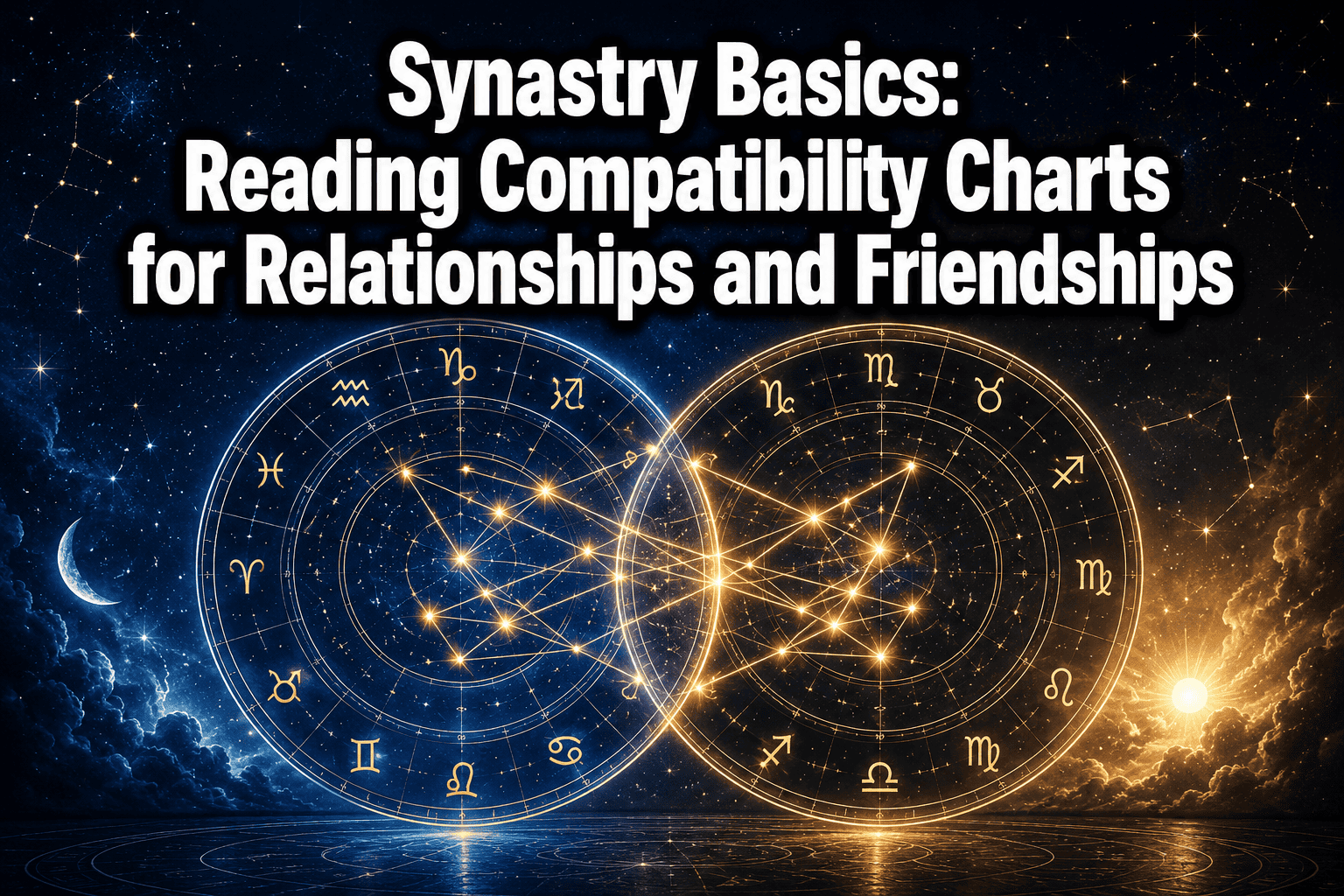
Synastry is the practice of comparing two people’s birth charts to understand how their personalities, needs, and energies interact. By looking at how one person’s planets align with another’s, you can spot natural harmony, friction, and growth potential in any relationship — romantic or platonic.
- Key Takeaways
- What Is Synastry and How Does It Work?
- How to Read a Synastry Chart for Beginners
- Synastry Chart Aspects Explained
- What's the Difference Between Synastry and Composite Charts?
- How Accurate Is Synastry for Relationship Compatibility?
- Can Synastry Predict If a Relationship Will Work Out?
- Synastry Chart for Friendships vs. Romantic Relationships
- What Are Hard Aspects in Synastry and What Do They Mean?
- How to Interpret Venus and Mars in Synastry
- Common Mistakes People Make Reading Synastry Charts
- Synastry Chart Calculator Online Free
- Do Synastry Charts Work If Birth Times Are Unknown?
- Synastry Aspects That Indicate Soulmates or Twin Flames
- How to Use Synastry to Improve a Struggling Relationship
- FAQ: Synastry Basics for Beginners
- Conclusion: Your Next Steps with Synastry
- References
Key Takeaways
- Synastry compares two birth charts by overlaying them and analyzing the angles (aspects) formed between each person’s planets.
- The Sun, Moon, Venus, and Mars are the most important planets to check first in any compatibility reading.
- Harmonious aspects (trines, sextiles) show ease and flow; challenging aspects (squares, oppositions) show tension that can fuel growth or conflict.
- Synastry works for friendships and family bonds, not just romantic relationships.
- Composite charts are different from synastry — they show the relationship itself as a single entity, while synastry shows how two individuals interact.
- Unknown birth times reduce accuracy but don’t make synastry useless — you can still read Sun, Moon, and planetary placements.
- No single aspect “guarantees” a soulmate connection or a doomed relationship. Context and the full chart always matter.
What Is Synastry and How Does It Work?
Synastry is the branch of astrology that compares two people’s natal (birth) charts to assess how their energies interact. Each person’s chart is a snapshot of where the planets were at the moment of their birth, and synastry works by placing those two snapshots side by side — or overlaying them — to see which planets form meaningful angles with each other. [1]
When Person A’s Venus lands close to Person B’s Mars, for example, that creates an aspect. Depending on the angle, that aspect can feel like magnetic attraction, playful tension, or outright friction. Astrologers read these connections to understand attraction, communication styles, emotional compatibility, and long-term potential. [2]
Here’s the basic process:
- Pull both people’s birth charts using accurate birth dates, times, and locations.
- Overlay the charts (most software does this automatically).
- Identify which planets from Chart A form aspects to planets in Chart B.
- Interpret each aspect based on the planets involved and the angle between them.
Synastry doesn’t predict whether a relationship will succeed — it maps the terrain. Think of it as a relationship weather report, not a verdict.
If you’re new to reading charts generally, the guide on astrology for absolute beginners: how to read your first birth chart is a solid starting point before diving into synastry.
How to Read a Synastry Chart for Beginners
For beginners, the best approach to synastry basics is to start with just four planets: the Sun, Moon, Venus, and Mars. These four carry the most weight in relationship dynamics and are the easiest to interpret without years of study. [2]
Step-by-step for first-time readers:
- Generate the chart — Go to astro.com, click “Free Horoscopes,” then “Extended Chart Selection.” Enter both people’s birth data and choose “Synastry Chart” from the chart type menu.
- Find the aspect grid — Most synastry charts include a grid showing every planet-to-planet connection. Start there.
- Focus on the inner planets first — Sun, Moon, Mercury, Venus, and Mars matter most for personal connection.
- Note the aspect symbols — Conjunctions (☌), trines (△), sextiles (✶), squares (□), and oppositions (☍) each have distinct meanings.
- Look for patterns — Multiple harmonious aspects suggest natural ease. Multiple squares suggest recurring friction.
- Check house overlays — Which house does Person A’s Sun fall into in Person B’s chart? That house shows where Person A activates Person B’s life.
Common mistake: Beginners often fixate on one “bad” aspect and panic. A single square doesn’t ruin a chart. Look at the overall balance of aspects before drawing conclusions. [8]
Synastry Chart Aspects Explained
Aspects are the angular relationships between two planets, and they’re the heart of any synastry reading. Each aspect type carries a different quality of energy — neither purely good nor purely bad. [1]
| Aspect | Angle | Symbol | Energy Quality |
|---|---|---|---|
| Conjunction | 0° | ☌ | Intense fusion; can amplify or overwhelm |
| Sextile | 60° | ✶ | Cooperative, easy, supportive |
| Square | 90° | □ | Tension, friction, motivation to grow |
| Trine | 120° | △ | Natural flow, harmony, comfort |
| Opposition | 180° | ☍ | Polarity, attraction, push-pull dynamic |
Key points to remember:
- Trines and sextiles feel easy but can also lack the spark that comes from tension.
- Squares are challenging but often create the chemistry and drive that keep relationships dynamic.
- Conjunctions depend heavily on which planets are involved — Sun conjunct Moon is beautiful; Saturn conjunct Sun can feel heavy.
- Oppositions often show up in long-term couples because the polarity creates fascination. [9]
💡 Pull quote: “A synastry chart full of only trines can feel comfortable but flat. Some squares are what keep two people genuinely engaged with each other.”
Orbs matter: An orb is how many degrees away from exact an aspect can be and still count. Most astrologers use orbs of 5–8° for major aspects and tighter orbs (2–3°) for minor ones.
What’s the Difference Between Synastry and Composite Charts?
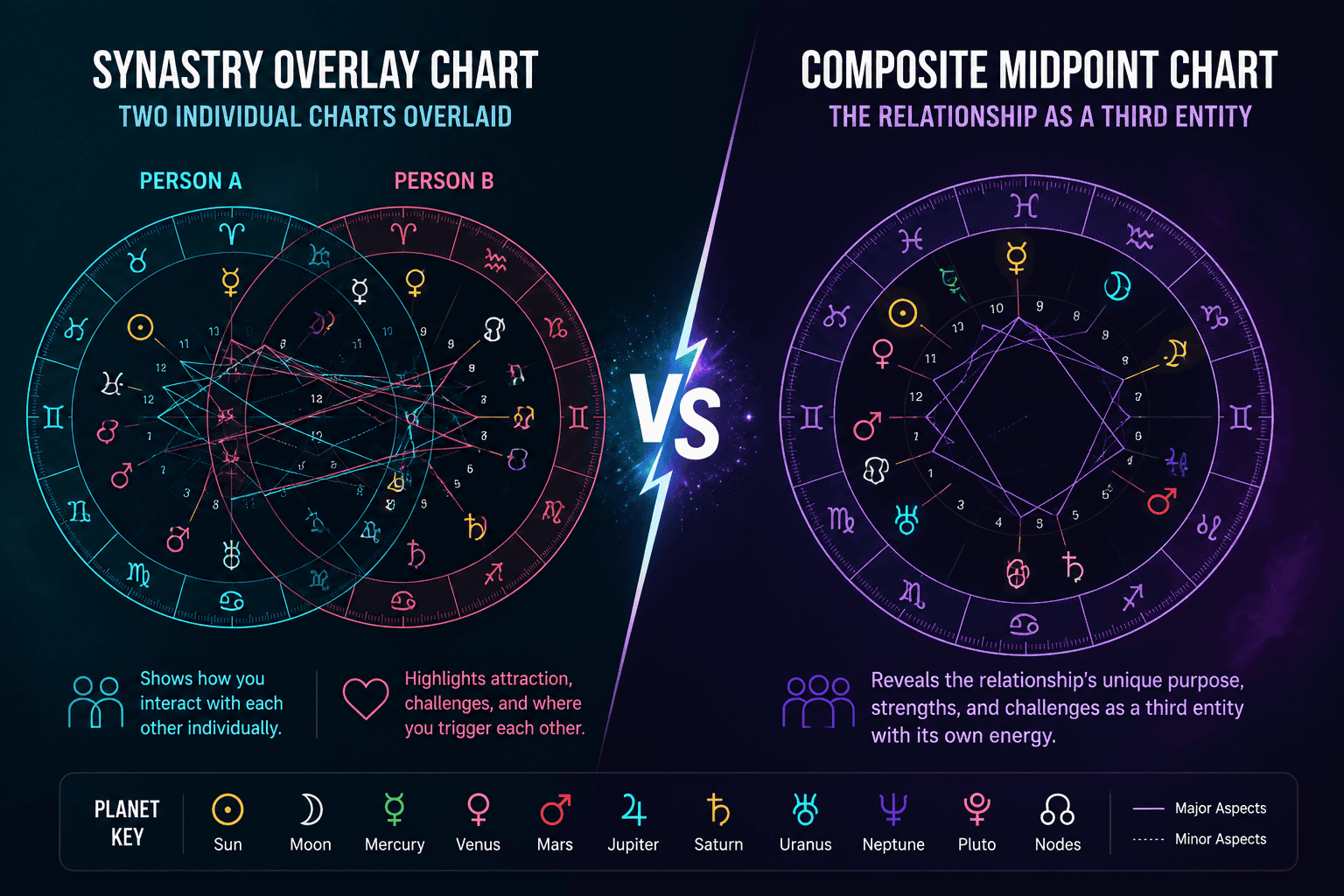
Synastry and composite charts are both compatibility tools, but they answer different questions. Synastry shows how two individuals interact — their planets talking to each other. A composite chart creates a single “relationship chart” by calculating the midpoint between each pair of planets, representing the relationship itself as a third entity. [7]
Choose synastry if you want to know:
- How do I experience this person? How do they experience me?
- Where do our energies naturally click or clash?
- What does this person trigger in me emotionally?
Choose a composite chart if you want to know:
- What is the nature of this relationship as a unit?
- What themes and challenges does this partnership face as a whole?
- Where is the relationship headed long-term?
Most astrologers recommend reading both together for a full picture. Synastry tells you about the chemistry; the composite tells you about the container. For a deeper look at how natal astrology compares to synastry, see this guide on natal astrology vs synastry: mapping personal destiny and relationship compatibility.
How Accurate Is Synastry for Relationship Compatibility?
Synastry is a useful interpretive framework, but it’s not a precise science with measurable accuracy rates. No peer-reviewed studies confirm that specific planetary aspects reliably predict relationship outcomes. What synastry does well is describe energetic patterns and tendencies — it can help explain why two people feel instantly connected or why they keep hitting the same wall. [5]
Factors that affect how useful synastry is:
- Accurate birth times dramatically improve chart precision, especially for house overlays and rising sign aspects.
- Astrological experience matters — the same chart can be read very differently by different practitioners.
- Free will and context — two people with challenging synastry can build a strong relationship through communication and effort.
Realistic expectations: Think of synastry as one lens among many. It works best alongside self-awareness, honest communication, and real-world observation of how two people actually treat each other. [8]
Can Synastry Predict If a Relationship Will Work Out?
Synastry cannot definitively predict whether a relationship will succeed or fail. It can highlight areas of natural ease and areas of recurring tension, but the outcome depends on both people’s choices, maturity, and willingness to grow. [9]
That said, certain patterns do show up consistently in long-lasting relationships:
- Strong Sun-Moon connections between partners (especially conjunctions or trines)
- Venus-Mars aspects that create mutual attraction and desire
- Jupiter aspects that bring optimism and generosity to the relationship
- Shared Saturn aspects that create commitment and long-term staying power
And some patterns tend to create recurring difficulty:
- Saturn square or opposite personal planets can feel restrictive or cold
- Pluto hard aspects can bring power struggles and intensity
- Multiple squares between inner planets can mean constant friction without resolution
Bottom line: Synastry shows potential and patterns. It’s a map, not a destiny.
Synastry Chart for Friendships vs. Romantic Relationships
Synastry works just as well for friendships, family bonds, and work partnerships as it does for romantic relationships. The planets you prioritize shift depending on the relationship type. [2]
For romantic relationships, focus on:
- Venus and Mars aspects (attraction, desire, values alignment)
- Sun-Moon connections (emotional compatibility)
- 5th and 7th house overlays (romance and partnership)
For friendships, focus on:
- Sun-Sun and Mercury aspects (shared identity and communication)
- Moon aspects (emotional safety and trust)
- 11th house overlays (friendship, community, shared goals)
For work partnerships:
- Saturn aspects (structure, responsibility, commitment)
- Mercury connections (communication efficiency)
- 6th and 10th house overlays (work ethic and shared ambitions)
Edge case: Two people with almost no romantic aspects but strong Mercury and Jupiter connections often make excellent long-term friends or creative collaborators, even if a romantic relationship between them fizzled. [5]
What Are Hard Aspects in Synastry and What Do They Mean?
Hard aspects in synastry are the square (90°), opposition (180°), and sometimes the conjunction (0°) when involving challenging planets like Saturn or Pluto. These aspects create friction, tension, and activation — they’re not automatically negative, but they do require more conscious navigation. [1]
What each hard aspect tends to feel like:
- Square: A recurring push-pull where both people trigger each other’s growth edges. Often creates strong chemistry alongside frustration.
- Opposition: A “you have what I lack” dynamic. Oppositions attract because they feel complementary, but they can also feel like constant tug-of-war.
- Challenging conjunctions (e.g., Saturn conjunct Moon): One person’s energy can feel heavy or limiting to the other, even when both people care deeply.
The upside of hard aspects: Relationships with no tension often lack growth. Squares and oppositions push both people to evolve. Many lasting couples have significant hard aspects that keep the relationship dynamic and alive. [9]
⚠️ Common mistake: Assuming hard aspects mean a relationship is doomed. In practice, some of the most enduring partnerships have more squares than trines — because the tension keeps both people invested.
How to Interpret Venus and Mars in Synastry
Venus and Mars are arguably the most important planets for romantic synastry. Venus represents what someone finds beautiful, how they love, and what they value; Mars represents desire, drive, and how someone pursues what they want. When these two planets connect across two charts, the chemistry is usually palpable. [2]
Key Venus-Mars synastry aspects:
- Venus conjunct Mars: One of the strongest indicators of physical and romantic attraction. The Venus person feels adored; the Mars person feels desired.
- Venus trine or sextile Mars: Smooth, easy attraction with mutual appreciation. Less intense than the conjunction but very pleasant.
- Venus square Mars: Magnetic but friction-filled. Attraction is strong, but so is the potential for conflict around values vs. desire.
- Venus opposite Mars: Classic push-pull attraction. Each person represents something the other wants but doesn’t fully have.
Also check:
- Venus conjunct Venus: Shared aesthetic and values — great for friendship and long-term partnership.
- Mars conjunct Mars: Shared drive and energy — can be energizing or competitive depending on other factors.
With Venus retrograde in 2026 affecting relationship dynamics for many signs this year, paying attention to Venus aspects in synastry is especially timely.
Common Mistakes People Make Reading Synastry Charts
Even experienced readers fall into predictable traps when interpreting synastry. Knowing these mistakes upfront saves a lot of misreading. [8]
The most common errors:
- Over-focusing on Sun signs — Sun-sign compatibility is the most surface-level reading. Moon, Venus, and rising sign connections matter far more.
- Treating one aspect as the whole story — A single Venus-Mars conjunction doesn’t guarantee a great relationship; a single Saturn square doesn’t doom it.
- Ignoring house overlays — Which house does someone’s planet activate in your chart? That’s where they impact your life most directly.
- Skipping the individual charts — Understanding each person’s natal chart first makes synastry far more accurate. Someone with Venus in Scorpio will experience the same Venus-Mars trine very differently than someone with Venus in Libra.
- Confusing intensity with compatibility — Pluto aspects feel powerful and transformative, but intensity isn’t the same as healthy connection.
- Ignoring the composite chart — Synastry shows the interaction; the composite shows the relationship’s purpose and trajectory.
For a broader foundation, the astrology for beginners guide to birth charts and natal placements covers the natal chart basics that make synastry readings more accurate.
Synastry Chart Calculator Online Free
Several free, reliable tools generate synastry charts without requiring an account or payment. The most widely used is astro.com, which offers detailed synastry charts with aspect grids, house overlays, and planet-by-planet breakdowns. [3]
Top free synastry chart tools in 2026:
- Astro.com — Most comprehensive free option; includes aspect tables and chart overlays.
- Astro-charts.com — Clean interface, beginner-friendly layout.
- Synastrychart.org — Simple input, quick results, good for basic readings. [3]
- Cafe Astrology — Includes written interpretations alongside chart data, useful for beginners.
What you’ll need to input:
- Full birth date (day, month, year) for both people
- Birth time (as accurate as possible — hospital records or birth certificates are ideal)
- Birth location (city and country)
If you don’t have a birth time: Enter 12:00 noon as a placeholder. The chart will still show planetary positions accurately for most planets, but house placements and the rising sign won’t be reliable.
You can also explore birth chart tools directly at Youstro’s birth chart discovery section.
Do Synastry Charts Work If Birth Times Are Unknown?
Yes, synastry charts are still useful without birth times, but with important limitations. The Sun, Moon (mostly), Mercury, Venus, Mars, Jupiter, and Saturn all move slowly enough that their zodiac sign placements are accurate for the full day — or in the case of outer planets, for months or years. [7]
What you lose without a birth time:
- Accurate rising sign (Ascendant) — this changes every 2 hours
- Correct house placements — houses shift throughout the day
- Precise Moon sign — the Moon moves about 13° per day, so if someone was born near a sign change, the Moon sign could be wrong
What still works:
- All Sun, Venus, Mars, Jupiter, Saturn, Uranus, Neptune, and Pluto aspects
- Most Moon aspects (unless born near a Moon sign cusp)
- General compatibility reading based on planetary placements
Practical tip: If birth time is truly unknown, focus the reading on Sun, Venus, and Mars connections. These give you the most useful compatibility information without needing house data.
Synastry Aspects That Indicate Soulmates or Twin Flames
Certain synastry aspects appear frequently in charts between people who describe their connection as unusually deep, fated, or transformative. While “soulmate” and “twin flame” are cultural concepts rather than astrological terms, specific planetary patterns do correlate with intense, often life-changing bonds. [5]
Aspects commonly associated with deep connection:
- Sun conjunct Moon (or Moon conjunct Sun): One of the most powerful indicators of emotional resonance and long-term compatibility. The Moon person feels deeply understood; the Sun person feels emotionally nourished.
- North Node conjunct personal planets: Suggests a karmic or destiny-flavored connection. The planet person often helps the Node person grow toward their life purpose.
- Venus conjunct Ascendant: Immediate, powerful attraction. The Venus person sees the Ascendant person as beautiful; the Ascendant person feels seen and admired.
- Pluto conjunct Sun, Moon, or Venus: Intense, transformative, often obsessive. These connections change both people profoundly — for better or worse.
- Chiron conjunct personal planets: A healing connection where one person helps the other work through deep wounds.
Important caveat: Intensity is not the same as health. Some of the most “fated-feeling” synastry patterns also carry the most potential for codependency or pain. Always look at the full chart. [8]
For more on how 2026’s planetary shifts are affecting relationship compatibility, the 2026 love horoscopes covering Venus retrograde offers timely context.
How to Use Synastry to Improve a Struggling Relationship
Synastry isn’t just a compatibility scorecard — it’s a diagnostic tool. When a relationship is struggling, a synastry chart can help both people understand why certain patterns keep repeating and where to focus their energy. [9]
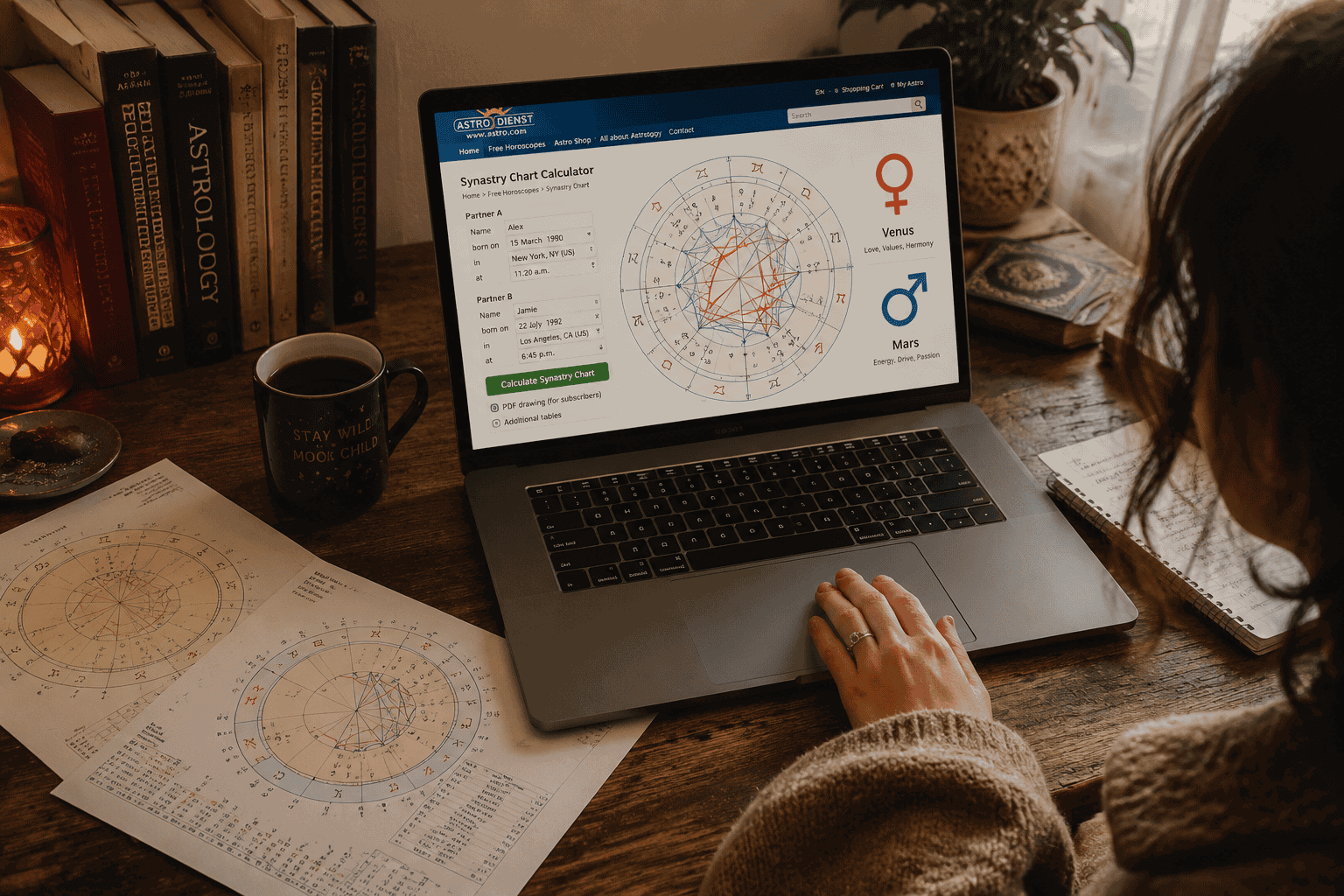
Practical steps for using synastry constructively:
- Identify the recurring friction pattern — Is the same argument happening over and over? Look for squares between Mercury (communication), Mars (conflict), or Saturn (restriction) in the chart.
- Find the strengths — Even difficult charts usually have harmonious aspects. Leaning into those areas can rebuild goodwill.
- Check Saturn aspects — Saturn connections often show where one person feels controlled or limited. Naming this consciously can reduce resentment.
- Look at house overlays — If Person A’s Saturn falls in Person B’s 4th house (home and family), Person A might unconsciously create pressure around domestic life. Awareness helps.
- Use it as a conversation starter — Sharing synastry findings with a partner can open dialogue about needs and patterns without blame.
Choose this approach if: Both people are open to self-reflection and willing to use astrology as a mirror rather than a weapon.
Avoid this approach if: One person is using synastry to “prove” the other person is the problem. Charts show patterns, not fault.
Mercury retrograde periods in 2026 can also amplify communication challenges — see the guide on how Mercury retrograde affects relationship compatibility for timing-specific advice.
FAQ: Synastry Basics for Beginners
Q: What is the most important aspect in a synastry chart? A: Sun-Moon aspects are generally considered the most important for emotional compatibility. Venus-Mars aspects follow closely for attraction and desire.
Q: Can synastry work for same-sex relationships? A: Yes, completely. Synastry is based on planetary placements and aspects, not gender. The same interpretive principles apply to any two people.
Q: How long does it take to learn to read a synastry chart? A: Most beginners can interpret the key aspects (Sun, Moon, Venus, Mars connections) within a few hours of study. Full chart fluency typically takes months of practice.
Q: Is synastry the same as a compatibility report? A: Not exactly. A compatibility report is an automated written interpretation of synastry data. Synastry itself is the raw chart comparison — the report is one way to interpret it.
Q: What if two people have no major aspects between their charts? A: Few or no aspects between charts can indicate two people who simply don’t activate each other much — the relationship may feel neutral or low-drama rather than intensely good or bad.
Q: Does synastry work for family relationships? A: Yes. Parent-child synastry, sibling synastry, and extended family charts all work using the same principles. Saturn and Moon aspects are especially relevant in family dynamics.
Q: What’s the best free tool for synastry in 2026? A: Astro.com remains the most comprehensive free option. It offers detailed aspect grids, house overlays, and the ability to save multiple charts.
Q: Can I do synastry without knowing astrology? A: You can get basic insights using automated reports, but understanding the underlying principles — even at a beginner level — makes the reading far more meaningful and accurate.
Q: Is a synastry chart the same as a couples’ horoscope? A: Not quite. A couples’ horoscope is usually a general Sun-sign forecast. A synastry chart is a detailed comparison of two full birth charts, which is much more specific and nuanced.
Q: What does it mean if someone’s planets fall in my 7th house? A: The 7th house rules partnership and marriage. Planets falling there from another person’s chart often indicate a significant relationship dynamic — they may feel like a natural partner or mirror to you.
Conclusion: Your Next Steps with Synastry
Synastry basics give anyone a practical, grounded way to understand why certain relationships feel easy and others feel like constant work. The key is to start simple: pull both charts, focus on the Sun, Moon, Venus, and Mars connections, and look for overall patterns rather than fixating on single aspects.
Actionable next steps:
- Generate your first synastry chart using astro.com or synastrychart.org — you need both people’s birth date, time, and location.
- Start with four planets: Sun, Moon, Venus, Mars. Read those aspects first before expanding.
- Read each person’s natal chart individually before comparing them — context always improves interpretation.
- Note the house overlays — they show where each person activates the other’s life most directly.
- Use synastry as a conversation tool, not a verdict. The goal is understanding, not judgment.
For broader astrological context in 2026, explore how planetary transits are currently shaping relationship dynamics across all signs. And if you’re ready to go deeper into how individual chart placements affect connection, the natal astrology vs synastry guide is the logical next read.
References
[1] Natal Chart Synastry – https://natalchartsauthority.com/natal-chart-synastry?utm_source=openai
[2] Synastry Guide Zodiac Compatibility – https://zodiacroots.com/synastry-guide-zodiac-compatibility/?utm_source=openai
[3] Compatibility Calculator – https://synastrychart.org/compatibility-calculator?utm_source=openai
[5] Starry Eyed Synastry Zodiac Sign Compatibility Guide – https://www.gaia.com/article/starry-eyed-synastry-zodiac-sign-compatibility-guide?utm_source=openai
[7] Synastry – https://myastrology.com/compatibility/synastry/?utm_source=openai
[8] Synastry Compatibility Guide – https://www.astrochartus.com/blog/synastry-compatibility-guide?utm_source=openai
[9] Synastry Compatibility Explained – https://zodiacroots.com/synastry-compatibility-explained/?utm_source=openai