Astrology’s three modalities — Cardinal, Fixed, and Mutable — are a layer of the zodiac system that explains how each sign operates, not just what it values. Fixed, Mutable, and Cardinal Signs: How Astrology’s Modalities Shape Personality and Behavior is the framework astrologers use to understand decision-making style, leadership approach, adaptability, and conflict response. Every zodiac sign belongs to exactly one modality, and that placement never changes.
- Key Takeaways
- What Exactly Are the Three Modalities in Astrology?
- What Are Fixed Signs in Astrology?
- How Do Cardinal Signs Differ from Mutable Signs?
- Which Zodiac Signs Are Fixed, Cardinal, and Mutable?
- How Much Do Astrological Modalities Really Impact Personality?
- What Are the Strengths and Weaknesses of Each Astrological Modality?
- Do Fixed Signs Struggle More with Change Than Other Modalities?
- Can Your Sign's Modality Predict Career Success and Which Professions Suit Each Modality?
- How Do Mutable Signs Adapt in Relationships?
- Are Cardinal Signs Natural Leaders in Every Situation?
- What Common Misconceptions Exist About Astrological Modalities?
- How Do Astrologers Use Modalities to Understand Compatibility?
- Can Your Modality Change, or Is It Permanent?
- Frequently Asked Questions
- Conclusion: Using Modalities as a Practical Personality Tool
- Sources
Key Takeaways
- The 12 zodiac signs are divided equally into three modalities: Cardinal (4 signs), Fixed (4 signs), and Mutable (4 signs).
- Cardinal signs (Aries, Cancer, Libra, Capricorn) initiate action and tend to lead naturally.
- Fixed signs (Taurus, Leo, Scorpio, Aquarius) sustain effort and resist change more than other modalities.
- Mutable signs (Gemini, Virgo, Sagittarius, Pisces) adapt quickly and excel at transitions.
- Modality is separate from element (fire, earth, air, water) — together, they create a more precise personality picture.
- Your modality shapes how you handle conflict, relationships, career choices, and stress responses.
- Modality is permanent — it’s determined by your sun sign’s position in the zodiac calendar and does not change.
- Astrologers use modality alongside element and planetary rulership to assess compatibility and chart dynamics.
What Exactly Are the Three Modalities in Astrology?

The three modalities — also called quadruplicities — are one of astrology’s core organizing systems. Each modality groups four zodiac signs by the style of energy they express, rather than the element they belong to. Think of modalities as the “operating mode” of a sign: Cardinal signs start things, Fixed signs sustain things, and Mutable signs shift things.
This framework has roots in classical astrology, where astrologers observed that signs appearing at the beginning, middle, and end of each season behaved differently from one another. Cardinal signs open each season, Fixed signs anchor the middle of each season, and Mutable signs close it out and prepare for the next.
Why does this matter? Because two people can share the same element (say, both are fire signs) and still behave very differently. An Aries (Cardinal fire) charges into new projects, while a Leo (Fixed fire) commits deeply to what it already loves. Modality explains that gap.
What Are Fixed Signs in Astrology?
Fixed signs are Taurus, Leo, Scorpio, and Aquarius. They sit in the middle of each season — Taurus in mid-spring, Leo in mid-summer, Scorpio in mid-autumn, Aquarius in mid-winter. This positioning reflects their core trait: stability. Fixed signs are built to sustain, deepen, and protect.
Core traits of Fixed signs:
- Strong willpower and follow-through
- Deep loyalty in relationships and commitments
- Resistance to change, especially when it feels imposed from outside
- Tendency to hold firm opinions and values
- High endurance under pressure
Fixed signs are often the most reliable people in a room — and sometimes the most stubborn. A Scorpio rising, for example, combines Fixed intensity with Scorpio’s emotional depth, creating someone who rarely shifts course once committed.
Common mistake: Assuming Fixed signs are simply “inflexible.” In reality, their resistance to change is often strategic — they’ve invested deeply and don’t abandon things lightly. That’s a strength in long-term projects and relationships, even if it creates friction during transitions.
How Do Cardinal Signs Differ from Mutable Signs?
Cardinal and Mutable signs sit at opposite ends of the seasonal cycle, and their personalities reflect that contrast directly.
Cardinal signs (Aries, Cancer, Libra, Capricorn) are initiators. They show up at the start of each season — spring, summer, autumn, winter — and carry that “beginning energy” into everything they do. Cardinal signs are typically action-oriented, goal-focused, and comfortable making the first move.
Mutable signs (Gemini, Virgo, Sagittarius, Pisces) are adapters. They arrive at the end of each season, when conditions are shifting. Mutable signs are flexible, open to new information, and skilled at pivoting when circumstances change.
| Feature | Cardinal | Mutable |
|---|---|---|
| Seasonal position | Season opener | Season closer |
| Core drive | Initiation | Adaptation |
| Strength | Starting projects | Finishing transitions |
| Challenge | Following through | Committing to one path |
| Decision style | Acts first, adjusts later | Gathers info, then decides |
| Conflict style | Direct confrontation | Avoidance or redirection |
Choose Cardinal if you need: someone to launch a project or make a quick decision under pressure. Choose Mutable if you need: someone to handle a crisis, pivot a strategy, or manage a complex transition.

Which Zodiac Signs Are Fixed, Cardinal, and Mutable?
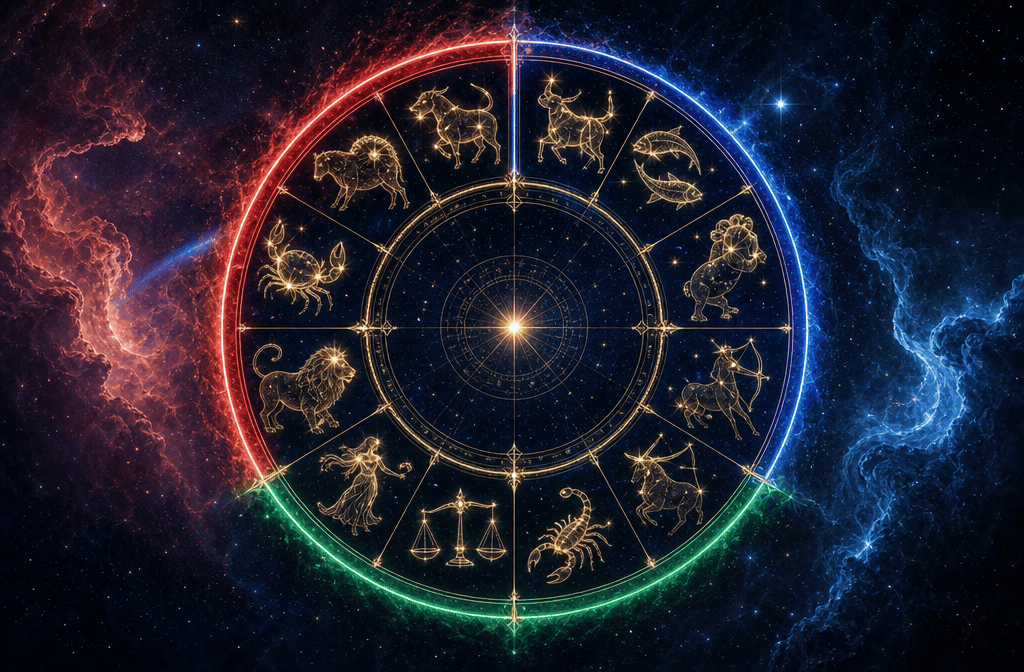
Here’s the complete breakdown of all 12 signs by modality:
Cardinal Signs:
- ♈ Aries (Fire) — bold, pioneering, competitive
- ♋ Cancer (Water) — nurturing, protective, emotionally driven
- ♎ Libra (Air) — diplomatic, relationship-focused, justice-seeking
- ♑ Capricorn (Earth) — ambitious, disciplined, achievement-oriented
Fixed Signs:
- ♉ Taurus (Earth) — patient, sensual, steadfast
- ♌ Leo (Fire) — charismatic, creative, proud
- ♏ Scorpio (Water) — intense, perceptive, transformative
- ♒ Aquarius (Air) — innovative, independent, principled
Mutable Signs:
- ♊ Gemini (Air) — curious, communicative, versatile
- ♍ Virgo (Earth) — analytical, detail-oriented, service-minded
- ♐ Sagittarius (Fire) — philosophical, adventurous, optimistic
- ♓ Pisces (Water) — intuitive, empathetic, imaginative
Each modality contains one sign from each element, which means the system is balanced by design. For a deeper look at how sun sign traits interact with modality, the Gemini Sun Sign Traits guide and the Leo Sun Sign Traits breakdown are useful starting points.
How Much Do Astrological Modalities Really Impact Personality?
Modalities are one of several layers in a natal chart — they don’t operate alone. However, astrologers consistently treat modality as a reliable indicator of behavioral style, particularly in how someone handles pressure, decisions, and change.
The honest answer is that modality’s impact depends on how prominent the modality is across the full chart. Someone with their sun, moon, and rising all in Fixed signs will show very strong Fixed traits. Someone with a mixed chart (say, Cardinal sun, Mutable moon, Fixed rising) will express a blend.
For a complete picture, it helps to understand how your moon sign, sun sign, and rising sign each contribute to the whole. Modality adds a behavioral dimension that element alone doesn’t capture.
What modality reliably predicts:
- How someone initiates (or avoids initiating) action
- How they respond when plans change unexpectedly
- Whether they tend to lead, maintain, or adapt in group settings
- Their general conflict resolution style
What modality doesn’t predict: specific talents, values, emotional needs, or relationship preferences — those require the full chart.
What Are the Strengths and Weaknesses of Each Astrological Modality?
Understanding Fixed, Mutable, and Cardinal Signs: How Astrology’s Modalities Shape Personality and Behavior means looking honestly at both sides of each modality.
Cardinal — Strengths and Weaknesses
✅ Strengths: Natural initiative, goal-setting ability, leadership confidence, quick decision-making, motivates others to act.
⚠️ Weaknesses: Can start too many projects without finishing them, may steamroll others’ input, sometimes prioritizes action over reflection.
Fixed — Strengths and Weaknesses
✅ Strengths: Exceptional follow-through, deep loyalty, high endurance, strong sense of purpose, reliable under pressure.
⚠️ Weaknesses: Resistance to necessary change, can become rigid or controlling, may hold grudges, struggles to let go of outdated patterns.
Mutable — Strengths and Weaknesses
✅ Strengths: Highly adaptable, excellent communicators, open to new perspectives, skilled at managing transitions and crises.
⚠️ Weaknesses: Can be indecisive, may lack consistency, sometimes changes direction too frequently, can struggle with commitment.
Do Fixed Signs Struggle More with Change Than Other Modalities?
Yes — Fixed signs generally have the most difficulty with externally imposed change, and this is one of the most consistent patterns in astrological modality analysis. Because Fixed signs are designed to sustain and deepen existing commitments, sudden shifts feel destabilizing rather than exciting.
This doesn’t mean Fixed signs can’t change — they absolutely can, and often make profound transformations. But those changes typically happen on their own timeline, through internal conviction rather than outside pressure. Taurus might take months to decide to move cities, but once decided, they’ll execute flawlessly. Scorpio resists surface-level change but is capable of complete personal reinvention when they choose it.
Edge case: A Fixed sign with a prominent Mutable moon or rising may actually adapt more fluidly than their sun sign suggests. The full chart always modifies the picture.
Practical tip: If you’re working with a Fixed sign colleague or partner and need them to change course, give them time, data, and space to arrive at the decision themselves. Forcing the issue tends to harden their resistance.
Can Your Sign’s Modality Predict Career Success and Which Professions Suit Each Modality?
Modality doesn’t predict success — but it does strongly indicate which work environments and roles will feel natural versus draining.

Cardinal signs thrive in: entrepreneurship, executive leadership, project management, emergency medicine, politics, real estate, and any role that rewards initiative. Aries and Capricorn in particular tend to gravitate toward roles where they can set the direction.
Fixed signs thrive in: research, finance, surgery, architecture, law, long-term investment management, and any field requiring deep expertise built over years. Taurus and Scorpio often excel in roles that reward patience and precision.
Mutable signs thrive in: journalism, teaching, consulting, therapy, translation, event coordination, and any role requiring quick thinking and versatility. Gemini and Virgo often do well in communication-heavy or analytical roles.
Important note: Career success depends on the full natal chart, not modality alone. Planetary placements, house positions, and current transits all play a role. For context on how planetary energy interacts with career timing, the complete guide to planetary transits in 2026 offers useful background.
How Do Mutable Signs Adapt in Relationships?
Mutable signs (Gemini, Virgo, Sagittarius, Pisces) are the most flexible partners in the zodiac — and that flexibility is both their greatest relationship asset and their biggest challenge.
In relationships, Mutable signs adapt naturally to their partner’s needs, communication style, and emotional rhythms. They’re less likely to dig in during conflict and more likely to find a workaround or shift their perspective. This makes them easy to live with in many ways.
Where Mutable signs struggle in relationships:
- Consistency: partners may feel like the Mutable sign is a different person depending on the day
- Commitment: Mutable signs can genuinely love someone while still feeling pulled toward new experiences
- Boundaries: their adaptability can slide into people-pleasing if they’re not self-aware
Gemini-Libra compatibility is a good example of how Mutable air energy interacts with Cardinal air energy in a relationship — the Gemini adapts and explores while the Libra initiates and balances.
Best match dynamic for Mutable signs: a partner with some Fixed energy provides the stability Mutable signs often secretly crave, while Mutable signs help Fixed partners loosen up.
Are Cardinal Signs Natural Leaders in Every Situation?
Cardinal signs have a strong leadership instinct, but “natural leader in every situation” overstates it. Cardinal energy is best suited to initiating leadership — stepping up when something new needs to be started or a direction needs to be set.
Where Cardinal signs can struggle as leaders:
- Long-term management: once the exciting launch phase is over, Cardinal energy can lose momentum
- Collaborative decisions: Cardinal signs often prefer to decide quickly, which can feel dismissive to team members who need more input time
- Crisis maintenance: they’re great at responding to a crisis but may hand off the sustained recovery work to Fixed colleagues
Aries leads through bold action and competitive drive. Cancer leads through emotional intelligence and protective instincts. Libra leads through consensus-building and fairness. Capricorn leads through strategy and long-term planning.
For a closer look at how Aries cardinal energy plays out in 2026, the Aries Season 2026 overview covers how Cardinal fire interacts with current planetary conditions.
What Common Misconceptions Exist About Astrological Modalities?
Several persistent misunderstandings make modalities harder to apply accurately.
Misconception 1: Fixed = stubborn, Mutable = flaky, Cardinal = bossy. These are caricatures. Every modality has a healthy expression and an unhealthy one. Fixed determination becomes stubbornness only under stress. Mutable flexibility becomes inconsistency only without self-awareness. Cardinal initiative becomes bossiness only without empathy.
Misconception 2: Your sun sign’s modality is your only modality. Your full chart contains placements across multiple signs. If your moon is in a Mutable sign and your sun is Cardinal, you’ll likely show significant Mutable traits in emotional situations.
Misconception 3: Modality is the same as element. Element (fire, earth, air, water) describes what a sign values. Modality describes how it acts. A Taurus (Fixed earth) and a Capricorn (Cardinal earth) both value security and practicality, but Taurus sustains while Capricorn initiates.
Misconception 4: One modality is better than the others. Each modality is necessary. Without Cardinal energy, nothing new begins. Without Fixed energy, nothing gets completed. Without Mutable energy, nothing transitions smoothly.
How Do Astrologers Use Modalities to Understand Compatibility?
Understanding Fixed, Mutable, and Cardinal Signs: How Astrology’s Modalities Shape Personality and Behavior is particularly useful in compatibility analysis, where modality often predicts friction patterns more accurately than element alone.

Same-modality pairings tend to understand each other’s operating style intuitively but can also amplify each other’s weaknesses. Two Fixed signs may be deeply loyal to each other but lock horns over who gets to be right. Two Cardinal signs may inspire each other but compete for control.
Cross-modality pairings often create productive tension. A Cardinal-Fixed pairing works well when the Cardinal partner initiates and the Fixed partner sustains — a natural division of roles. A Fixed-Mutable pairing can balance stability with flexibility, though the Fixed partner may find the Mutable partner unreliable.
Astrologers look at modality in synastry and natal chart comparison to identify where two people naturally complement each other and where they’re likely to clash. Modality squares — Cardinal vs. Cardinal, Fixed vs. Fixed, Mutable vs. Mutable — often show up as the most intense points of conflict in a relationship chart.
For a broader look at compatibility layers beyond modality, Moon and Venus compatibility adds emotional and relational nuance to the picture.
Can Your Modality Change, or Is It Permanent?
Your sun sign’s modality is permanent — it’s determined by the date you were born and the position of the sun in the zodiac at that time. Aries is always Cardinal. Taurus is always Fixed. Gemini is always Mutable. That doesn’t change.
What can shift is how prominently a modality expresses itself in your life. As people mature, they often learn to access the strengths of modalities other than their dominant one. A Fixed-heavy person can learn to embrace change. A Cardinal-heavy person can develop follow-through. A Mutable-heavy person can build consistency.
Additionally, transiting planets move through different modalities throughout the year, temporarily activating Cardinal, Fixed, or Mutable energy for everyone. For example, when multiple planets cluster in Fixed signs, collective energy tends to feel more resistant and determined. When Cardinal signs are heavily activated — as during Aries season — there’s a collective push toward new beginnings.
Frequently Asked Questions
Q: What is the rarest modality combination? A: No modality is inherently rare — each contains four signs. However, having a chart dominated entirely by one modality (sun, moon, rising, and multiple planets all in Fixed signs, for example) is less common and creates a very concentrated personality expression.
Q: Can two people with the same modality have a successful relationship? A: Yes. Same-modality relationships are common and can be deeply fulfilling. The key is awareness of shared blind spots — two Mutable signs need to build structure together, while two Fixed signs need to practice compromise.
Q: Is modality the same as quality in astrology? A: Yes — “quality” and “modality” are used interchangeably in astrology. Both terms refer to the Cardinal, Fixed, and Mutable classification system.
Q: Which modality is most common among world leaders? A: Anecdotally, Cardinal signs appear frequently among political leaders, which aligns with their initiating nature. However, no large-scale peer-reviewed study has confirmed this, so treat it as an observation rather than a verified fact.
Q: Do modalities apply to rising signs and moon signs too? A: Yes. Every sign placement in your chart — sun, moon, rising, Mercury, Venus, Mars, and so on — carries the modality of whatever sign it falls in. A Scorpio moon is Fixed. A Sagittarius rising is Mutable.
Q: Which modality handles stress best? A: Each handles stress differently. Cardinal signs act — they respond to stress by doing something. Fixed signs endure — they dig in and outlast the pressure. Mutable signs adapt — they reframe the situation and find a new angle. None is objectively “better” at stress; it depends on the type of challenge.
Q: Are Mutable signs more likely to change their minds? A: Yes, more so than Fixed signs. Mutable signs genuinely update their views when new information arrives — this is a strength, not a flaw. Fixed signs tend to hold their positions longer, which can be either principled or rigid depending on the situation.
Q: What does it mean to have a “modality imbalance” in a natal chart? A: A modality imbalance means most of your chart’s planets fall in one or two modalities, with little representation in the third. For example, a chart heavy in Cardinal and Fixed but light in Mutable signs may indicate someone who struggles with transitions and adapting to unexpected change.
Q: How do modalities interact with the 12 astrological houses? A: The houses don’t carry modalities directly, but the signs that rule each house do. Understanding which modality governs your 1st house (rising sign), 10th house (career), and 7th house (relationships) can reveal a lot. The 12 astrological houses explained is a good resource for connecting houses with sign modalities.
Q: Is modality used in Vedic astrology too? A: Yes — Vedic astrology uses a similar system called gunas (Rajas, Tamas, Sattva), which loosely parallels the Cardinal, Fixed, and Mutable framework, though the philosophical framing differs significantly.
Conclusion: Using Modalities as a Practical Personality Tool
The framework of Fixed, Mutable, and Cardinal Signs: How Astrology’s Modalities Shape Personality and Behavior is one of astrology’s most immediately useful tools — not because it predicts the future, but because it explains the how behind behavior that sun signs alone can’t fully account for.
Actionable next steps:
- Identify your dominant modality. Check your sun, moon, and rising sign — do they share a modality? If so, that modality’s traits will be especially prominent in your personality.
- Look at your chart’s modality balance. Count how many planets fall in Cardinal, Fixed, and Mutable signs. A heavy imbalance in one direction is worth noting.
- Apply modality awareness to relationships. When friction arises with someone, consider whether it’s a modality clash — a Cardinal person pushing for action while a Fixed person resists change, for example.
- Use modality to choose environments wisely. If you’re Fixed-dominant, seek roles with long-term projects. If you’re Mutable-dominant, prioritize flexibility and variety. If you’re Cardinal-dominant, look for opportunities to lead and initiate.
- Explore your full chart. Modality is one layer. For the complete picture, understanding your natal chart’s houses and planetary placements adds depth that modality alone can’t provide.
Modalities won’t tell you everything — but they’ll explain a surprising amount about why you and the people around you operate the way you do.
Sources
- Arroyo, Stephen. Astrology, Psychology, and the Four Elements. CRCS Publications, 1975.
- Hand, Robert. Horoscope Symbols. Whitford Press, 1981.
- Sasportas, Howard. The Twelve Houses. Flare Publications, 1985.
- Tyl, Noel. Synthesis & Counseling in Astrology. Llewellyn Publications, 1994.
- Campion, Nicholas. A History of Western Astrology, Volume II. Continuum, 2009.