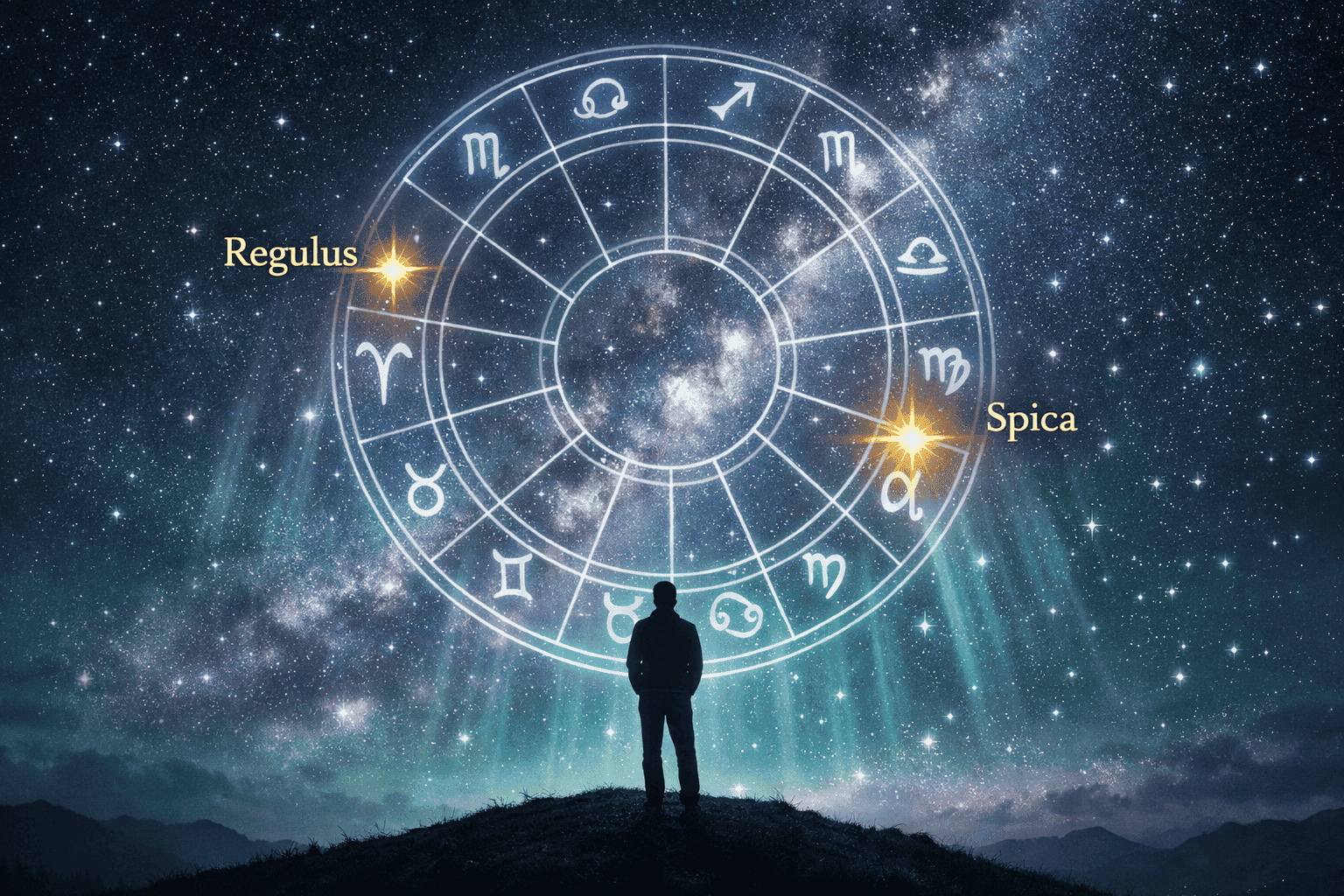
Fixed stars in your natal chart are specific bright stars whose positions at your birth add layers of meaning that planets and houses alone cannot provide. When a fixed star aligns closely with a natal planet or angle (within 1–2 degrees), it can amplify, challenge, or redirect that planet’s energy in powerful ways. Stars like Sirius, Aldebaran, Regulus, and Spica have been used by astrologers for over 2,000 years to describe fame, fortune, courage, and downfall. Checking fixed star conjunctions is one of the most practical ways to deepen any birth chart reading.
- Key Takeaways
- What Are Fixed Stars in Astrology, and Why Do They Matter?
- How Do Fixed Stars Work in a Natal Chart? The Mechanics Explained
- The Most Important Fixed Stars and Their Meanings
- How to Find Fixed Stars in Your Own Natal Chart
- Fixed Stars in Your Natal Chart: How They Interact with Transits and Progressions
- Fixed Stars vs. Planets and Houses: What's the Difference?
- FAQ: Fixed Stars in Natal Astrology
- Conclusion: Adding Fixed Stars to Your Astrological Practice
- References
Key Takeaways
- Fixed stars are not actually fixed — they move very slowly (about 1 degree every 72 years due to precession), but they appear stationary compared to the planets.
- Orb matters enormously: Most modern astrologers use a tight orb of 1–2 degrees for fixed star conjunctions. Wider orbs dilute the effect significantly.
- Conjunctions are king: Fixed stars primarily work through conjunction with natal planets or chart angles (Ascendant, Midheaven, Descendant, IC).
- The 15 Behenian stars are a classical set of stars considered especially powerful in traditional astrology.
- Sirius, Aldebaran, Regulus, and Spica are among the most widely interpreted fixed stars in natal work.
- Fixed stars do not replace planets — they add a layer of nuance, often describing the quality or fate of a planetary energy rather than its basic function.
- Precession shifts star positions over centuries, so modern star positions differ from those used in ancient texts by roughly 24–25 degrees.
- 2026 is an active year for fixed star research, as astrologers are cross-referencing star positions with major transits like Uranus entering Gemini and Saturn in Aries.
What Are Fixed Stars in Astrology, and Why Do They Matter?
Fixed stars are distant suns — some thousands of light-years away — whose positions in the sky appear stable compared to the moving planets. In natal astrology, a fixed star’s influence becomes relevant when it sits within a very tight orb of a planet, the Ascendant, or the Midheaven in a birth chart.
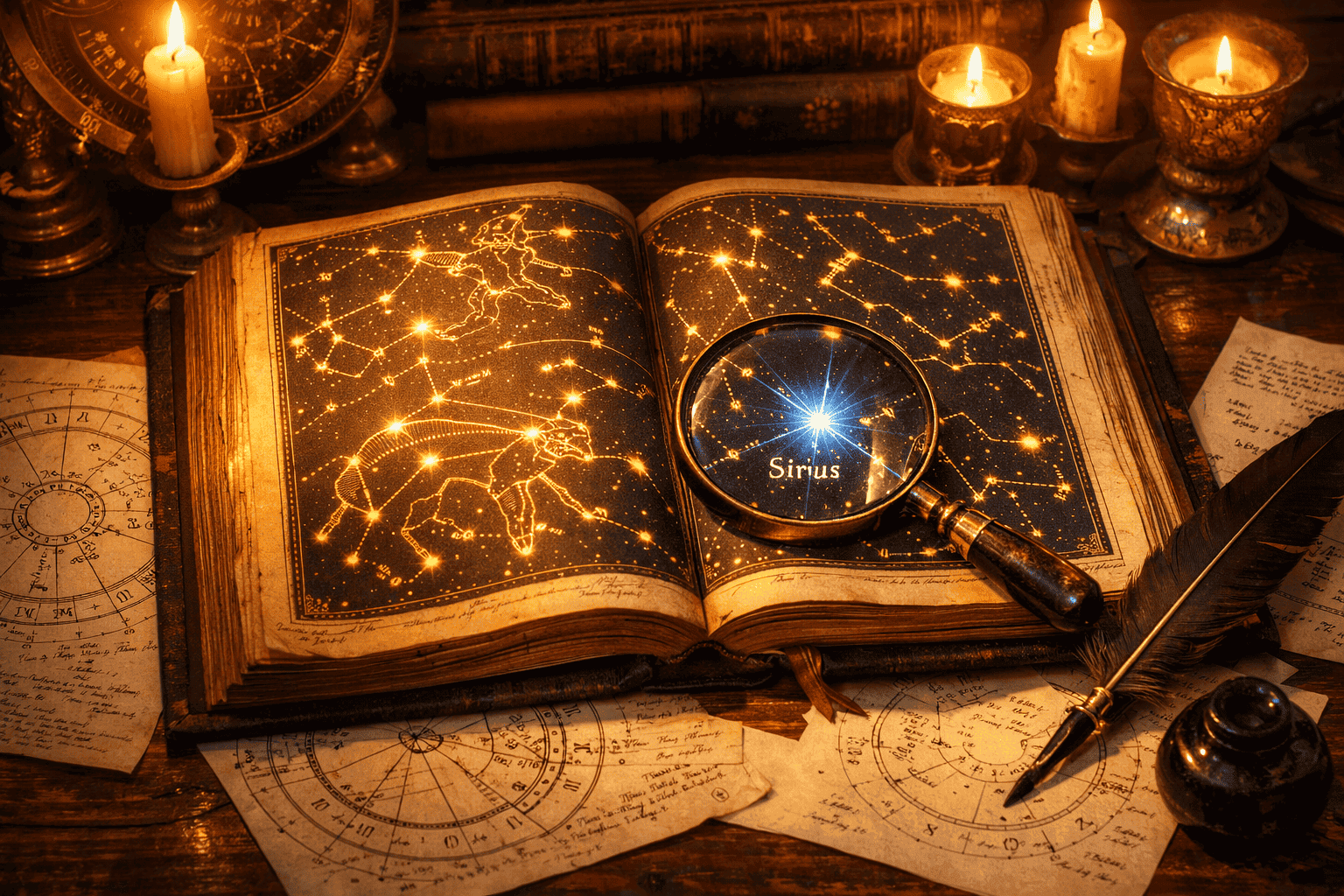
The concept of Fixed Stars in Your Natal Chart: Hidden Cosmic Influences Beyond Planets and Houses has deep roots. Babylonian, Egyptian, Greek, and medieval astrologers all catalogued star positions and assigned specific meanings to them. The Greek astronomer Ptolemy included fixed stars in his Tetrabiblos (c. 150 CE), and medieval astrologers like Cornelius Agrippa documented the 15 Behenian stars — a curated list of stars thought to hold special magical and predictive power.
Why do they matter in 2026?
- Planets describe how energy operates (Mars = action, Venus = love, Saturn = structure).
- Fixed stars describe what kind of destiny or quality colors that energy — often in vivid, specific terms like “great honor,” “sudden loss,” or “exceptional skill.”
- When a natal planet sits on a powerful fixed star, the star’s archetype can define that planet’s expression for an entire lifetime.
💡 Key distinction: Planets move through your chart via transits and progressions. Fixed stars stay essentially locked to your natal degree, making their influence a permanent background note rather than a passing transit.
If you’re new to birth chart reading, start with the astrology basics guide before adding fixed stars — the foundational concepts make star work much clearer.
How Do Fixed Stars Work in a Natal Chart? The Mechanics Explained
Fixed stars work almost exclusively through conjunction. Unlike planets, they don’t form squares, trines, or oppositions in the traditional sense. A fixed star’s energy “activates” when it falls within 1–2 degrees of a natal planet or chart angle.
The three most important contact points:
- Conjunct the Ascendant — shapes physical appearance, first impressions, and life approach.
- Conjunct the Midheaven (MC) — strongly influences career, public reputation, and legacy.
- Conjunct a natal planet — colors how that planet expresses its core themes throughout life.
Orb guidelines (practical use):
| Contact Point | Recommended Orb |
|---|---|
| Ascendant or MC | Up to 2° |
| Sun or Moon | Up to 2° |
| Other personal planets (Mercury, Venus, Mars) | 1°–1.5° |
| Outer planets (Jupiter–Pluto) | 1° or less |
Common mistake: Using orbs of 5–7 degrees for fixed stars (the way you might for planetary aspects). This produces so many hits that every chart looks loaded with star influences, which dilutes accuracy considerably.
Precession note: Fixed star positions advance about 1 degree every 72 years. A star listed at 14° Cancer in a 1st-century text sits around 24° Cancer today. Always use current (precessed) star positions when working with a modern birth chart.
The Most Important Fixed Stars and Their Meanings
Not all fixed stars carry equal weight. The ones below appear most consistently in serious natal interpretations, and each has a distinct archetypal signature.
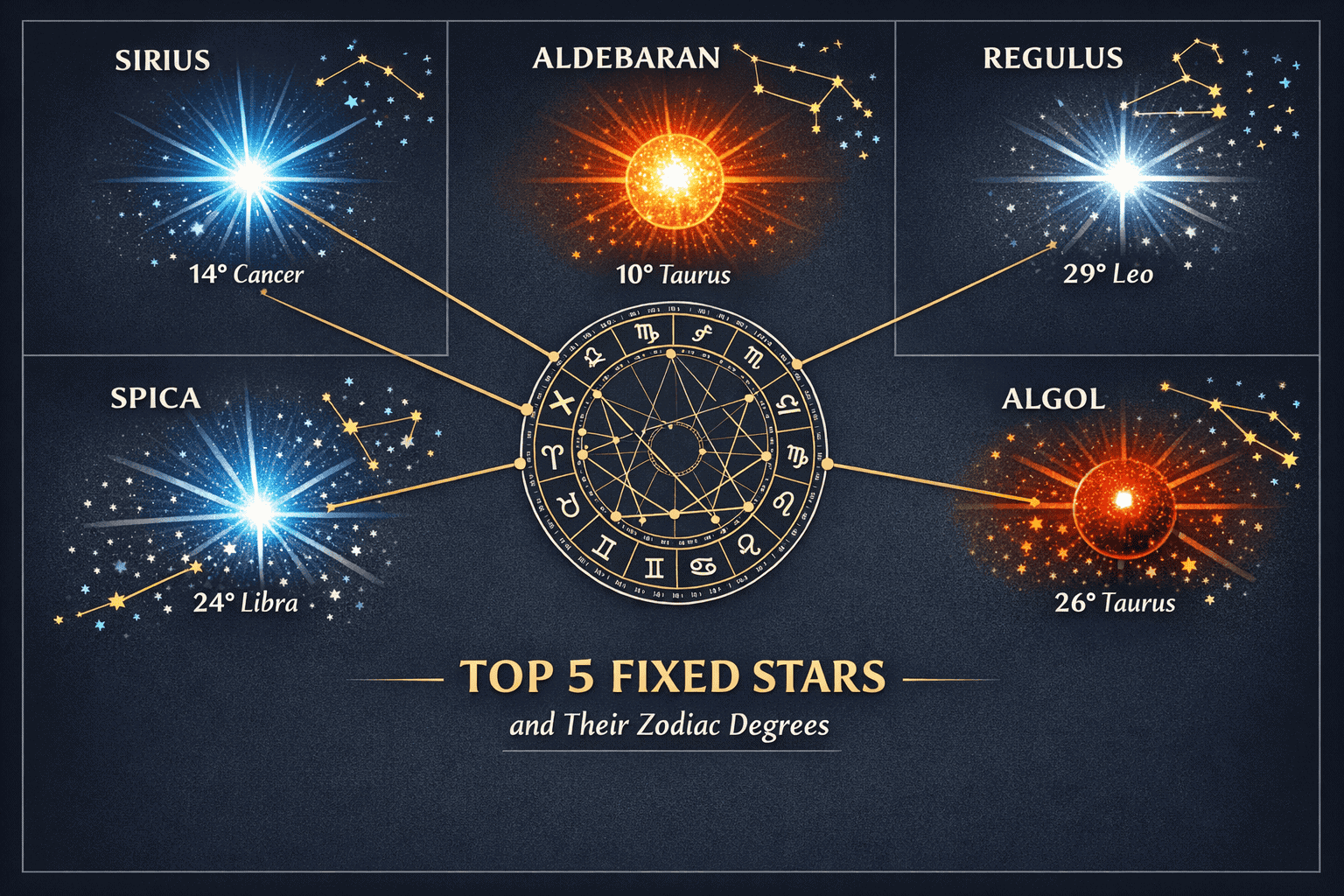
Sirius (currently ~14° Cancer)
Sirius is the brightest star in the night sky and one of the most consistently positive fixed stars in natal work. Its conjunction with natal planets or angles is associated with fame, exceptional achievement, loyalty, and strong intuition. Ancient Egyptians considered Sirius the “Star of Isis” and marked the Nile’s flooding by its heliacal rising.
- Conjunct Sun or MC: Strong potential for public recognition and lasting reputation.
- Conjunct Moon: Emotional depth, strong family bonds, and intuitive gifts.
- Shadow side: Sirius can also indicate burnout from overachievement or living too intensely.
Aldebaran (currently ~10° Gemini)
Aldebaran is one of the four Royal Stars of Persia, associated with integrity, courage, and leadership. It promises great success — but with a condition: the success holds only as long as the person maintains their integrity. Betrayal or corruption can reverse the fortune sharply.
- Conjunct Ascendant or MC: Natural authority, charisma, and the ability to lead.
- Conjunct Mars: Warrior energy, physical courage, and competitive drive.
- Watch for: The “condition” of Aldebaran is real in practice — charts with this star prominent often show dramatic rises followed by equally dramatic falls when ethics are compromised.
Regulus (currently ~0° Virgo)
Regulus, the “Heart of the Lion,” moved from Leo into Virgo around 2011–2012 due to precession — a shift that astrologers are still interpreting. Traditionally, Regulus offers fame, honor, and military or leadership success, again with the condition that revenge is avoided. Seeking revenge when wronged is said to undo all the gains Regulus provides.
- Conjunct Sun: Strong leadership potential and public prominence.
- Conjunct Midheaven: Career in leadership, politics, military, or public service.
- 2026 context: With Saturn now in Aries building new structures in your natal chart, those with Regulus conjunct personal planets may feel a particular push to lead with discipline and restraint.
Spica (currently ~24° Libra)
Spica is widely considered the most purely beneficial fixed star in astrology. It sits in the constellation Virgo and is associated with gifts, talents, artistic ability, and fortunate circumstances that seem to arrive without much effort. Spica conjunct a natal planet often indicates a natural talent in that planet’s domain.
- Conjunct Venus: Exceptional artistic or musical ability, beauty, social grace.
- Conjunct Mercury: Brilliant mind, writing talent, gift for languages.
- Conjunct Jupiter: Remarkable luck, generosity, and the ability to attract abundance.
Algol (currently ~26° Taurus)
Algol is the most feared fixed star in Western astrology — called the “Demon Star” or “Medusa’s Head” in Perseus. It’s associated with violence, loss, and intense transformation. However, modern astrologers increasingly interpret Algol as representing raw, primal power that, when consciously channeled, becomes transformative rather than destructive.
- Conjunct Sun or Ascendant: Intense life experiences, often involving loss or confrontation with darkness, but also deep resilience.
- Conjunct Mars: Powerful physical energy that needs conscious direction.
- Reframe: Algol is not automatically “bad” — it’s intense. Many surgeons, trauma workers, and crisis leaders have Algol prominent.
How to Find Fixed Stars in Your Own Natal Chart
Finding fixed star conjunctions is straightforward with the right tools. Here’s a practical step-by-step approach:

Step-by-step process:
- Get your natal chart with exact planet and angle degrees. If you’re still building your chart-reading skills, the beginner’s guide to birth charts covers the essentials.
- List your natal positions — note the degree and sign of your Sun, Moon, Ascendant, Midheaven, and personal planets (Mercury through Mars).
- Use a fixed star reference — Astro.com’s extended chart selection includes fixed stars as an overlay option. Alternatively, Bernadette Brady’s Brady’s Book of Fixed Stars (1998) provides a comprehensive modern reference.
- Check for conjunctions within 1–2 degrees using current (precessed) star positions.
- Prioritize by importance: Ascendant and MC contacts first, then Sun and Moon, then other planets.
- Read the star’s archetype and consider how it modifies the planet’s basic energy.
Quick reference — major fixed stars and current positions (2026):
| Star | Current Position | Traditional Meaning |
|---|---|---|
| Algol | ~26° Taurus | Intense transformation, raw power |
| Alcyone (Pleiades) | ~0° Gemini | Mysticism, grief, artistic vision |
| Aldebaran | ~10° Gemini | Courage, integrity, leadership |
| Sirius | ~14° Cancer | Fame, loyalty, exceptional achievement |
| Regulus | ~0° Virgo | Honor, leadership, avoid revenge |
| Spica | ~24° Libra | Gifts, talent, fortunate circumstances |
| Arcturus | ~24° Libra | New paths, pioneering, success abroad |
| Antares | ~10° Sagittarius | Warrior spirit, obsession, intensity |
Fixed Stars in Your Natal Chart: How They Interact with Transits and Progressions
Fixed stars in your natal chart don’t just sit quietly — they can be activated by transiting planets moving over the same degree. This is where Fixed Stars in Your Natal Chart: Hidden Cosmic Influences Beyond Planets and Houses becomes especially practical for timing.
How activation works:
- When a transiting planet crosses within 1 degree of your natal fixed star conjunction, the star’s themes often surface in real-world events.
- Solar Arc directions and secondary progressions can also trigger fixed star degrees.
- Example: If natal Mars sits at 13° Cancer (conjunct Sirius at ~14° Cancer), a transiting Jupiter crossing 13–14° Cancer could bring a significant public achievement or recognition — Sirius’s signature amplified by Jupiter’s expansion.
2026 activations worth watching:
- Jupiter enters Cancer on June 2, 2026 bringing emotional wealth expansion, which means Jupiter will move through Sirius’s degree (~14° Cancer) in late summer 2026. Anyone with natal planets near 14° Cancer may experience a Sirius-flavored Jupiter transit — a strong window for recognition and achievement.
- Uranus entering Gemini in April 2026 revolutionizing communication and self-expression will move toward Aldebaran (~10° Gemini) over the coming years, potentially shaking up themes of leadership and integrity on a collective level.
💡 Practical tip: Note the degrees of your most important fixed star conjunctions, then track when slow-moving planets (Jupiter, Saturn, Uranus) cross those degrees. These are often the years when the star’s promise — or challenge — becomes most visible.
For a broader look at how to read your natal chart during active transit periods, see this guide on reading your natal chart during a green-light month.
Fixed Stars vs. Planets and Houses: What’s the Difference?
Understanding how fixed stars fit alongside planets and houses prevents confusion and makes chart reading more layered without becoming overwhelming.
| Element | What It Describes | How It Changes |
|---|---|---|
| Planets | Core drives, psychological functions | Move continuously; shift by transit/progression |
| Houses | Life areas (career, love, home, etc.) | Fixed to birth time; activated by transits |
| Signs | Style, tone, and approach | Fixed at birth |
| Fixed Stars | Archetypal destiny quality; specific fate themes | Essentially permanent; move ~1°/72 years |
Choose fixed stars when:
- A natal planet or angle has an unusually strong or unusual expression that signs and houses don’t fully explain.
- A person’s life story shows recurring themes (persistent fame, recurring loss, exceptional talent) that seem “fated” rather than circumstantial.
- You want to add depth to a Midheaven or Ascendant reading.
Don’t use fixed stars when:
- You’re still learning the basics — planets, signs, and houses should be solid first.
- You’re using orbs wider than 2 degrees (the results become unreliable).
- You want to explain everyday moods or short-term events (transiting planets are better for that).
For those also exploring relationship dynamics, natal astrology vs. synastry explains how these different chart layers interact in compatibility readings.
FAQ: Fixed Stars in Natal Astrology
Q: Do fixed stars work for everyone, or only certain chart types? Fixed stars work for any natal chart, but their influence is most noticeable when they conjunct the Ascendant, Midheaven, Sun, or Moon. Charts with no tight fixed star conjunctions simply have less star influence — that’s normal, not a deficiency.
Q: How many fixed stars should I look for in my chart? Focus on 2–5 at most. Checking every star in the sky produces noise rather than insight. Prioritize the major stars listed in this article and use a strict 1–2 degree orb.
Q: Is Algol always negative? No. Algol is intense and associated with confrontation with darkness, but many people with Algol prominent lead lives of deep transformation, healing, and resilience. The key is conscious engagement with the star’s energy rather than avoidance.
Q: Can fixed stars override a planet’s sign placement? They don’t override — they layer on top. A Venus in Capricorn conjunct Spica still operates with Capricorn’s practical, structured approach to love, but Spica adds a gift quality and artistic ease that plain Capricorn Venus might not show.
Q: Do fixed stars affect synastry (relationship charts)? Yes, though this is advanced territory. When one person’s planet conjuncts a fixed star in the other person’s chart, the star’s themes can color the relationship dynamic. Sirius contacts in synastry often indicate loyalty and intensity; Algol contacts can indicate transformative but turbulent bonds.
Q: How do I know if a fixed star is really influencing my chart? Look at your life story. If Regulus conjuncts your Midheaven and you’ve consistently been drawn to leadership roles, or if Spica conjuncts your Mercury and you’ve always had an unusual ease with language, the star is working. Life patterns confirm star influence more reliably than theory alone.
Q: What’s the difference between a Behenian star and other fixed stars? The 15 Behenian stars are a medieval classification of stars considered especially powerful for magical and astrological purposes. They include Sirius, Aldebaran, Regulus, Spica, and Algol, among others. The classification comes from Arabic and Latin medieval texts and was popularized by Cornelius Agrippa in the 16th century. Being “Behenian” doesn’t make a star more real — it just means it was prioritized in the classical tradition.
Q: Are fixed stars used in Vedic astrology too? Yes — Vedic astrology uses 27 Nakshatras (lunar mansions), which are essentially fixed star-based divisions of the zodiac. The approach differs from Western fixed star work but shares the core idea that specific star positions add meaning beyond planetary signs.
Q: How often do fixed star positions change? Due to precession of the equinoxes, fixed stars advance approximately 1 degree every 72 years. Over a human lifetime, a star moves less than 1 degree — essentially negligible for natal work. But comparing ancient star positions to modern ones requires accounting for roughly 24–25 degrees of accumulated precession.
Q: Can I use fixed stars for predictive astrology, not just natal? Yes. When a transiting or progressed planet crosses a natal fixed star degree, the star’s themes often manifest as events. This is one of the most practical predictive uses of fixed stars.
Conclusion: Adding Fixed Stars to Your Astrological Practice
Fixed stars offer a dimension of natal chart interpretation that planets and houses simply cannot replicate. They describe the quality of fate — the specific archetypal flavor that colors a planet’s expression for an entire lifetime. Sirius brings brilliance and loyalty. Aldebaran demands integrity as the price of success. Regulus warns against revenge. Spica delivers gifts almost effortlessly. Algol transforms through intensity.
Actionable next steps:
- Pull up your natal chart and list the exact degrees of your Ascendant, Midheaven, Sun, Moon, and personal planets.
- Cross-reference with the fixed star table in this article. Look for conjunctions within 1–2 degrees.
- Read the star’s archetype and reflect on whether its themes appear in your life story.
- Track upcoming transits over your fixed star degrees — especially Jupiter’s move through Cancer in summer 2026, which will activate Sirius for many charts.
- Start with one or two stars before expanding. Depth beats breadth in fixed star work.
The planets show the engine. The houses show the terrain. The fixed stars show the destiny woven into the fabric of the chart — the hidden cosmic influences that have been there all along, waiting to be noticed.
References
[1] Astrology April 2026 The Destiny Reset You Cant Ignore – https://t2conline.com/astrology-april-2026-the-destiny-reset-you-cant-ignore/ [5] April 2026 Astrology Forecast – https://www.moonomens.com/april-2026-astrology-forecast/ [6] This Month In Astrology April 2026 – https://cafeastrology.com/this-month-in-astrology-april-2026/ [7] The 7 Major Shifts Happening In 2026 – https://www.chani.com/blogs/the-7-major-shifts-happening-in-2026