A birth chart (also called a natal chart) is a snapshot of the sky at the exact moment you were born. It maps where the Sun, Moon, and every planet were positioned across 12 zodiac signs and 12 houses. Reading it reveals far more about your personality and life path than your Sun sign alone ever could.
- Key Takeaways
- What Is a Birth Chart and Why Does It Matter?
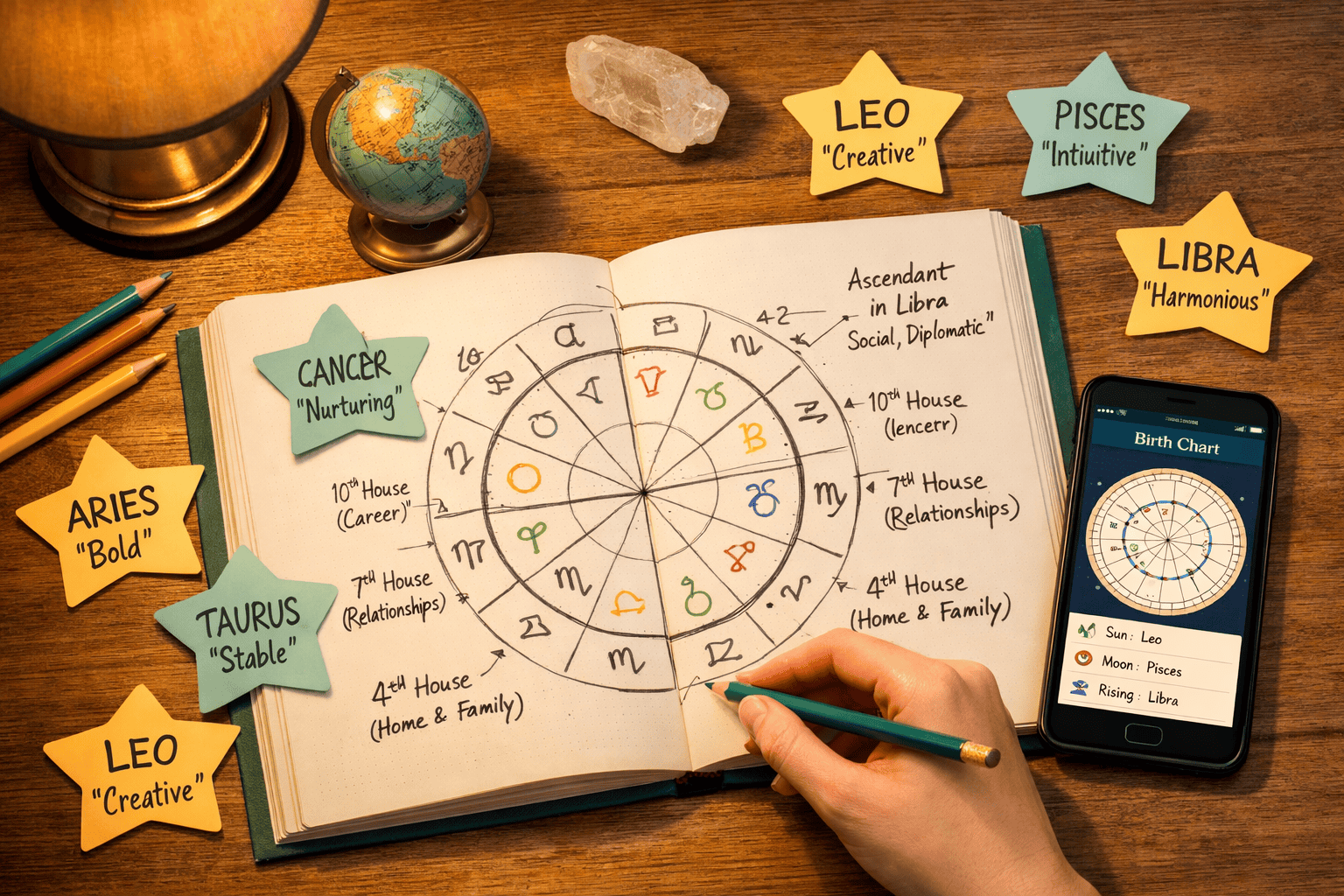
- The Big Three: Sun, Moon, and Rising Sign Explained
- How the 12 Houses Shape Your Natal Placements
- What Do the Planets Represent in Astrology?
- How to Read Your Birth Chart Step by Step
- What Are Planetary Aspects and Why Do They Matter?
- How Current Transits Interact With Your Natal Chart
- Common Beginner Mistakes When Learning Natal Astrology
- FAQ: Astrology for Beginners and Birth Chart Questions
- Conclusion: Your Next Steps in Reading Your Birth Chart
- References
Key Takeaways
- Your birth chart requires your exact birth date, time, and location to be accurate.
- The Sun sign shows your core identity; the Moon sign shows your emotional inner world; the Rising sign (Ascendant) shapes how others first perceive you.
- Ten planets, 12 zodiac signs, and 12 houses all interact to create a unique personality blueprint.
- No two birth charts are identical, even for twins born minutes apart.
- Planetary transits in 2026, such as Uranus entering Gemini, are actively reshaping how certain natal placements express themselves right now. [5]
- Free chart calculators (and apps like YOUSTRO) make it easy to generate your chart in seconds.
- Understanding your chart is a process, not a one-time read. Start with the Sun, Moon, and Rising, then build from there.
What Is a Birth Chart and Why Does It Matter?
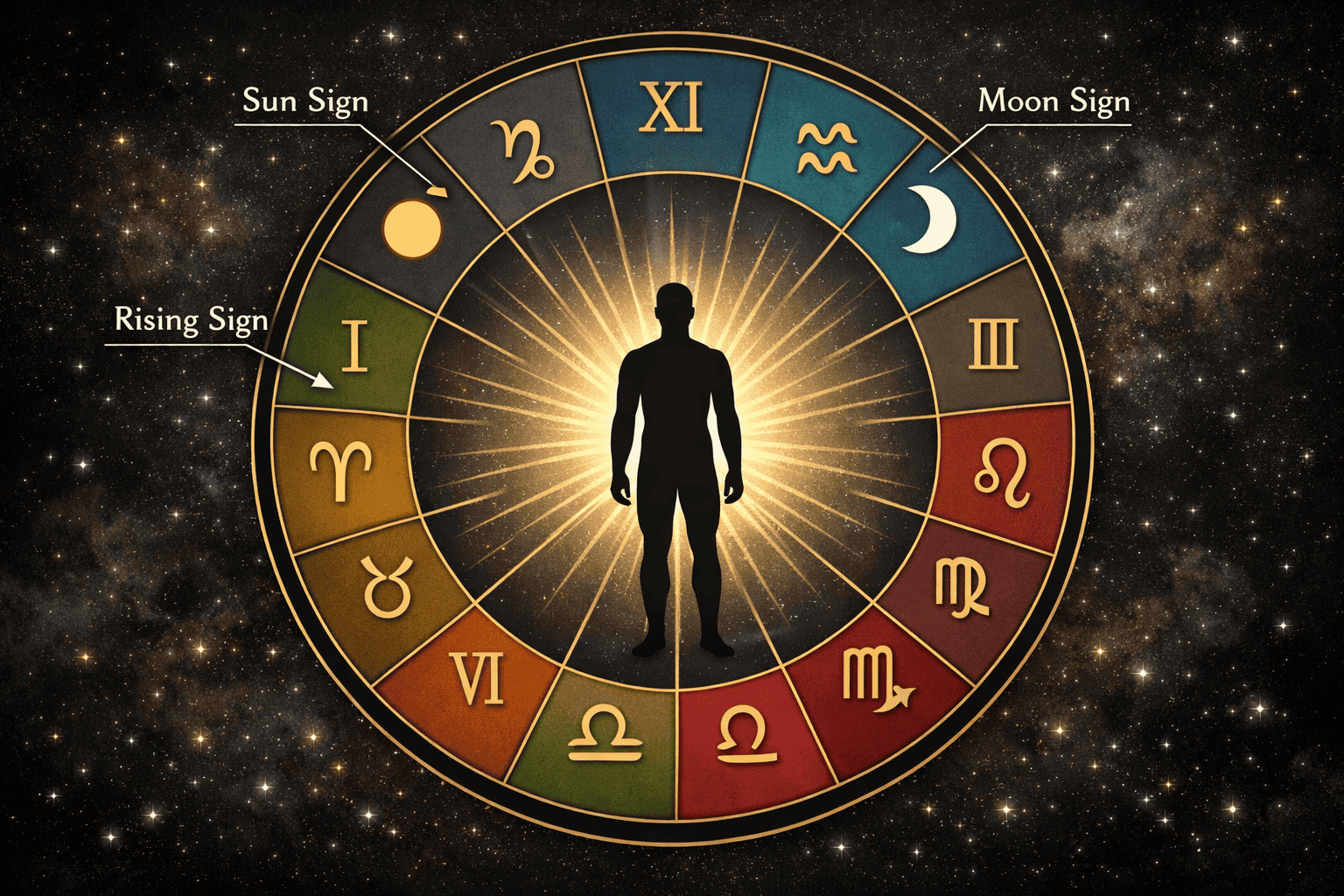
A birth chart is a circular map of the solar system drawn from Earth’s perspective at the precise moment of your birth. Every planet occupies a specific zodiac sign and falls into one of 12 houses, each governing a different area of life.
This matters because astrology for beginners: understanding your birth chart and natal placements starts with recognizing that your Sun sign (the one you read in magazine horoscopes) is just one of dozens of data points in your chart. Someone born on the same day as you but in a different city, or even at a different hour, will have a meaningfully different chart.
What you need to generate your birth chart:
- Full birth date (day, month, year)
- Exact birth time (check your birth certificate; even 15 minutes changes your Rising sign)
- Birth city or location
Choose a chart calculator if: you want a free, fast result. YOUSTRO’s personalized horoscope platform and similar tools generate a full chart instantly.
💡 Common mistake: Skipping the birth time. Without it, the Rising sign and house placements cannot be calculated accurately. If you genuinely don’t know your birth time, a professional astrologer can use a technique called “chart rectification” to estimate it.
The Big Three: Sun, Moon, and Rising Sign Explained
The Sun, Moon, and Rising sign are the three most important placements in any natal chart. Together, they form the foundation of your astrological identity.
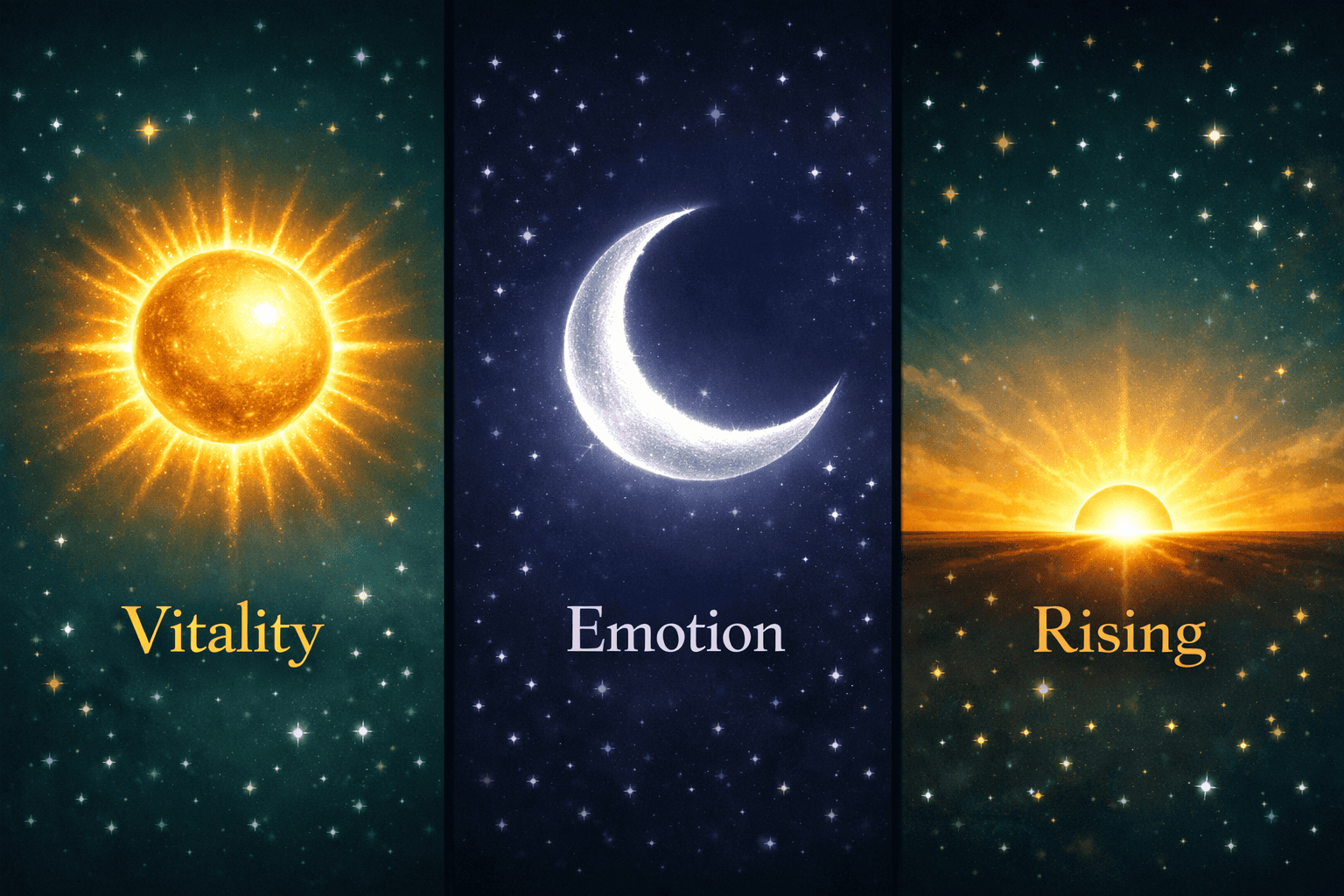
☀️ Sun Sign: Your Core Self
The Sun moves through one zodiac sign per month. Your Sun sign reflects your conscious identity, ego, and life purpose. It’s the part of you that you actively express and build toward.
🌙 Moon Sign: Your Emotional Core
The Moon changes signs roughly every 2.5 days, which is why birth time matters so much here. Your Moon sign governs your emotional needs, instincts, and subconscious patterns. Two people with the same Sun sign but different Moon signs will process feelings very differently.
⬆️ Rising Sign (Ascendant): Your Social Mask
The Rising sign changes approximately every two hours. It represents the zodiac sign that was rising on the eastern horizon at your birth. It shapes your first impressions, physical appearance, and the “front door” of your personality.
| Placement | What It Rules | Changes Every |
|---|---|---|
| Sun Sign | Core identity, ego, purpose | ~30 days |
| Moon Sign | Emotions, instincts, needs | ~2.5 days |
| Rising Sign | Appearance, first impressions | ~2 hours |
Quick example: A person with a Scorpio Sun, Libra Moon, and Sagittarius Rising will appear friendly and adventurous (Rising), feel a deep need for harmony and partnership (Moon), but at their core be intensely driven and private (Sun). All three layers are real. They just show up in different contexts.
How the 12 Houses Shape Your Natal Placements
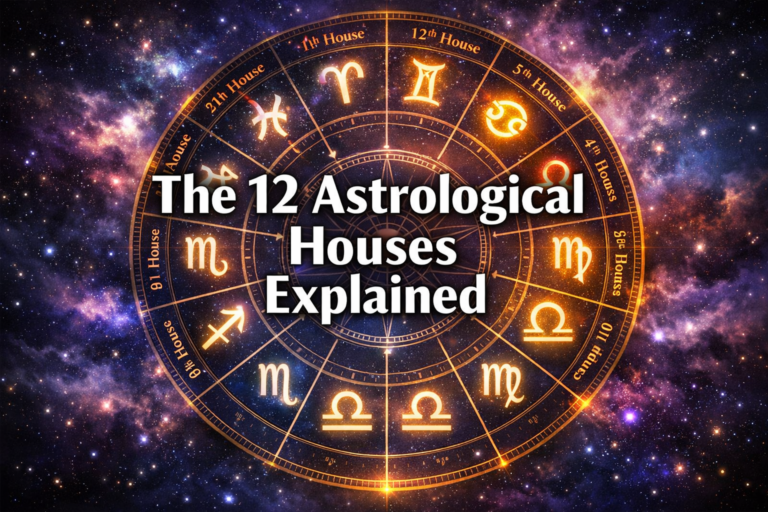
Each birth chart is divided into 12 houses, and each house governs a specific life domain. The planets that land in each house at birth color how those life areas play out for you.
The 12 houses at a glance:
- 1st House – Self, appearance, first impressions
- 2nd House – Money, possessions, self-worth
- 3rd House – Communication, siblings, short travel
- 4th House – Home, family, roots
- 5th House – Creativity, romance, children, play
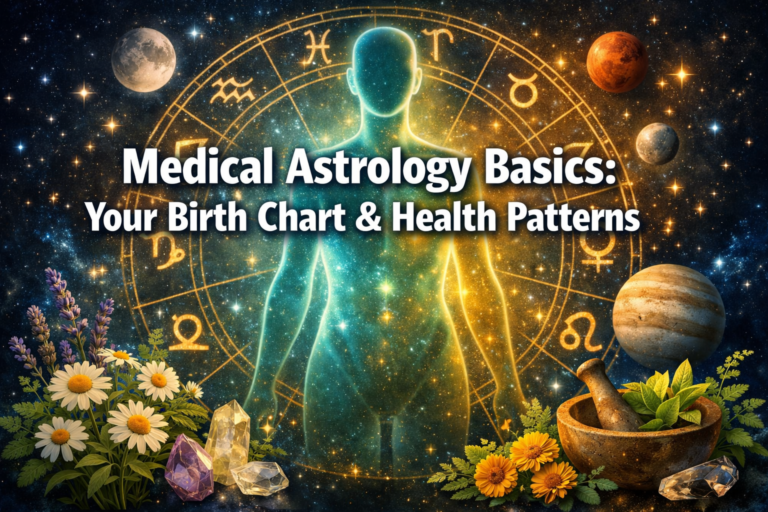
- 6th House – Health, daily routines, work habits
- 7th House – Partnerships, marriage, open enemies
- 8th House – Transformation, shared resources, death/rebirth
- 9th House – Philosophy, higher education, long travel
- 10th House – Career, public reputation, legacy
- 11th House – Friendships, community, hopes
- 12th House – Hidden matters, spirituality, self-undoing
Choose this focus if: you want to understand a specific life area. If relationships feel complicated, look at your 7th house. If career feels stuck, examine your 10th house and any planets sitting in it.
💡 Edge case: Empty houses are not a problem. Most people have several empty houses. An empty house simply means that life area isn’t a primary focus in this lifetime, not that it’s broken or missing.
What Do the Planets Represent in Astrology?
Each of the ten classical planets in astrology rules a different area of human experience. Where a planet sits in your chart (its sign and house) describes how that energy operates in your life.
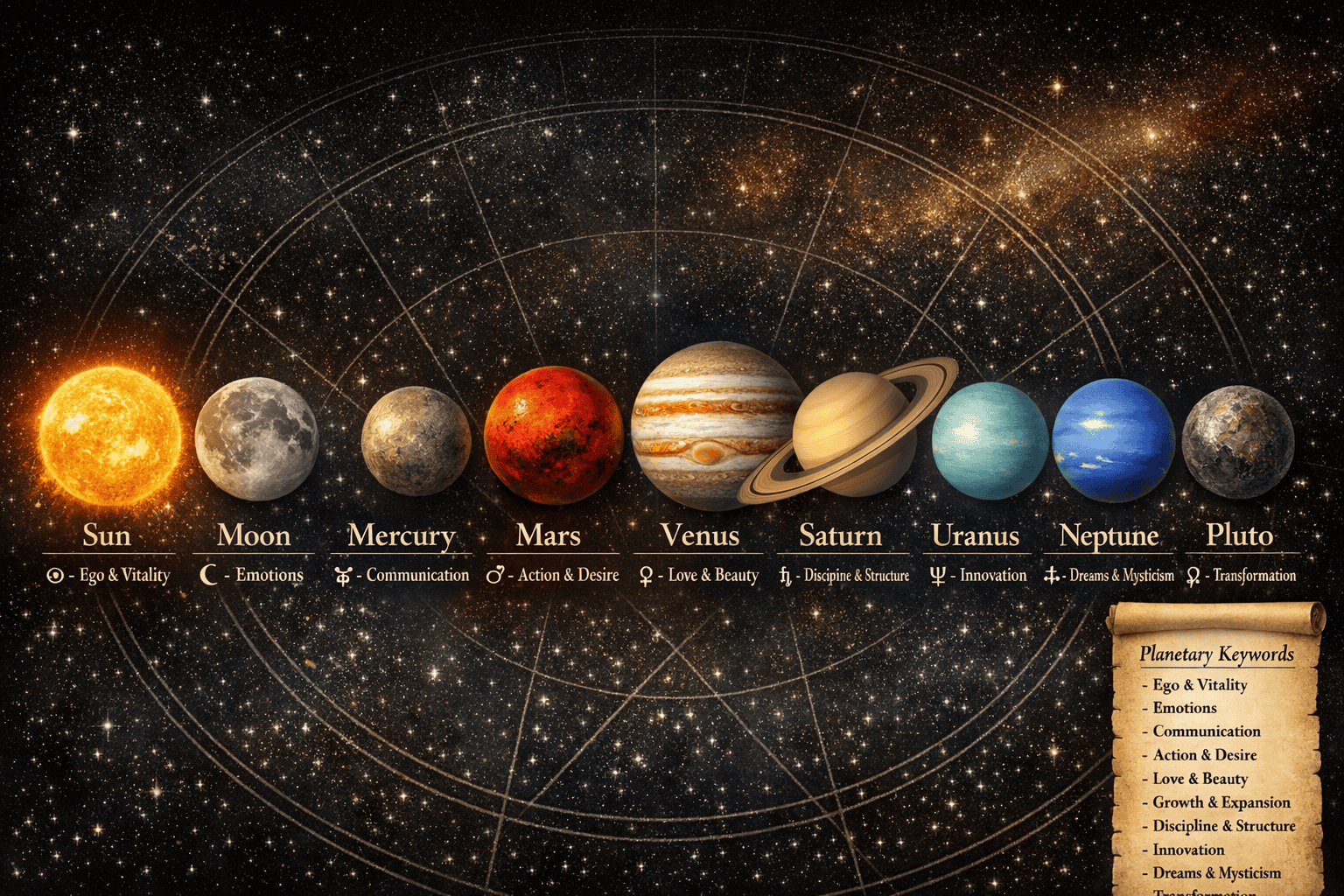
| Planet | Rules | Keywords |
|---|---|---|
| ☀️ Sun | Identity | Ego, vitality, purpose |
| 🌙 Moon | Emotions | Instinct, nurturing, memory |
| ☿ Mercury | Mind | Communication, logic, learning |
| ♀ Venus | Love | Beauty, values, attraction |
| ♂ Mars | Drive | Action, ambition, conflict |
| ♃ Jupiter | Growth | Expansion, luck, philosophy |
| ♄ Saturn | Discipline | Limits, responsibility, mastery |
| ♅ Uranus | Change | Innovation, rebellion, surprise |
| ♆ Neptune | Dreams | Spirituality, illusion, creativity |
| ♇ Pluto | Power | Transformation, depth, rebirth |
Why this matters in 2026: Major planetary shifts are actively affecting how natal placements express themselves. Uranus moved into Gemini in 2025, a transit that shakes up communication, technology, and the way people process information for years ahead. [5] If you have natal planets in Gemini, Sagittarius, Virgo, or Pisces, you may feel this transit most directly. [4]
April 2026 in particular features a New Moon in Aries and the Sun’s move into Taurus, creating a period of fresh starts followed by grounded consolidation, a useful time to begin studying your chart for the first time. [2]
How to Read Your Birth Chart Step by Step
Reading a natal chart for the first time can feel like looking at a foreign language. The good news is that a structured approach makes it manageable.
Step-by-step process for beginners:
Generate your chart. Use a reliable tool like YOUSTRO’s personalized astrology platform or a similar calculator. Input your birth date, exact time, and location.
Identify your Big Three. Find your Sun sign, Moon sign, and Rising sign. Write them down. These three alone tell a rich story.
Note which houses your Sun, Moon, and Rising occupy. The house number tells you which life area each energy focuses on.
Look for planet clusters. If three or more planets sit in one sign or house, that area of life is heavily emphasized for you.
Check for major aspects. Aspects are geometric angles between planets. Conjunctions (0°), oppositions (180°), and squares (90°) are the most noticeable. They show where planets cooperate or create tension.
Read one placement at a time. Don’t try to absorb everything at once. Spend a week just with your Moon sign before moving on.
Track transits. Compare today’s planetary positions to your natal chart. When a current planet crosses one of your natal planets, events in that life area often shift. [1]
💡 Common mistake: Treating every placement as a fixed destiny. Astrology describes tendencies and timing, not locked-in outcomes. A difficult Saturn placement, for example, often points to an area where hard work eventually produces lasting results.
What Are Planetary Aspects and Why Do They Matter?
Aspects are the angles formed between planets in your birth chart. They reveal whether planetary energies work together smoothly or create friction that pushes growth.
The five major aspects:
- Conjunction (0°): Planets blend their energies. Can amplify or overwhelm, depending on the planets involved.
- Sextile (60°): Harmonious, easy flow of energy. Opportunities that require a small push to activate.
- Square (90°): Tension and challenge. These placements push you to grow, often through repeated friction.
- Trine (120°): Natural talent and ease. Energy flows without effort, though it can lead to taking gifts for granted.
- Opposition (180°): Polarity and balance. Often shows up as tension between two life areas or inner drives pulling in opposite directions.
Practical rule: Trines and sextiles show where life comes more easily. Squares and oppositions show where the most growth (and often the most interesting life stories) happen.
How Current Transits Interact With Your Natal Chart
Your birth chart is fixed, but the planets keep moving. When a moving planet forms an angle to one of your natal planets, it triggers that natal energy, sometimes gently, sometimes dramatically.
In 2026, several significant transits are worth tracking even as a beginner:
- Uranus in Gemini is disrupting communication patterns and mental frameworks for many people, especially those with Gemini or Sagittarius placements. [5]
- Mars entering Aries brings a surge of forward energy that activates natal Mars placements and 1st house planets. [4]
- April 2026’s New Moon in Aries opens a fresh cycle in whatever house Aries rules in your chart, making it a natural starting point for new intentions. [2]
Astrologers describe April 2026 as an especially active month, with multiple sign changes and lunations creating momentum across most charts. [1] For beginners, this makes it a genuinely useful time to start paying attention to how transits feel in real life.
You can track these transits through YOUSTRO’s personalized horoscope tools or explore the YOUSTRO mobile app for daily updates matched to your natal chart.
💡 Beginner tip: Keep a simple journal. Note the date, which planet is transiting where, and what’s happening in your life. After a few months, patterns become obvious.
Common Beginner Mistakes When Learning Natal Astrology
Astrology for beginners: understanding your birth chart and natal placements is rewarding, but a few common errors slow progress.
Mistakes to avoid:
- Reading only your Sun sign horoscope. Generic horoscopes are written for 1/12 of the population. Your Rising sign’s horoscope is often more accurate for day-to-day events.
- Expecting the chart to be all positive. Every chart has challenges. Difficult placements are where character is built.
- Treating astrology as deterministic. The chart shows potential and timing, not a script you’re forced to follow.
- Ignoring the Moon sign. For emotional and relational patterns, the Moon is often more revealing than the Sun.
- Trying to learn everything at once. Start with the Big Three. Add houses. Then aspects. Then deeper placements like the North Node or Chiron.
- Using an inaccurate birth time. Even a 10-minute difference can shift your Rising sign or house cusps significantly.
For questions about how YOUSTRO’s astrology tools generate personalized readings, their platform explains the methodology clearly.
FAQ: Astrology for Beginners and Birth Chart Questions
Q: Do I need my exact birth time to get a birth chart? A: Yes, for a complete chart. Without it, your Rising sign and house placements can’t be determined. Your Sun and Moon signs can still be calculated, though the Moon may be uncertain if you were born near a sign change.
Q: What’s the difference between a natal chart and a horoscope? A: A natal chart is your fixed birth map, calculated once. A horoscope describes how current planetary movements (transits) interact with charts, typically written for a sign or time period.
Q: Is my Sun sign the most important placement? A: Not always. For many people, the Moon sign or Rising sign feels more personally accurate. The Sun is central to identity, but all three of the Big Three carry significant weight.
Q: Can two people have the same birth chart? A: Only if they were born at the same moment in the same location. Even twins born minutes apart will have slightly different charts, particularly in the Rising sign and house cusps.
Q: What does it mean if I have a lot of planets in one house? A: A stellium (three or more planets in one sign or house) concentrates energy there. That life area tends to be a major theme, sometimes an obsession or a source of both talent and challenge.
Q: How long does it take to learn to read a birth chart? A: The basics (Big Three, houses, major aspects) can be understood in a few weeks of consistent study. Deeper fluency takes months to years, and most astrologers say they’re still learning after decades.
Q: What is the North Node in astrology? A: The North Node (also called the True Node) points to your soul’s growth direction in this lifetime. It’s not a planet but a mathematical point. Its opposite, the South Node, shows ingrained patterns from the past.
Q: Are some zodiac signs more compatible than others? A: Sun sign compatibility is a starting point, but synastry (comparing two full charts) gives a far more accurate picture of relationship dynamics.
Q: What does Uranus in Gemini mean for my chart in 2026? A: Uranus in Gemini disrupts and innovates in the areas of communication, learning, and information. If Gemini rules a particular house in your chart, expect unexpected changes or breakthroughs in that life area over the next several years. [5]
Q: Where can I get a reliable personalized birth chart reading? A: YOUSTRO’s personalized horoscope platform offers chart tools and daily readings tailored to your placements. For deeper questions, the YOUSTRO contact page can point you toward additional resources.
Conclusion: Your Next Steps in Reading Your Birth Chart
Astrology for beginners: understanding your birth chart and natal placements is genuinely accessible once you break it into manageable pieces. The chart isn’t a verdict. It’s a map, and maps are most useful when you’re actually moving.
Actionable next steps:
- Generate your chart today using YOUSTRO or a similar tool. You need your birth date, time, and location.
- Write down your Big Three: Sun sign, Moon sign, Rising sign. Read about each one separately before combining them.
- Identify your most populated house. That’s where to focus your first deeper study.
- Download the YOUSTRO mobile app to track daily transits against your natal chart.
- Keep a simple journal noting transits and real-life events. Patterns will emerge faster than you expect.
- Be patient with the process. Every layer you add makes the previous layers richer. Start simple, stay curious, and let the chart reveal itself over time.
The sky at the moment of your birth was uniquely yours. Learning to read it is one of the most personal forms of self-study available, and in 2026, with major planetary shifts already underway, there’s no better time to start.
References
[1] Zodiac Signs Breakthrough April 2026 Changes Everything – https://www.yourtango.com/zodiac/zodiac-signs-breakthrough-april-2026-changes-everything
[2] April 2026 Exciting Month Zodiac Signs Says Astrologer – https://www.yourtango.com/zodiac/april-2026-exciting-month-zodiac-signs-says-astrologer
[4] April 2026 Astrology Forecast – https://www.chronogram.com/horoscopes/astrology/april-2026-astrology-forecast/
[5] Horoscopes April 2026 New Moon Aries Taurus Season Uranus Gemini – https://www.dazeddigital.com/beauty/article/70025/1/horoscopes-april-2026-new-moon-aries-taurus-season-uranus-gemini