Astrology is a belief system that interprets the positions and movements of celestial bodies — the Sun, Moon, and planets — as meaningful indicators of human personality, relationships, and life events. It is not a science in the modern sense, but it is one of humanity’s oldest symbolic languages, with roots stretching back over 4,000 years. Whether someone approaches it literally or as a tool for self-reflection, astrology remains a significant cultural and psychological force in 2026.
- Key Takeaways 🔑
- What Exactly Is Astrology? A Clear Definition
- Where Did Astrology Come From? A Brief History
- How Does Astrology Actually Work?
- Astrology vs. Astronomy: What's the Difference?
- Why Did Astrology Lose (and Regain) Popularity?
- What Are the Main Branches of Astrology?
- Is Astrology Right for You? Honest Guidance for Skeptics and Beginners
- Astrology in 2026: Where It Stands Today
- Conclusion: What to Do Next
- Frequently Asked Questions
- References
Key Takeaways 🔑
- Astrology is a symbolic system, not a science. It interprets celestial patterns as meaningful, but empirical research has not validated its predictive claims.
- It originated in ancient Babylon around 2000 BCE and spread through Greek, Egyptian, Roman, and eventually global cultures.
- The 12 zodiac signs, planets, and houses are the three core building blocks of any astrological reading.
- Famous scientists including Galileo and Kepler practiced astrology — it was taught in universities until the 17th century.
- The Scientific Revolution separated astrology from astronomy, and astrology lost academic standing by the late 1600s.
- Modern astrology is primarily used for self-reflection, personality insight, and cultural connection rather than literal prediction.
- Skeptics and beginners alike can engage with astrology as a psychological and cultural framework without needing to accept it as literal truth.
- A natal birth chart — calculated from birth date, time, and location — is the foundation of personal astrology.
- Astrology is not fortune-telling. Most contemporary practitioners describe it as a map of tendencies, not fixed outcomes.
What Exactly Is Astrology? A Clear Definition
Astrology is a system of belief and interpretation that proposes a correlation between the positions of celestial bodies and events or characteristics on Earth. [5][6] In plain terms: astrologers study where the Sun, Moon, and planets were positioned at a specific moment — most often a person’s birth — and use that map to describe personality traits, relationships, and life patterns.
The word itself comes from the Greek astron (star) and logos (reason or study). For a deeper look at how the word evolved, see this breakdown of astrology’s etymology from ancient star-telling to modern practice.
Three things astrology is:
- A symbolic language for understanding personality and cycles
- A cultural and historical tradition spanning thousands of years
- A tool many people use for self-reflection and meaning-making
Three things astrology is not:
- A branch of modern science
- A system with proven predictive accuracy (empirical studies have not supported its claims) [3]
- A single, unified belief system (Western, Vedic, Chinese, and other traditions differ significantly)
“Astrology’s historical significance, cultural impact, and psychological appeal remain undeniable despite lacking scientific validation — representing one of humanity’s oldest attempts to find meaning in celestial patterns.” [5]
Choose this framework if: you’re looking for a reflective tool, a cultural lens, or a way to explore personality archetypes. Skip the literal predictions if you prefer evidence-based decision-making.
Where Did Astrology Come From? A Brief History
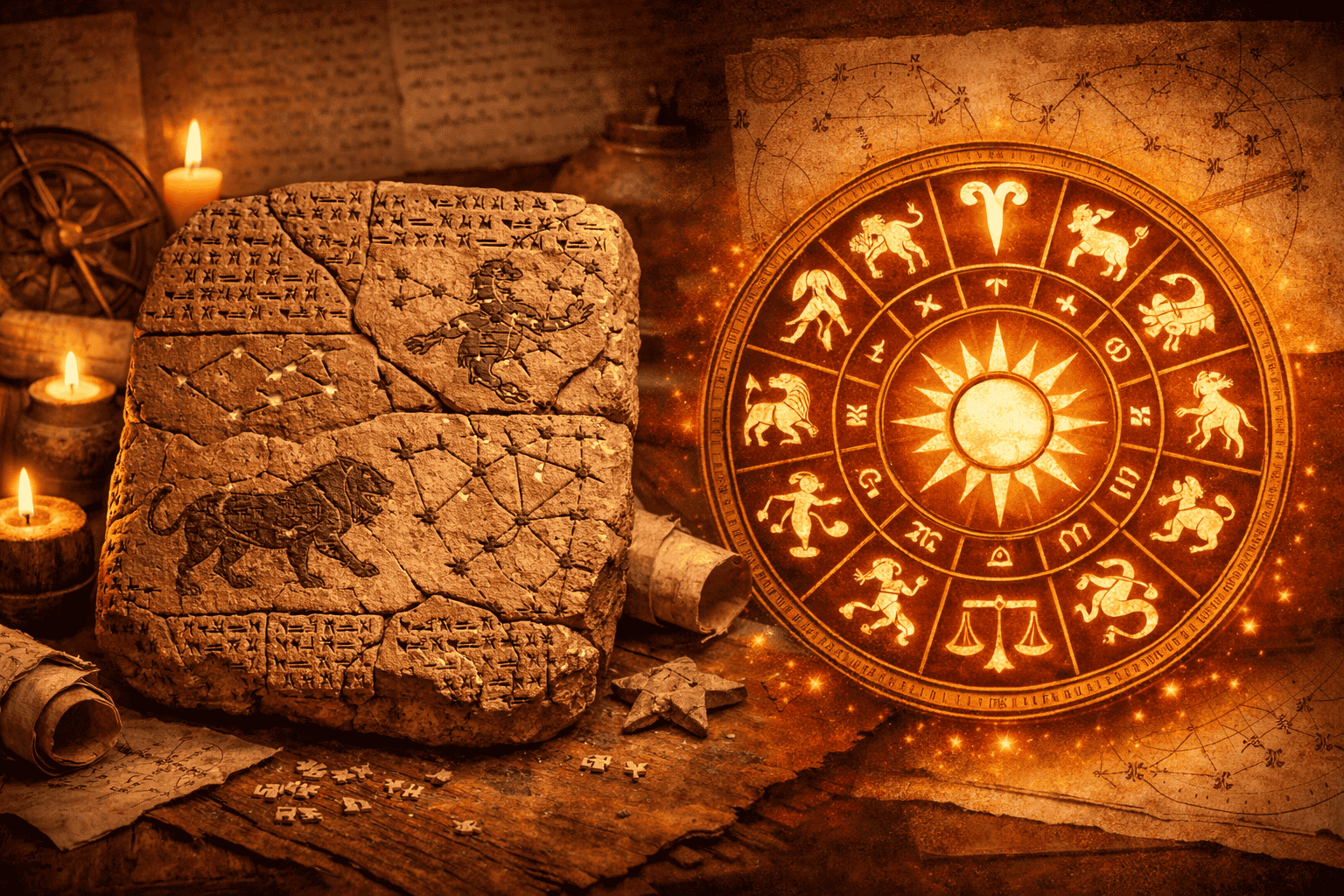
Astrology’s origins are ancient and well-documented. The Babylonians developed the first organized astrological system around 2000 BCE, with some estimates placing early star observation as far back as the 3rd millennium BCE. [2][4] By around 600 BCE, they had created the earliest recorded horoscope system and divided the sky into the 12 zodiac signs still used in Western astrology today. [2]
A simplified timeline:
| Era | Development |
|---|---|
| ~3000–2000 BCE | Babylonian sky observation begins; celestial omens recorded |
| ~600 BCE | First personal horoscopes appear in Babylon [4] |
| ~400–200 BCE | Greek philosophers integrate astrology with philosophy and medicine |
| 140 CE | Claudius Ptolemy publishes Tetrabiblos, the foundational astrological text [4] |
| 9th–14th century | Astrology flourishes in Islamic scholarship; spreads to medieval Europe |
| 15th–17th century | Taught in European universities; Galileo and Kepler both practice it [2] |
| Late 1600s | Scientific Revolution undermines astrology’s theoretical basis; it loses academic standing [3] |
| 19th–20th century | Revival through popular press, newspaper horoscopes, and figures like Evangeline Adams [1] |
| 2000s–2026 | Digital platforms and apps drive a new wave of mainstream interest |
Key figure worth knowing: Claudius Ptolemy, a Greek-Egyptian scholar, wrote Tetrabiblos in 140 CE. It explained planets, zodiac signs, and houses in a structured framework that still shapes Western astrology today. [4]
Common mistake: Many people assume astrology and astronomy were always separate. They weren’t. For centuries, they were the same discipline. The split only became firm after Isaac Newton’s work on gravity gave physical explanations for planetary motion, making mystical influences seem unnecessary. [2]
How Does Astrology Actually Work?
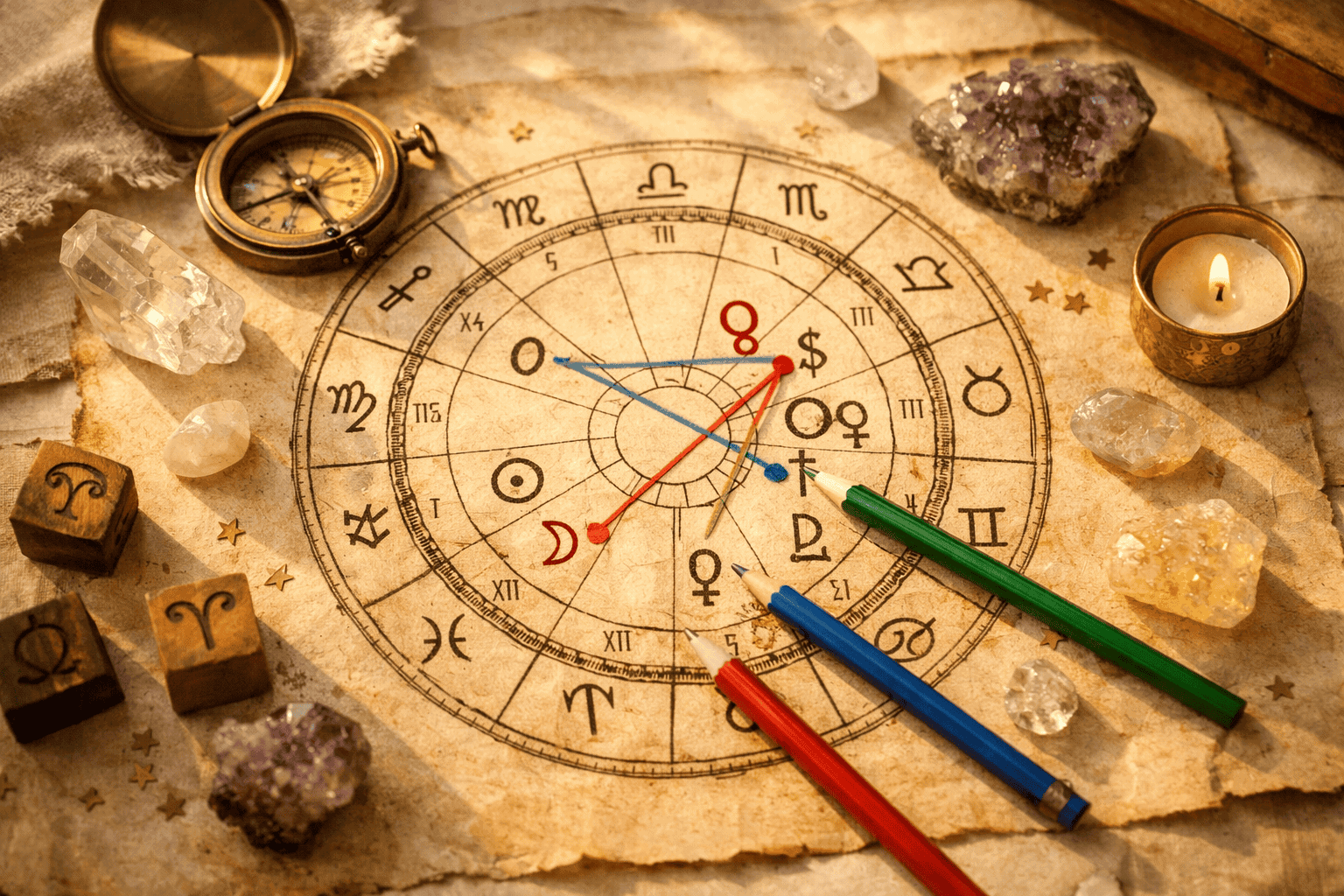
Astrology works by mapping the positions of celestial bodies at a specific moment onto a circular chart called a natal chart (also called a birth chart or horoscope). That chart is then interpreted using three main components.
The three core building blocks:
- Zodiac Signs (12 total) — Each sign (Aries through Pisces) represents a set of personality traits and energies. Your “Sun sign” is determined by where the Sun was on your birthday.
- Planets (10 main bodies) — The Sun, Moon, Mercury, Venus, Mars, Jupiter, Saturn, Uranus, Neptune, and Pluto each represent different areas of life (communication, love, drive, etc.).
- Houses (12 divisions) — The chart is divided into 12 sections representing life areas: identity, money, communication, home, creativity, health, relationships, and more.
An astrologer reads how these three layers interact. For example, Mars (drive and action) in Capricorn (discipline) in the 10th house (career) might be interpreted as someone with focused, ambitious professional energy.
For a practical walkthrough of reading your own chart, the beginner’s guide to birth charts and natal placements is a solid starting point.
Quick example: Someone born on March 15 has a Pisces Sun. But their Moon might be in Aries, and their rising sign (ascendant) might be Virgo. Each layer adds nuance. This is why two people with the same Sun sign can feel very different — the full chart matters far more than just the Sun sign. To understand how the Moon layer works, see this comparison of Moon signs vs Sun signs.
Astrology vs. Astronomy: What’s the Difference?
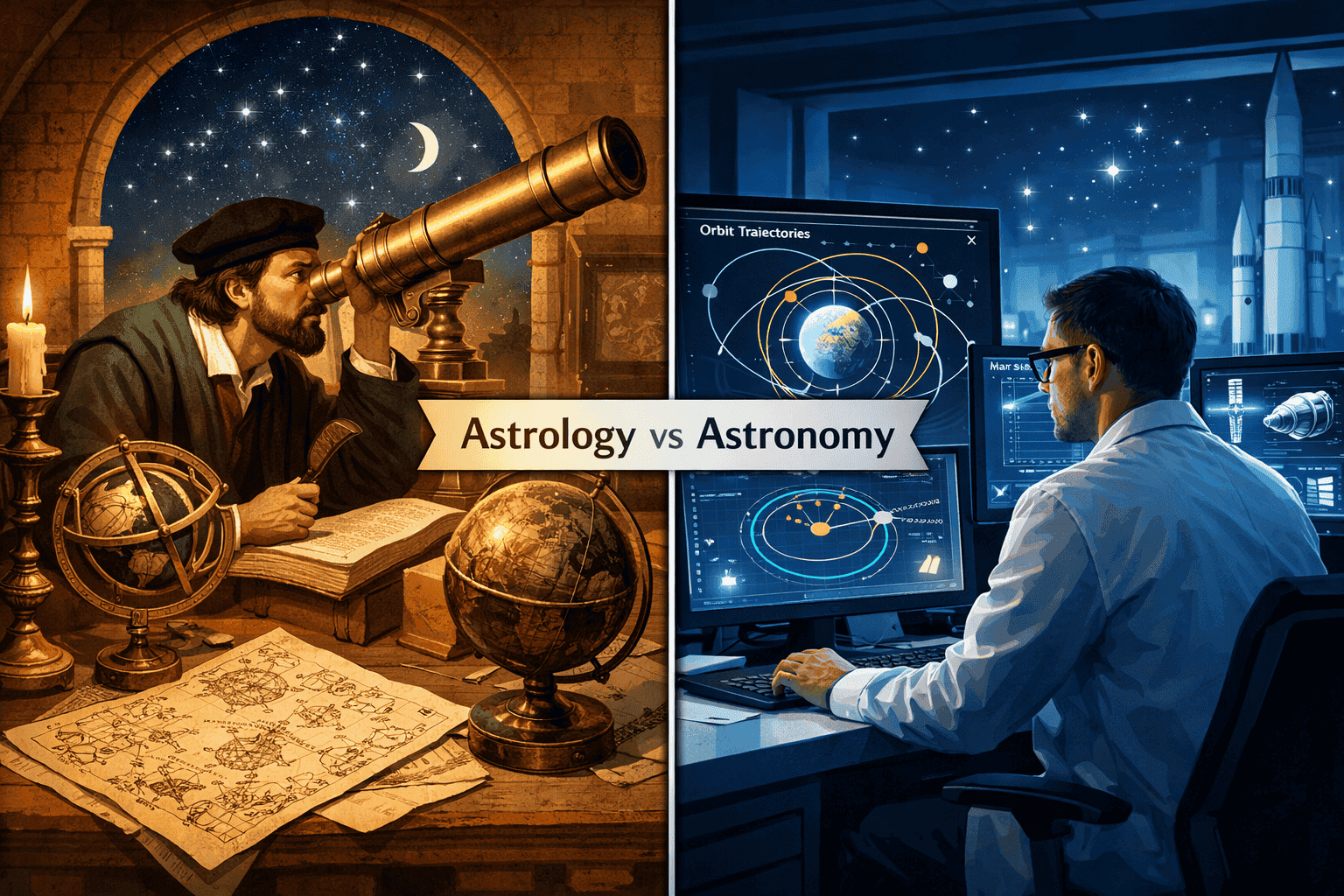
Astrology and astronomy both study celestial objects, but they are fundamentally different disciplines. Astronomy is a natural science that uses physics, mathematics, and observation to understand the universe. Astrology is a symbolic system that interprets celestial positions as meaningful for human experience. [6]
| Astrology | Astronomy | |
|---|---|---|
| Type | Belief system / symbolic framework | Natural science |
| Method | Interpretation of chart patterns | Empirical observation and measurement |
| Goal | Meaning, personality insight | Understanding the physical universe |
| Validation | Cultural, psychological | Peer-reviewed, testable |
| Shared history | Yes — both emerged from the same ancient tradition | Yes |
The honest answer for skeptics: Controlled scientific studies, including a well-known 1985 study by Shawn Carlson published in Nature, have found that astrological predictions perform no better than chance. [3] Astrology does not meet the criteria of a science. That said, many people find it genuinely useful as a reflective tool — similar to how personality frameworks like Myers-Briggs or Enneagram are used, despite their own scientific limitations.
Edge case: Some researchers study astrology from a psychological or anthropological perspective, examining why it resonates with so many people rather than whether it’s literally true. Carl Jung’s concept of archetypes is often cited in this context.
Why Did Astrology Lose (and Regain) Popularity?
Astrology lost academic credibility during the Scientific Revolution of the 16th through 18th centuries. [2] Newton’s laws of motion and gravity explained planetary movement through physics, not mystical influence. By the late 1600s, astrology had been largely removed from university curricula across Europe and was increasingly regarded as a pseudoscience. [3]
But it never disappeared from public life. It survived through almanacs, dream manuals, and popular print culture. [1] In the late 19th century, American astrologer Evangeline Adams built a thriving consulting practice and helped establish astrology as a culturally legitimate — if not scientifically accepted — pursuit. [1]
The 20th century revival came through newspaper horoscope columns (which began in the 1930s), New Age movements, and eventually the internet. In 2026, astrology apps, personalized chart services, and social media communities have made it more accessible than at any point in history.
Why does it keep coming back? Researchers who study the psychology of belief point to several factors:
- It provides a framework for self-understanding
- It creates community and shared language
- It offers a sense of order and meaning during uncertain times
- The descriptions in astrology (called the “Barnum effect”) tend to feel personally accurate because they’re broad enough to apply to many people
What Are the Main Branches of Astrology?
Astrology is not one single tradition. Several distinct systems have developed across cultures, each with different methods and philosophical foundations.
The four most widely practiced systems:
- Western Astrology — Based on the tropical zodiac (tied to Earth’s seasons). Uses Sun, Moon, planets, and 12 houses. Most common in Europe and the Americas.
- Vedic Astrology (Jyotish) — Rooted in ancient Indian texts. Uses the sidereal zodiac (tied to actual star positions). Places more emphasis on the Moon sign and rising sign than the Sun sign.
- Chinese Astrology — Based on a 12-year lunar cycle, with each year associated with an animal sign (Rat, Ox, Tiger, etc.). Incorporates elements and yin/yang philosophy.
- Hellenistic Astrology — The ancient Greek system from which Western astrology descends. Experiencing a revival among traditional astrologers who prefer its original techniques.
Choose Western astrology if: you’re a complete beginner and want the most widely available resources, apps, and communities.
Choose Vedic astrology if: you want a system with deep philosophical roots and a stronger emphasis on life purpose and karma.
Planetary transits — the ongoing movement of planets through the zodiac — are another major area of modern practice. For example, Mercury Retrograde in 2026 is a transit that many people track for its supposed effects on communication and technology.
Is Astrology Right for You? Honest Guidance for Skeptics and Beginners
Astrology is a clear definition, history, and modern relevance topic that genuinely means different things to different people. Whether it’s worth your time depends entirely on what you’re looking for.
Astrology is likely a good fit if you:
- Enjoy personality frameworks and self-reflection tools
- Are curious about history, mythology, and cultural traditions
- Want a shared language for discussing relationships and emotions
- Approach it with open-minded curiosity rather than literal belief
Astrology is probably not what you need if you:
- Are looking for evidence-based predictions about future events
- Want a replacement for professional advice (medical, financial, legal)
- Need concrete, testable answers to life decisions
A note for skeptics specifically: Engaging with astrology doesn’t require believing it’s literally true. Many people use it the way they might use a personality quiz — as a starting point for reflection, not a final verdict. The historical and cultural dimensions alone make it worth understanding.
For those ready to go deeper, exploring astrology basics is a practical next step, and checking planetary transits can show how astrologers track current celestial events.

Astrology in 2026: Where It Stands Today
In 2026, astrology is more mainstream than it has been in centuries. Apps deliver personalized daily readings. Social media communities debate chart placements. Major transit events — like Jupiter entering Cancer on June 30, 2026 — generate significant online discussion.
What’s driving modern interest:
- Accessibility: Free birth chart calculators make entry-level astrology available to anyone with a phone
- Community: Online spaces create shared cultural reference points around zodiac signs
- Mental health overlap: Many people use astrological cycles as a framework for processing emotions and transitions
- Personalization: Unlike generic Sun sign horoscopes, modern astrology emphasizes the full natal chart
What hasn’t changed: The scientific consensus remains the same. Astrology is not validated by empirical research. [3][6] But its cultural footprint and psychological utility continue to grow regardless.
The most honest way to frame modern astrology: it’s a living tradition that functions as part symbolic language, part personality psychology, part cultural mythology, and part community ritual. Whether that combination has value is something each person decides for themselves.
Conclusion: What to Do Next
Understanding what astrology is — a clear definition, history, and modern relevance for skeptics and beginners — doesn’t require picking a side. It requires knowing what you’re actually looking at.
Astrology is a 4,000-year-old symbolic system that once sat at the center of human knowledge and has since found a new home in culture, psychology, and personal practice. It’s not science. It is, however, one of the most persistent and widely shared human frameworks for making sense of personality and time.
Actionable next steps:
- Get your natal chart — Use a free calculator (you’ll need your birth date, time, and location). It takes under two minutes.
- Start with the basics — Learn your Sun sign, Moon sign, and rising sign before going deeper. The beginner’s guide to birth charts covers exactly this.
- Explore the history — Understanding where astrology came from makes it far more interesting, regardless of your beliefs about its validity.
- Stay critical — Enjoy the framework without outsourcing major life decisions to it. Use it as a lens, not a rulebook.
- Follow current transits — If you want to see astrology in action, track a major event like Venus Retrograde in 2026 and observe how astrologers interpret it.
Astrology has survived empires, scientific revolutions, and centuries of skepticism. Whatever its ultimate truth, it clearly speaks to something deeply human — the desire to find pattern, meaning, and connection in an unpredictable world. 🌙
Frequently Asked Questions
Q: What is astrology in simple terms? Astrology is a belief system that interprets the positions of the Sun, Moon, and planets as meaningful for understanding human personality and life patterns. It’s a symbolic framework, not a science.
Q: Is astrology the same as astronomy? No. Astronomy is a natural science that studies the physical universe using math and observation. Astrology is a symbolic system that interprets celestial positions as meaningful for human life. They share ancient roots but diverged firmly by the 17th century.
Q: Is astrology real or fake? Astrology is a real cultural and historical tradition, but its predictive claims have not been validated by scientific research. Whether it’s “real” depends on what you mean: as a science, no; as a cultural and psychological tool, many people find it genuinely useful.
Q: What is a birth chart? A birth chart (also called a natal chart) is a map of where the Sun, Moon, and planets were positioned at the exact moment of your birth. Astrologers use it to describe personality traits, strengths, challenges, and life themes.
Q: What is the difference between a Sun sign and a Moon sign? Your Sun sign is determined by the Sun’s position on your birthday and represents your core identity. Your Moon sign is determined by the Moon’s position and represents your emotional nature and inner world. Both matter in a full astrological reading.
Q: When did astrology start? The first organized astrological system developed in Babylon around 2000 BCE. The 12 zodiac signs were established by around 600 BCE. Greek scholars later expanded the system, and Ptolemy’s Tetrabiblos (140 CE) became the foundational Western astrological text.
Q: Why do scientists reject astrology? Scientists reject astrology’s predictive claims because controlled studies have not found evidence that astrological predictions are more accurate than chance. The mechanism by which distant planets would influence human personality has no established physical basis.
Q: Can you believe in astrology and science at the same time? Yes. Many people engage with astrology as a reflective or cultural tool without believing it operates as a literal physical force. Holding both perspectives — scientific skepticism and cultural appreciation — is a common and reasonable position.
Q: What’s the difference between Western and Vedic astrology? Western astrology uses the tropical zodiac (based on seasons) and emphasizes the Sun sign. Vedic astrology uses the sidereal zodiac (based on actual star positions) and places more emphasis on the Moon sign and rising sign. The two systems often produce different sign placements for the same person.
Q: Is astrology a religion? No. Astrology is not a religion, though it can overlap with spiritual practices. It has no central deity, scripture, or required set of beliefs. People of many different religious backgrounds and no religious background practice astrology.
References
[1] Stargazing The Rise Of Modern Astrology – https://dekalbhistory.org/blog-posts/stargazing-the-rise-of-modern-astrology/ [2] The History Of Astrology – https://www.centreofexcellence.com/the-history-of-astrology/ [3] History Of Astrology – https://en.wikipedia.org/wiki/History_of_astrology [4] History Of Astrology – https://mymodernmet.com/history-of-astrology/ [5] What Is Astrology – https://vama.app/blog/what-is-astrology/ [6] Astrology – https://www.britannica.com/topic/astrology [7] The History And Modern Applications Of Astrology – https://www.aistro.io/content/blog/en/the-history-and-modern-applications-of-astrology-15