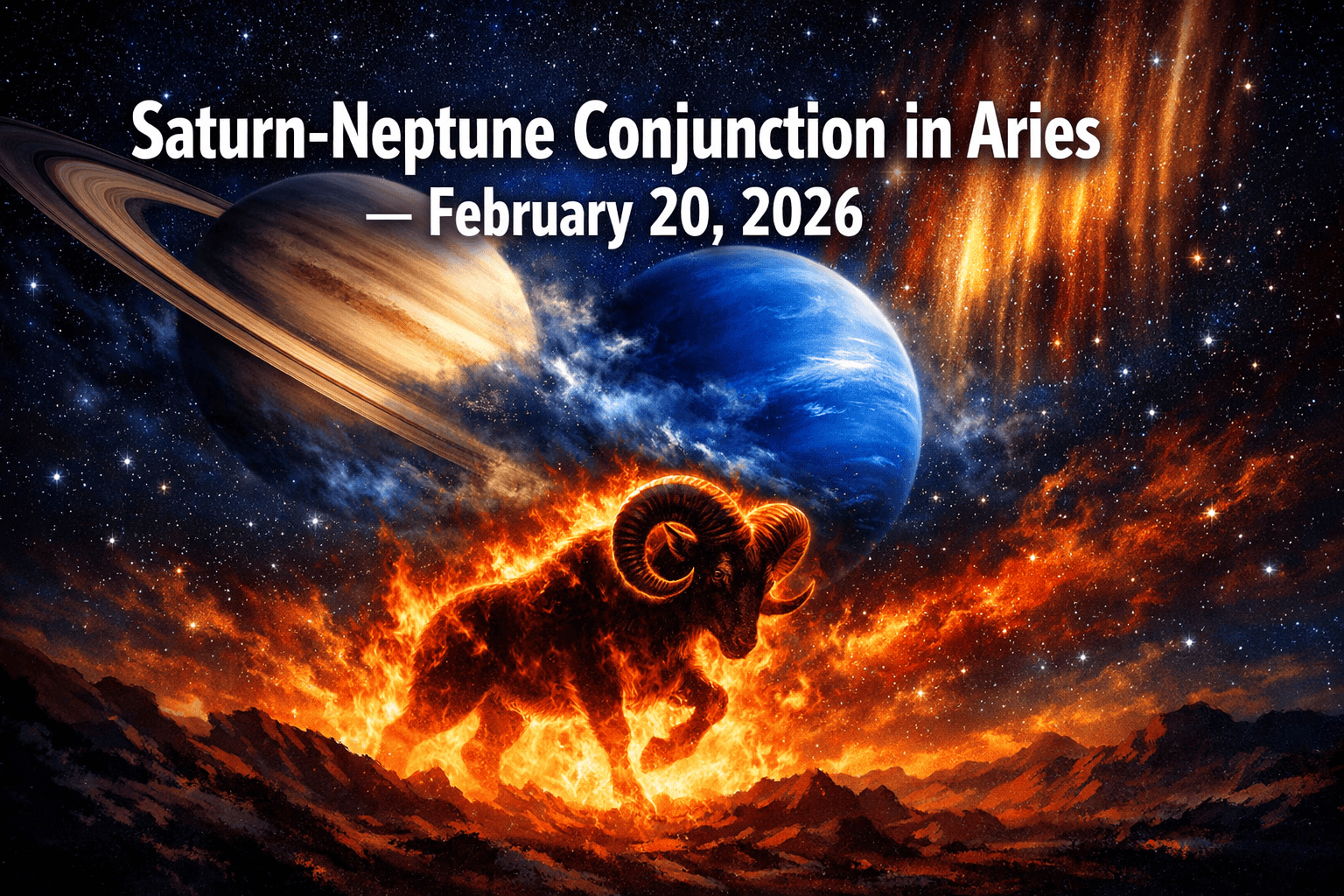
The Saturn-Neptune conjunction in Aries on February 20, 2026 is a rare, once-in-approximately-170-year alignment that occurred at exactly 0° Aries at 11:52 AM EST. [2] It marks the first meeting of these two planets at this precise degree in over 2,000 years, and the first Saturn-Neptune conjunction since 1989. [1] This alignment blends Saturn’s energy of structure and discipline with Neptune’s energy of dreams and dissolution, launching a new 36-year cycle that will shape both collective reality and personal transformation across all zodiac signs. [4]
- Key Takeaways 🔑
- What Exactly Is the Saturn-Neptune Conjunction in Aries February 20, 2026?
- Why Is This Conjunction So Rare and Historically Significant?
- What Are the Core Themes of Dissolving Old Structures and Manifesting New Realities?
- How Does This Conjunction Affect Each Zodiac Sign?
- What Does This Conjunction Mean for Collective Reality in 2026?
- How Can You Work With This Energy Personally?
- What Comes After the February 20, 2026 Conjunction?
- FAQ: Saturn-Neptune Conjunction in Aries February 20, 2026
- Conclusion: What to Do With This Rare Alignment
- References
Key Takeaways 🔑
- Exact timing: February 20, 2026 at 11:52 AM EST, at 0° Aries — the very first degree of the zodiac. [2]
- Extreme rarity: The last Saturn-Neptune conjunction happened in 1989; the next won’t occur until 2061. [1]
- 0° Aries significance: This degree is called the Aries Point, a place where personal events ripple out into collective, world-scale shifts.
- 36-year cycle begins: This conjunction launches a new Saturn-Neptune cycle with effects felt through 2061. [4]
- Who feels it most: People with natal placements in early Cardinal signs (Aries, Cancer, Libra, Capricorn) or late Mutable signs (Gemini, Virgo, Sagittarius, Pisces) will feel this most intensely. [2]
- Core theme: Old systems, beliefs, and structures dissolve so that more authentic, inspired ones can take their place.
- Aries energy adds fire: Aries brings courage, initiative, and a willingness to start fresh — pushing this conjunction toward bold, pioneering action rather than passive waiting.
- Watch Mercury Retrograde: Mercury Retrograde in Pisces begins just five days later on February 25, adding a reflective, inward layer to this already charged period.
- Both collective and personal: This transit reshapes global institutions AND individual identity simultaneously.
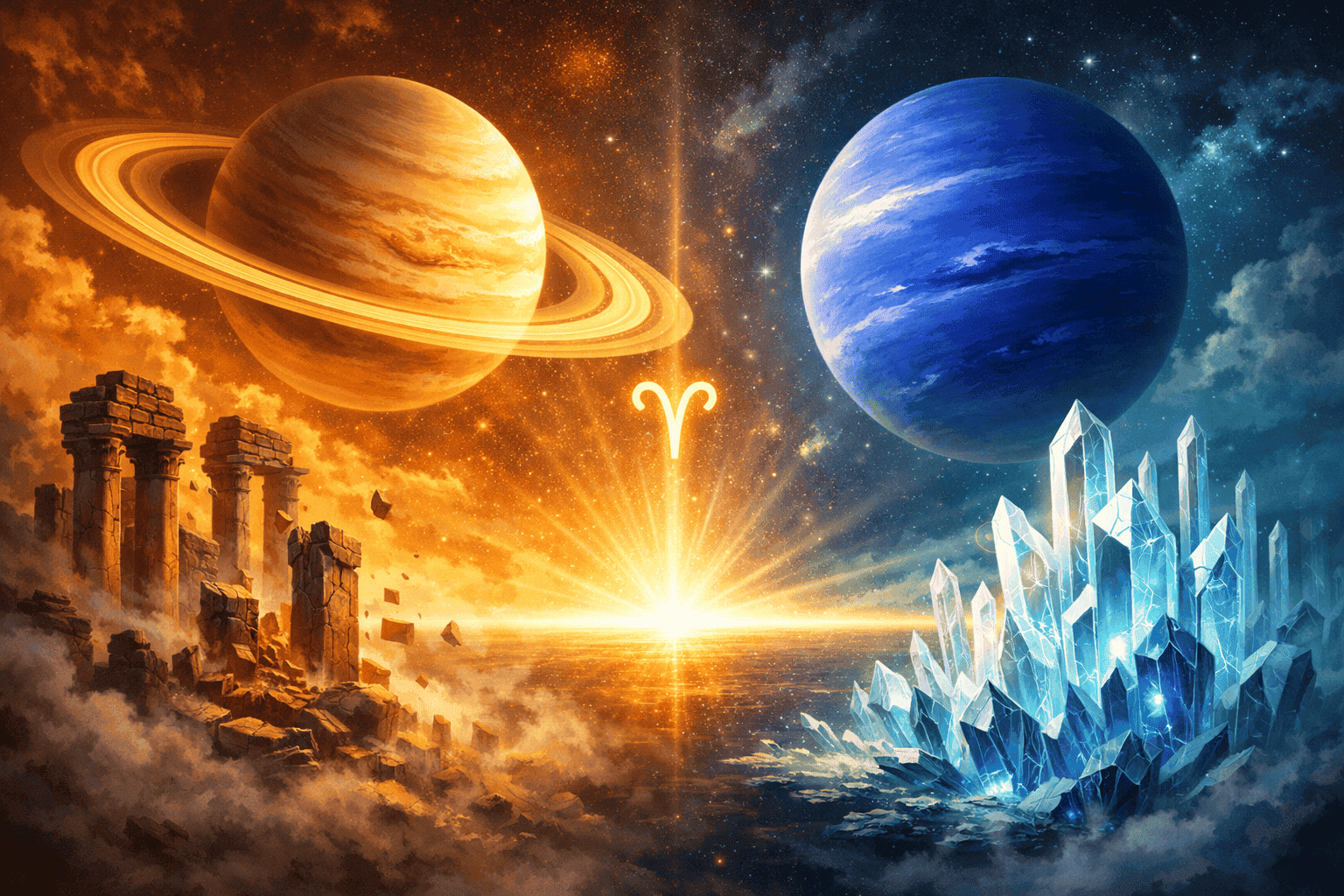
What Exactly Is the Saturn-Neptune Conjunction in Aries February 20, 2026?
The Saturn-Neptune conjunction in Aries on February 20, 2026 is the precise moment when Saturn and Neptune occupy the same degree of the zodiac — 0° Aries — as seen from Earth. This is called a conjunction, and it’s one of the most significant planetary meetings in astrology because it fuses two very different energies into a single, concentrated force. [1]
Saturn is the planet of discipline, limits, reality, and long-term building. Neptune is the planet of dreams, spirituality, illusion, and dissolution. When they meet, the result is a push-pull between what is and what could be — between hard facts and inspired vision.
Why 0° Aries matters so much:
- 0° Aries is the first degree of the entire zodiac, often called the Aries Point.
- Events at this degree tend to have outsized public and collective impact.
- It’s the spring equinox degree — a symbolic “reset” point for the whole zodiac wheel.
- The last time Saturn and Neptune met at this exact point was over 2,000 years ago, making 2026 genuinely unprecedented in the modern astrological record. [2]
“This is not just a personal transit. It’s a civilizational reset point.” — astrological framing from multiple astrologers analyzing the 2026 alignment [5]
Why Is This Conjunction So Rare and Historically Significant?
Saturn and Neptune conjoin roughly every 36 years, but the sign and degree they meet in changes every cycle. The last conjunction was in 1989 in Capricorn, coinciding with the fall of the Berlin Wall and the collapse of Soviet-era structures — a period of massive systemic dissolution. [7]
The conjunction before that was in 1953, in Libra, during the post-war restructuring of global alliances and the early Cold War.
A pattern emerges: Each Saturn-Neptune conjunction tends to coincide with a period when old, rigid systems break down and new social contracts form. [7]
| Conjunction Year | Sign | Notable World Events |
|---|---|---|
| 1953 | Libra | Post-WWII restructuring, Cold War begins |
| 1989 | Capricorn | Berlin Wall falls, Soviet Union dissolves |
| 2026 | Aries | New 36-year cycle begins at the Aries Point |
The 2026 conjunction is especially significant because:
- It lands at 0° Aries, the most cardinal, initiating degree possible.
- It’s the first Saturn-Neptune meeting in Aries in over 2,000 years. [2]
- It launches a new 36-year cycle whose themes will unfold through 2061. [4]
For more on how this transit reshapes natal charts, see this deep dive on the Saturn-Neptune conjunction in Aries 2026 and your natal chart’s first house.
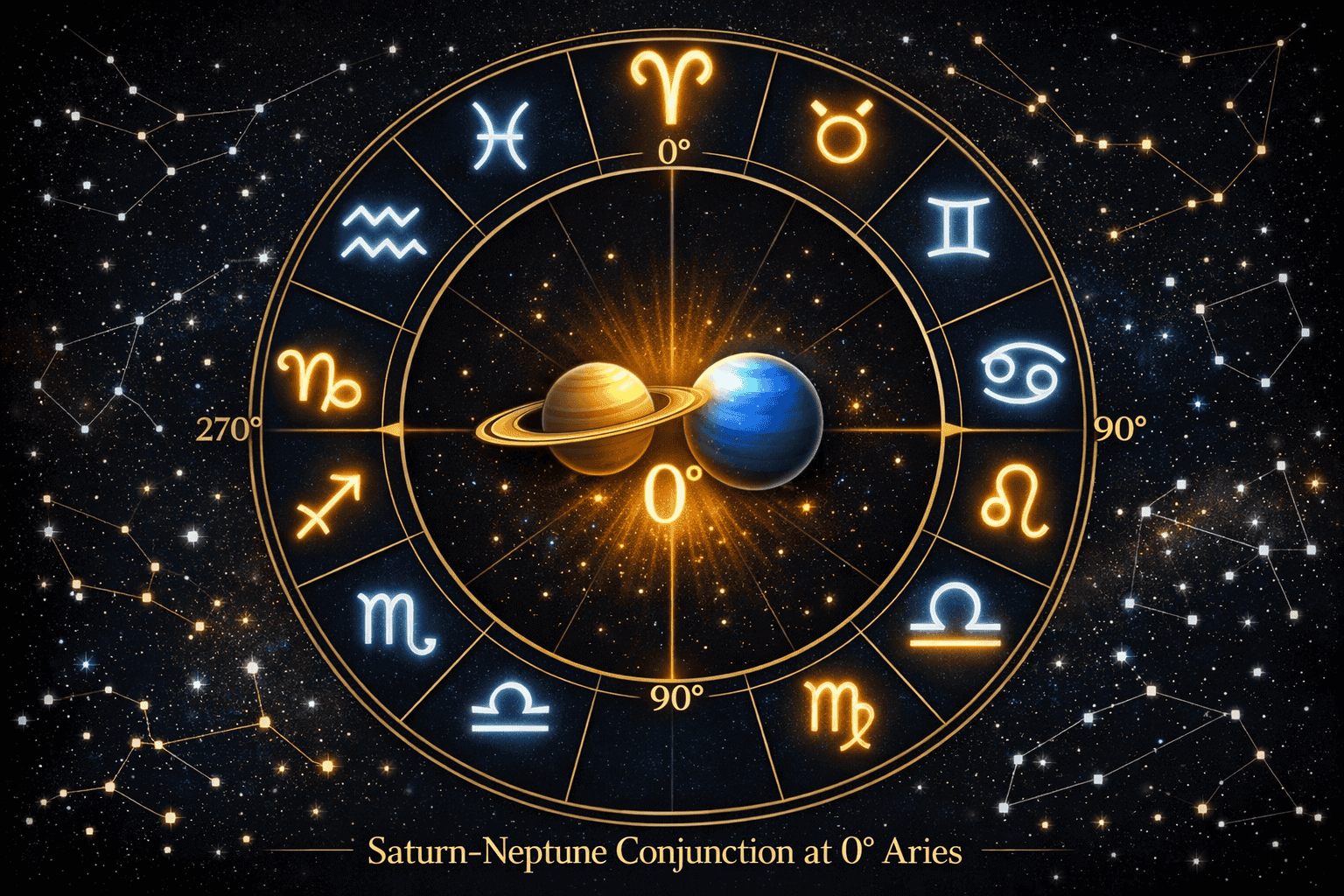
What Are the Core Themes of Dissolving Old Structures and Manifesting New Realities?
The Saturn-Neptune conjunction in Aries February 20, 2026 carries a central theme: what no longer serves must dissolve so that something truer can be built. This isn’t destruction for its own sake — it’s purposeful clearing.
Saturn’s role: Identifies what is outdated, unsustainable, or built on false foundations. It applies pressure until cracks appear.
Neptune’s role: Softens rigid structures, introduces compassion and vision, and dissolves what Saturn has exposed as hollow.
Aries’ role: Provides the courage to let go and the fire to begin again — fast, boldly, and without waiting for permission.
Together, these three energies create a specific kind of change:
- Old identities, roles, and self-concepts may feel suddenly unstable.
- Systems built on fear, control, or illusion face pressure to transform.
- Creative and spiritual visions that once felt impractical start to feel possible — and even necessary.
- The line between “realistic” and “idealistic” blurs in productive ways.
Common mistake to avoid: Treating this energy as purely disruptive. The dissolution happening now is preparation for building something more aligned. Resist the urge to cling to structures simply because they’re familiar.
For a broader look at how Aries energy amplifies this conjunction, see Aries personality traits amplified by the Saturn-Neptune conjunction in 2026.
How Does This Conjunction Affect Each Zodiac Sign?
The Saturn-Neptune conjunction in Aries February 20, 2026 affects every sign, but the intensity and focus area varies based on where 0° Aries falls in each person’s natal chart. People with placements in early Cardinal signs or late Mutable signs feel this most directly. [2]
Signs feeling the strongest activation:
- Aries: Identity, physical self, personal brand — a complete reinvention of who you are.
- Cancer: Career and public reputation — old professional structures dissolve, new ambitions emerge.
- Libra: Relationships and partnerships — outdated relationship patterns face a reckoning.
- Capricorn: Home, roots, and family — foundational life structures shift.
Signs with significant but less direct impact:
- Gemini, Virgo, Sagittarius, Pisces: These late Mutable sign placements are also activated, often through a sense of completion before a new beginning. [2]
For all 12 signs, the general themes are:
- A life area that has felt stuck or stagnant begins to move.
- Dreams or visions that have been suppressed resurface.
- Discipline applied to spiritual or creative goals yields real results.
For a full breakdown by zodiac sign, the Saturn-Neptune conjunction in Aries April 2026 guide on blending discipline with dreams offers detailed natal chart guidance.
What Does This Conjunction Mean for Collective Reality in 2026?
At the collective level, the Saturn-Neptune conjunction in Aries February 20, 2026 signals a period when the gap between idealism and practical action narrows. Society is being asked to build systems that actually reflect its stated values — not just talk about them. [5]
Key collective themes to watch in 2026:
- Institutional reform: Governments, financial systems, and religious structures face pressure to become more transparent and genuinely functional.
- New leadership models: Aries rules leadership and individual initiative. Expect new kinds of leaders to emerge — those who combine vision (Neptune) with accountability (Saturn).
- Technology and spirituality: Neptune rules the invisible and the digital; Saturn rules structure. Their meeting in Aries may accelerate the structuring of AI ethics, digital identity, and online communities.
- Environmental accountability: Neptune rules water and oceans; Saturn rules long-term consequence. Climate commitments made now carry unusual weight in this cycle.
Historical note: The 1989 Saturn-Neptune conjunction in Capricorn (the sign of governments and institutions) directly preceded the collapse of the Soviet Union. The 2026 conjunction in Aries (the sign of the individual and the pioneer) may signal a shift toward more decentralized, individual-led systems of change. [7]
How Can You Work With This Energy Personally?
Working with the Saturn-Neptune conjunction in Aries February 20, 2026 means finding the balance between dreaming big and building deliberately. Neither pure idealism nor pure pragmatism works here — the conjunction demands both at once.
A practical 5-step approach for this transit:
- Audit what’s hollow. Look at commitments, roles, or beliefs you’ve been maintaining out of habit rather than genuine alignment. Saturn will expose them anyway — better to see them clearly first.
- Name your vision. Neptune activates imagination. Write down what you actually want your life to look like — not what seems “realistic,” but what feels true.
- Find one concrete step. Aries energy rewards action. Pick one small, specific action that moves toward your vision and take it before the end of February 2026.
- Expect some confusion. Neptune also rules fog and uncertainty. If things feel unclear in mid-to-late February, that’s normal. Clarity tends to follow the initial dissolution phase.
- Revisit in 2027. The seeds planted at a conjunction take time to sprout. Check back in 12–18 months to see what has grown from what you started now.
Helpful tools during this period:
- Journaling (Neptune loves reflection; Saturn loves records)
- Natal chart review — especially your Aries house
- Meditation or contemplative practice
- Setting structured creative projects with real deadlines
For deeper natal chart context, understanding your birth chart basics is a great starting point if you’re new to astrology.
Also note: Saturn officially enters Aries in March 2026, extending this structural-discipline energy well beyond the February conjunction date.

What Comes After the February 20, 2026 Conjunction?
The February 20 date is the peak of the conjunction, but it’s not the end of the story. The Saturn-Neptune cycle that begins now will unfold in phases through 2061. [4]
Key follow-up transits to watch in 2026:
- February 25, 2026: Mercury Retrograde begins in Pisces, adding a reflective, inward quality to the weeks immediately following the conjunction. Expect revisiting, rethinking, and refining rather than charging forward.
- March 2026: Saturn fully settles into Aries, beginning a multi-year transit through this sign.
- April 2026: Uranus enters Gemini, adding another major cycle shift to an already eventful astrological year.
- 2061: The next Saturn-Neptune conjunction — the end of the cycle that begins now. [4]
The 36-year arc: Think of February 20, 2026 as the planting of a seed. The first square (a 90-degree challenge aspect) between Saturn and Neptune will come roughly 9 years later, around 2035, when the themes of this conjunction face their first major test. The opposition (the halfway point) arrives around 2044. What gets started now — personally and collectively — will be tested, refined, and eventually completed over the next three and a half decades.
FAQ: Saturn-Neptune Conjunction in Aries February 20, 2026
Q: What time did the Saturn-Neptune conjunction happen on February 20, 2026? A: The conjunction was exact at 11:52 AM EST on February 20, 2026, at 0° Aries. [2]
Q: How often does a Saturn-Neptune conjunction happen? A: Roughly every 36 years. The previous conjunction was in 1989 (in Capricorn), and the next will be in 2061. [1]
Q: Is this conjunction really once in 2,000 years? A: The conjunction itself happens every 36 years, but the last time it occurred at 0° Aries specifically was over 2,000 years ago. That’s what makes the 2026 alignment so historically unusual. [2]
Q: Which zodiac signs are most affected? A: People with natal placements in early Cardinal signs (Aries, Cancer, Libra, Capricorn) or late Mutable signs (Gemini, Virgo, Sagittarius, Pisces) feel the strongest effects. [2]
Q: What house does this conjunction activate in my chart? A: It activates whichever house 0° Aries falls in your natal chart. For example, if Aries rules your 7th house, expect major shifts in partnerships and relationships.
Q: Is this a “good” or “bad” transit? A: Neither, strictly speaking. It’s a transit of significant change. The dissolution of old structures can feel uncomfortable, but it creates space for more authentic realities to form.
Q: How long do the effects last? A: The peak is February 20, 2026, but the broader cycle it launches lasts until 2061. Most astrologers suggest the themes remain active for at least 12–18 months after the conjunction date. [4]
Q: Does this conjunction affect non-astrologers too? A: Yes. Collective transits like this one affect social, political, and cultural systems regardless of whether individuals follow astrology. The personal effects, however, are more consciously navigable with astrological awareness.
Q: What’s the connection between this conjunction and the 1989 fall of the Berlin Wall? A: The 1989 Saturn-Neptune conjunction in Capricorn coincided with the dissolution of Soviet-era structures. Astrologers note the pattern: each Saturn-Neptune meeting tends to correlate with the breakdown of systems built on illusion or outdated power. [7]
Q: Should I make major life decisions right at the conjunction? A: The conjunction is a powerful time for setting intentions and beginning processes, but with Mercury Retrograde starting just five days later (February 25), it’s wise to stay flexible and avoid locking in irreversible decisions until after March 20, 2026.
Q: How does this relate to Chiron in Aries? A: Chiron has been transiting Aries since 2018, working on collective wounds around identity and self-worth. The Saturn-Neptune conjunction joins Chiron in this sign, adding a layer of healing and restructuring to those same wounds. See Chiron in Aries 2026 for more.
Q: Where can I learn more about planetary transits in 2026? A: The Planetary Transits section at YOUSTRO covers the full range of 2026 transits with detailed sign-by-sign breakdowns.
Conclusion: What to Do With This Rare Alignment
The Saturn-Neptune conjunction in Aries February 20, 2026 — dissolving old structures and manifesting new realities — is not a passive event. It’s an active invitation to participate in one of the most significant astrological cycles of the modern era.
The core message is straightforward: what was built on fear, habit, or illusion is ready to dissolve. What is built on genuine vision and disciplined effort is ready to take root.
Actionable next steps:
- Check your natal chart for planets or angles at 0°–5° of Cardinal signs — those are your most activated areas.
- Journal your honest vision for your life, career, relationships, or creative work — not what seems safe, but what feels true.
- Take one concrete action toward that vision before the end of February 2026, while the conjunction energy is at its peak.
- Stay flexible through March 2026, as Mercury Retrograde (starting February 25) invites revision rather than rigid execution.
- Think in cycles. The seeds you plant now will be tested around 2035 and mature around 2044. Play the long game.
This is a rare moment. The planets won’t align at 0° Aries again like this for another 2,000 years. The question isn’t whether change is coming — it’s whether you’ll shape it consciously or simply be carried along by it.
References
[1] Saturn Neptune Alignment February 20 2026 Meaning – https://astrostyle.com/saturn-neptune-alignment-february-20-2026-meaning/
[2] The Saturn Neptune Conjunction In Aries – https://www.moonomens.com/the-saturn-neptune-conjunction-in-aries/
[4] How Very Rare Saturn Neptune Alignment February 20 2026 Affects Your Zodiac Sign – https://www.yourtango.com/2026395057/how-very-rare-saturn-neptune-alignment-february-20-2026-affects-your-zodiac-sign
[5] February 20th 2026 The Saturn-Neptune Conjunction And A New Kind Of Fire – https://rubyslipper.ca/ruby-slipper-astrology/2026/2/february-20th-2026-the-saturnneptune-conjunction-and-a-new-kind-of-fire
[7] How Saturn Neptune Conjunctions Reshape Our World – https://www.chani.com/blogs/how-saturn-neptune-conjunctions-reshape-our-world