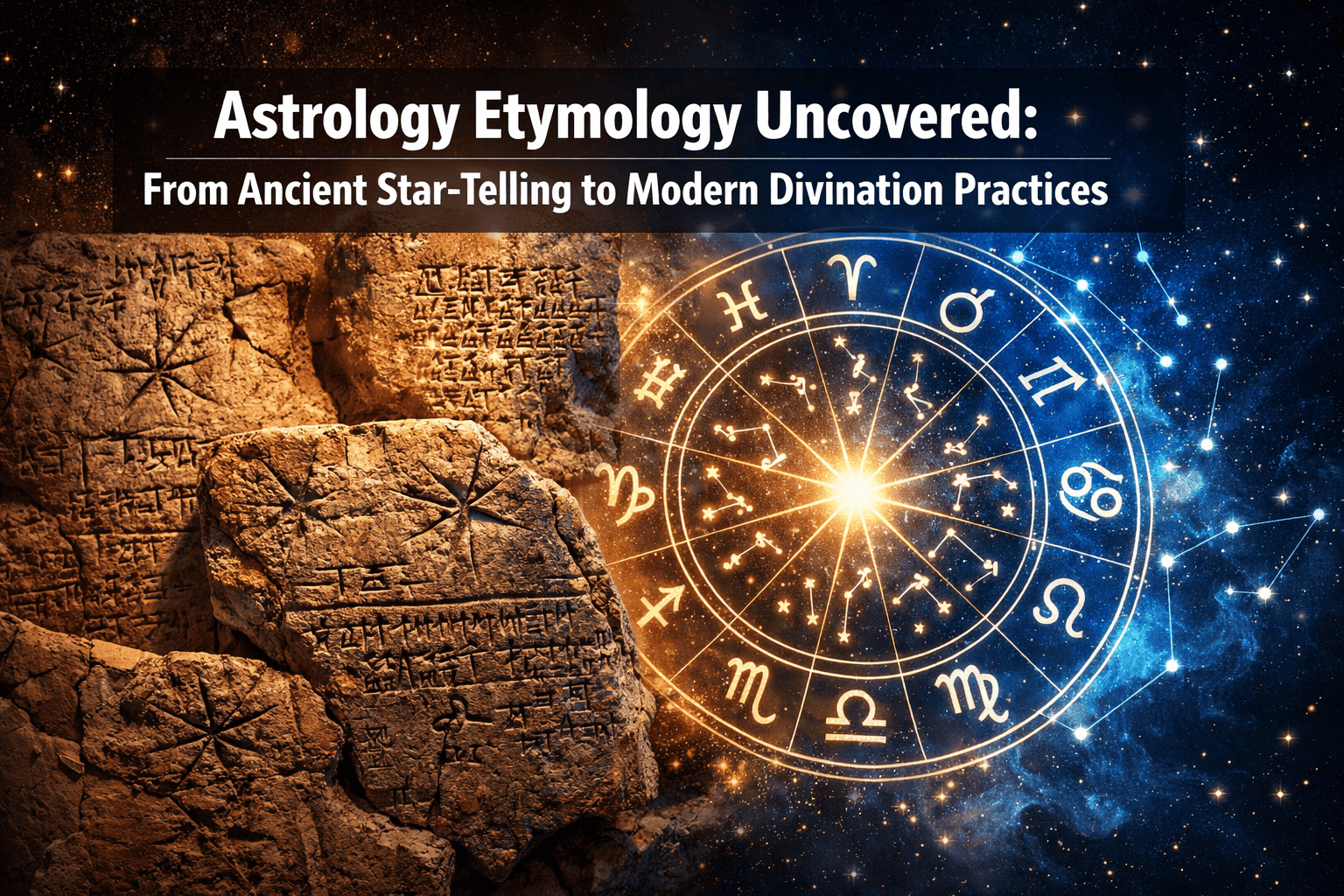
The word “astrology” comes from the ancient Greek astrologia, combining astron (star) and logos (word, reason, or study), literally meaning “star-telling.” Over roughly 4,000 years, this term evolved from a respected scientific discipline in Babylon and Greece into the personality-focused, divination-oriented practice recognized in 2026. Understanding this etymology helps beginners and enthusiasts connect the language of astrology to its rich cultural roots.
- Key Takeaways 🌟
- What Does "Astrology" Actually Mean? The Word's Greek Roots
- Where Did Astrology Begin? Tracing the Babylonian Origins
- How Did Egypt and Greece Shape Astrological Language?
- How Did Astrology Travel Through Islamic and Medieval Europe?
- What Changed in the Modern Era? From Science to Self-Discovery
- How Is Digital Technology Reshaping Astrological Language in 2026?
- How Can Beginners Apply Astrology Etymology to Their Own Charts?
- Astrology Etymology Uncovered: A Timeline of Key Language Shifts
- FAQ: Astrology Etymology and History
- Conclusion: What Ancient Words Still Teach Us About the Stars
- References
Key Takeaways 🌟
- “Astrology” is Greek in origin, from astron (star) + logos (study/telling), first used around the 4th century BCE.
- The Babylonians built the first zodiac system around 2000–3000 BCE, dividing the sky into 12 equal segments of 30 degrees each. [1]
- Egyptian priests merged Babylonian star-lore with Greek philosophy, shaping the astrological vocabulary still used today. [1]
- Claudius Ptolemy’s Tetrabiblos (2nd century CE) standardized zodiac terminology that practitioners still reference. [1]
- Astrology was taught in universities as an academic subject until the early 1600s, when the Enlightenment shifted its classification. [6]
- Carl Jung’s 20th-century psychological reframing changed astrology’s language from “prediction” to “self-understanding.” [3]
- Today, AI-powered apps like Co-Star generate chart interpretations algorithmically, marking the newest chapter in astrology’s linguistic evolution. [1]
- The original Babylonian zodiac had 17 or 18 constellations before being consolidated into the 12-sign system known today. [1]
What Does “Astrology” Actually Mean? The Word’s Greek Roots

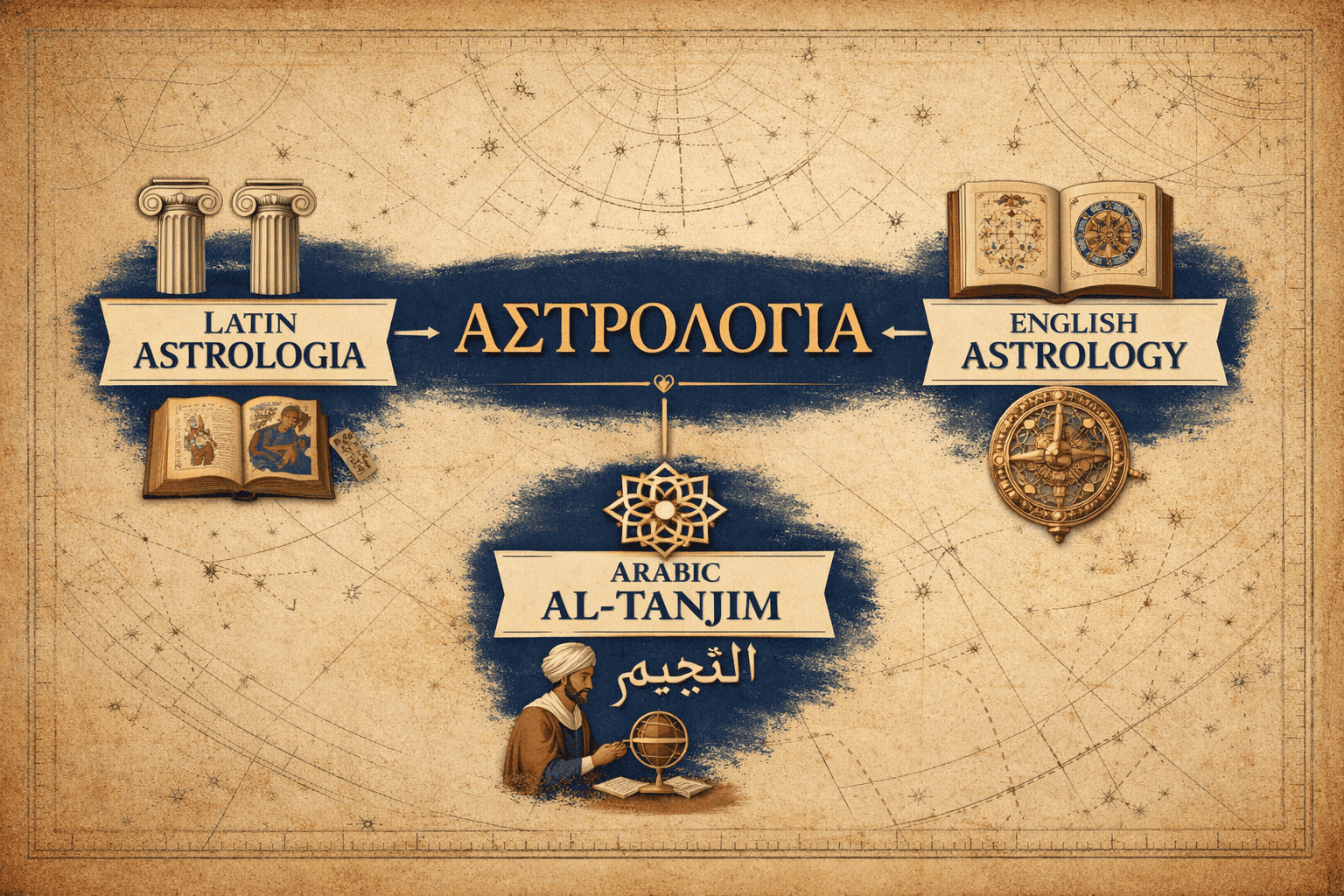
“Astrology” literally means “star-telling” or “star-reasoning” in Greek. The word joins astron (ἄστρον, meaning star) with logos (λόγος, meaning word, reason, or study). In its earliest Greek usage, astrologia described the observation and interpretation of stars as a unified discipline, not yet separated from what we now call astronomy.
Here is a quick breakdown of the root words:
| Root | Language | Meaning |
|---|---|---|
| astron | Ancient Greek | Star |
| logos | Ancient Greek | Word, reason, study |
| astrologia | Greek (combined) | Star-telling / study of stars |
| astronomia | Greek | Star-arranging / law of stars |
The split between astrologia and astronomia is important. Early Greek thinkers used both terms almost interchangeably. Over centuries, astronomia came to mean the mathematical, observational science of celestial bodies, while astrologia shifted toward interpretation and meaning-making. That fork in the linguistic road is central to understanding Astrology Etymology Uncovered: From Ancient Star-Telling to Modern Divination Practices as a whole story.
Pull quote: “The Greeks didn’t separate the sky’s mechanics from its meaning. For them, measuring a star and reading its message were two sides of the same coin.”
Where Did Astrology Begin? Tracing the Babylonian Origins
Astrology originated in ancient Mesopotamia, roughly between 2000 and 3000 BCE, making it one of the oldest organized systems of knowledge on Earth. [5] Babylonian priests called tupšarru (scribes) tracked celestial events on clay tablets, linking planetary movements to earthly events like harvests, floods, and royal fortunes.
Key facts about the Babylonian foundation:
- The Babylonians divided the ecliptic (the sun’s apparent path) into 12 equal sections of 30 degrees each, creating the zodiac framework still used today. [8]
- The original zodiac included 17 or 18 constellations before later scholars consolidated them into 12 signs. [1]
- Early Babylonian astrology was primarily mundane, meaning it focused on collective events (wars, weather, kings) rather than individual horoscopes.
- The Enuma Anu Enlil, a massive Babylonian text of celestial omens, is among the earliest astrological records known to scholars. [4]
Common mistake: Many people assume the 12-sign zodiac was always 12. It wasn’t. The consolidation was a deliberate mathematical and cultural decision, not a natural feature of the sky.
For anyone exploring astrology basics, understanding this Babylonian origin explains why the zodiac feels both mathematical and mythological at the same time.
How Did Egypt and Greece Shape Astrological Language?
Egyptian priests and Greek philosophers transformed Babylonian star-observation into a rich symbolic and linguistic system. Egyptian religious culture added layers of spiritual meaning to celestial interpretation, while Greek thinkers gave astrology its philosophical framework and much of its surviving vocabulary. [1] [3]
The Egyptian Bridge
Egyptian priests absorbed Babylonian astrology and merged it with their own religious cosmology. This fusion gave astrological language a sacred dimension, where stars weren’t just omens but expressions of divine order. [1]
The Greek Philosophical Framework
When Babylonian knowledge reached Greece (roughly 4th century BCE onward), Greek scholars did something new: they connected star positions to individual human personality and fate. This shift is enormous for etymology. The Greeks named zodiac signs after mythological figures and linked those names to character traits, creating the etymological bridge between constellations and personality descriptions that modern astrology still uses. [1]
Claudius Ptolemy, a Greek-Egyptian scholar writing in the 2nd century CE, produced the Tetrabiblos, one of the most influential astrological texts ever written. [1] [3] It standardized:
- Zodiac sign names and their meanings
- Planetary rulerships
- The language of aspects (conjunctions, oppositions, trines)
Most of the technical vocabulary in a modern birth chart traces directly back to Ptolemy’s terminology. That’s a 1,900-year-old vocabulary still in active use.
By the 1st century BCE, two distinct astrological traditions had emerged: one focused on precise horoscope readings about past, present, and future events, and another called theurgic astrology, which emphasized the soul’s spiritual ascent through the planetary spheres. [4]
How Did Astrology Travel Through Islamic and Medieval Europe?
Astrology survived the fall of the Western Roman Empire largely because Islamic scholars preserved and expanded it. After entering Islamic culture as part of the Greek intellectual inheritance, astrological texts were translated into Arabic, refined, and eventually returned to European culture during the medieval period. [5]
This transmission had direct effects on astrological language:
- Arabic terms entered European astrology, including almanac (from Arabic al-manakh), zenith (from Arabic samt), and nadir (from Arabic naẓīr).
- Islamic scholars like Al-Kindi and Abu Ma’shar expanded Ptolemy’s system and wrote extensively on planetary transits and natal charts.
- Medieval European universities taught astrology alongside medicine and mathematics. [6]
Astrology held academic status across much of Eurasia and was taught in universities until the early 1600s, when the Scientific Revolution and Enlightenment-era emphasis on reason began to separate it from formal science. [6] This shift is reflected directly in how the word “astrology” changed in social meaning: from a legitimate academic discipline to a “philosophy” or “divination practice” in popular usage.
Understanding planetary transits in 2026 connects to this long chain of transmission. Every time a modern astrologer describes a Saturn transit, they’re using vocabulary shaped by Babylonian, Greek, Arabic, and Latin hands.
What Changed in the Modern Era? From Science to Self-Discovery
The biggest shift in astrology’s modern language came from psychology, not astronomy. Carl Jung’s work in the 20th century reframed astrology’s core terminology from “deterministic prediction” to a tool for introspection and self-understanding. [3] This single reframing is why modern astrologers say things like “your chart shows tendencies, not destiny.”
The Renaissance and Enlightenment Turning Point
The Renaissance briefly revived astrology through renewed interest in ancient texts. But the Enlightenment hit hard. As empirical science demanded repeatable, testable results, astrology couldn’t compete on those terms. [3] Its vocabulary shifted:
- Before: “Science of the stars,” “judicial astrology,” “natural philosophy”
- After: “Divination,” “occult practice,” “personal philosophy”
This wasn’t just a semantic change. It was a cultural reclassification that shaped how millions of people relate to astrology today.
Jung and Psychological Astrology
Jung saw the zodiac as a map of the psyche, not a prediction machine. His influence introduced language like:
- Archetypes (connecting zodiac signs to universal personality patterns)
- Individuation (using a birth chart as a tool for self-knowledge)
- Synchronicity (the idea that celestial events and personal events can be meaningfully connected without being causally linked)
This psychological vocabulary is now so embedded in modern astrology that many practitioners use it without knowing its Jungian origin. If you’re just getting started, understanding your birth chart and natal placements is a great way to see this modern language in action.
How Is Digital Technology Reshaping Astrological Language in 2026?
Digital platforms and AI tools are adding a new layer to astrology’s evolving vocabulary. Apps like Co-Star and The Pattern use algorithms to generate birth chart interpretations, introducing tech-inflected language (“real-time transit notifications,” “algorithmic chart analysis”) into a tradition that once lived entirely in handwritten manuscripts. [1] [2]
New terms entering the astrological lexicon in 2026:
- AI-generated interpretations — automated chart readings based on planetary data
- Real-time transit alerts — push notifications tied to planetary movements
- Personalized horoscope engines — apps that tailor content to individual natal charts
This digital shift raises an interesting etymological question: if astrologia meant “star-telling” by a human observer, what do we call star-telling by an algorithm?
For now, the community still uses the same Greek-rooted vocabulary. But the practice is changing fast. Exploring resources like personalized horoscopes and astrology tools shows how far the tradition has traveled from Babylonian clay tablets.
Pull quote: “From cuneiform tablets to smartphone apps, the word ‘astrology’ has carried 4,000 years of human curiosity about the sky.”
How Can Beginners Apply Astrology Etymology to Their Own Charts?

Knowing the etymology of astrological terms makes reading a birth chart significantly easier and more meaningful. When beginners understand that “zodiac” comes from the Greek zodiakos kyklos (circle of animals), or that “horoscope” comes from Greek horoskopos (hour-watcher), the symbols stop feeling arbitrary.
Practical Steps for Beginners
- Start with your Sun sign — the most widely known placement, rooted in Greek solar mythology. The Sun’s position at birth shapes your core identity narrative.
- Learn your Moon sign — the Moon’s placement reflects emotional patterns. Understanding the difference between Moon signs and Sun signs is a foundational step.
- Identify your rising sign (Ascendant) — from Latin ascendere (to rise), this is the zodiac sign rising on the eastern horizon at your birth moment.
- Look at planetary placements — each planet’s name comes from Roman mythology (Mars, Venus, Jupiter), which in turn came from Greek equivalents (Ares, Aphrodite, Zeus).
- Note the houses — the 12 houses divide the chart into life areas. “House” in this context comes from the Latin domus, meaning home or domain.
Choose this approach if: You want to build genuine understanding rather than just memorize keywords. Etymology gives you the “why” behind every symbol.
Common mistake: Beginners often skip the rising sign because it requires a precise birth time. Don’t skip it. It’s one of the most personally specific parts of the chart.
Astrology Etymology Uncovered: A Timeline of Key Language Shifts
Here is a condensed timeline showing how astrological vocabulary evolved across cultures and centuries. This overview covers the full arc of Astrology Etymology Uncovered: From Ancient Star-Telling to Modern Divination Practices.
| Era | Key Development | Language Impact |
|---|---|---|
| 2000–3000 BCE | Babylonian star-observation begins [5] | Cuneiform omen texts; no Greek vocabulary yet |
| 4th–1st century BCE | Greek philosophers adopt Babylonian system [1] | Astrologia, zodiac sign names, mythological links |
| 2nd century CE | Ptolemy writes Tetrabiblos [1] | Standardized planetary and sign terminology |
| 7th–12th century CE | Islamic scholars translate and expand texts [5] | Arabic terms enter European vocabulary |
| 12th–16th century | Medieval universities teach astrology [6] | Latin academic terminology dominates |
| 17th–18th century | Enlightenment separates astrology from astronomy [3] | “Divination” replaces “science” in common usage |
| 20th century | Jung introduces psychological astrology [3] | “Archetypes,” “individuation,” “self-knowledge” |
| 2000s–2026 | AI and apps digitize practice [1] [2] | Algorithmic, personalized, real-time vocabulary |
FAQ: Astrology Etymology and History
Q: What does “astrology” literally mean? “Astrology” comes from the Greek astrologia, combining astron (star) and logos (word/study), meaning “star-telling” or “the study of stars.”
Q: Is astrology the same as astronomy etymologically? Both words share the Greek root astron (star). The difference is the second part: logos (interpretation/study) versus nomos (law/arrangement). They were once used interchangeably before diverging in meaning.
Q: Who invented the 12-sign zodiac? The Babylonians created the 12-sign system by dividing the ecliptic into 12 equal 30-degree segments. The original Babylonian zodiac had 17 or 18 constellations before consolidation. [1]
Q: When did astrology stop being considered a science? Astrology lost its academic standing in the early 1600s during the Scientific Revolution and Enlightenment, when empirical methods became the standard for knowledge. [6]
Q: What did Carl Jung contribute to astrology’s language? Jung reframed astrology from deterministic prediction to a tool for psychological self-understanding, introducing terms like “archetypes” and “synchronicity” into astrological practice. [3]
Q: What is the “horoscope” etymology? “Horoscope” comes from Greek horoskopos, meaning “hour-watcher” — referring to the observation of the sky at a specific birth hour to determine planetary positions.
Q: Why are zodiac signs named after animals and mythological figures? The Greeks named zodiac signs after mythological figures and animals to link celestial patterns to human stories and character traits, establishing the symbolic language still used today. [1]
Q: What Arabic words entered astrological vocabulary? Words like almanac (from al-manakh), zenith (from samt), and nadir (from naẓīr) all entered astrological and astronomical vocabulary through Arabic scholarship during the medieval period. [5]
Q: How does knowing etymology help with reading a birth chart? Etymology reveals the “why” behind astrological symbols. Knowing that “ascendant” means “rising” or that “zodiac” means “circle of animals” makes chart symbols feel logical rather than arbitrary.
Q: What is the difference between mundane and natal astrology? Mundane astrology (from Latin mundus, world) focuses on collective events like political shifts and natural events. Natal astrology focuses on an individual’s birth chart and personal life patterns.
Q: Are modern astrology apps changing astrological language? Yes. Apps like Co-Star and The Pattern introduce tech vocabulary (“real-time alerts,” “algorithmic interpretations”) into a tradition built on ancient Greek and Latin terminology. [1] [2]
Q: Where can beginners start learning astrology with this etymological context? Starting with astrology for beginners and birth chart basics gives a practical foundation that connects historical language to modern chart reading.
Conclusion: What Ancient Words Still Teach Us About the Stars
The journey from Babylonian clay tablets to AI-powered birth chart apps is, at its core, a story about language. Every term in modern astrology — zodiac, horoscope, ascendant, transit, aspect — carries thousands of years of human observation, cultural exchange, and philosophical debate inside it.
Astrology Etymology Uncovered: From Ancient Star-Telling to Modern Divination Practices is more than a linguistic exercise. It’s a reminder that the questions astrology asks (Who am I? What do the patterns around me mean? How do I navigate uncertainty?) are genuinely ancient, and the vocabulary built to answer them is remarkably durable.
Actionable Next Steps
- Explore your birth chart using a trusted resource like YOUSTRO’s birth chart tools and look up the etymology of each placement you encounter.
- Learn the difference between your Sun and Moon sign — start with Moon Signs vs Sun Signs to understand the emotional versus identity layers of your chart.
- Track a current planetary transit — resources like Mercury Retrograde 2026 show how ancient vocabulary applies to real-time sky events.
- Keep a sky journal — note which astrological terms you encounter and look up their roots. It deepens understanding faster than memorizing keywords.
- Share what you learn — astrology’s vocabulary has always spread through conversation, from Babylonian scribes to Greek philosophers to your group chat.
The stars haven’t changed. The language we use to describe them has. And that evolution is still happening.
References
[1] The History Of Astrology – https://www.centreofexcellence.com/the-history-of-astrology/ [2] The Background Evolution Of Astrology – https://vama.app/blog/the-background-evolution-of-astrology/ [3] Tracing The Origins Development And Cultural Impact Of Astrology – https://www.einpresswire.com/article/671037957/tracing-the-origins-development-and-cultural-impact-of-astrology [4] History Of Astrology – https://en.wikipedia.org/wiki/History_of_astrology [5] Astrology – https://www.britannica.com/summary/astrology [6] Stargazing The Rise Of Modern Astrology – https://dekalbhistory.org/blog-posts/stargazing-the-rise-of-modern-astrology/ [8] Index – https://www.fu-berlin.de/en/featured-stories/research/2022/zodiac/index.html